

Alexander W. Doniphan
In May 1846, Governor Edwards of Missouri requested Colonel Alexander W. Doniphan, a lawyer living in Liberty, to assist him in raising troops in the state’s western counties for volunteer service in the war with Mexico. Within just a week or so, Doniphan had raised eight companies of men, which were organized at Fort Leavenworth, Kansas, forming First Missouri Mounted Volunteers. This regiment formed a portion of the column known as the Army of the West, commanded by General Stephen W. Keary. After the volunteers went through a few weeks’ drilling, the Army of the West commenced its march to Santa Fe, New Mexico, on June 26, 1846, and on August 18, they entered Santa Fe without firing a gun.
In November 1846, Colonel Doniphan was ordered with his regiment into the country of the Navajo Indians on the western slope of the Rocky Mountains to subdue any aggression. He completed this movement swiftly even though his soldiers toiled through snows three feet deep on the crests and eastern slope of the mountains.
Having accomplished this by concluding a satisfactory treaty with the Indians, he returned to the Rio del Norte. On the banks of that stream, he collected and refreshed his men, preparing to meet up with General John E. Wool.
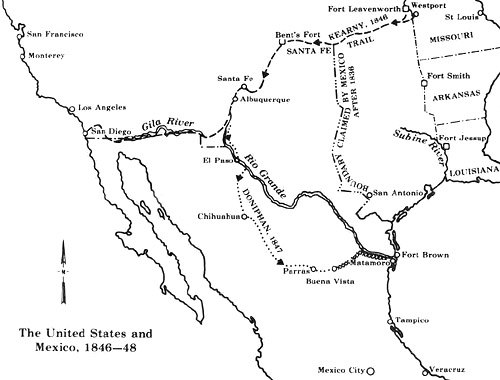
Doniphan Expedition
In December 1846, he and his men moved south towards Chihuahua. In quick succession followed his brilliant and decisive victories at Brazito and Sacramento, the capture of Chihuahua, the plunge of his little army into the unknown country between Chihuahua and Saltillo, and its emergence in triumph. After he arrived at Saltillo, his regiment was ordered home. The march continued to Matamoras before making its way to New Orleans. The men were discharged at New Orleans and arrived home about July 1, 1847.
The march of this regiment from Fort Leavenworth to Santa Fe, Chihuahua, Saltillo, and Matamoras — a distance of nearly 3,600 miles — is called Doniphan’s Expedition. It is important in Kansas history, as there was no road leading from Fort Leavenworth to the Santa Fe Trail at the time of the expedition. The army, therefore, steered its course southwesterly, with the view of intersecting the main Santa Fe Trail at or near the Narrows, 65 miles west of Independence, Missouri. Many deep ravines and creeks with high and rugged banks were encountered in accomplishing this. The heat was often excessive; the grass was tall, and rank; the earth in many places so soft that the heavily loaded wagons would sink almost up to the axle upon the level prairie, and the men were frequently compelled to dismount and drag them from the mire with their hands. Hence the march was, of necessity, both slow and tedious. About noon on June 30, they arrived upon the banks of the Kansas River, which they crossed in boats without loss or accident, and encamped for the night on the west bank among the friendly Shawnee Indians. On July 1, the troops continued a southwesterly march to intersect the road leading from Independence to Santa Fe. After a toilsome march of some 15 miles without a guide, sometimes directing their course to the southward and sometimes to the westward, they at length struck upon the Santa Fe trace and encamped for the night near Black Jack in what is now Douglas County.
Provisions were conveyed in wagons, and beef cattle were driven along for the use of the men. The animals subsisted entirely by grazing. By July 5, the troops had reached Council Grove, now the county seat of Morris County, Kansas, one of the most important stations on the old trail. Advancing about 16 miles further, they encamped near Diamond Spring.
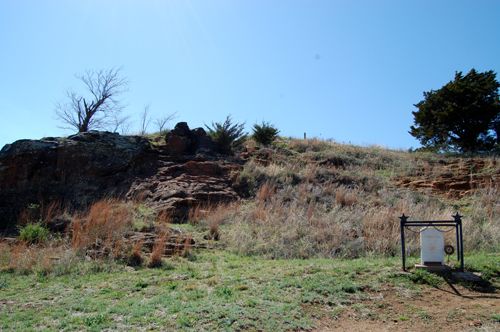
Pawnee Rock, Kansas by Kathy Alexander.
On July 9, they arrived at the Little Arkansas River in Rice County. The evening of July 12 found them at Walnut Creek in Barton County. The following day brought them to the noted Pawnee Rock, near which they diverged from the main Santa Fe Trail and followed the Arkansas River to a point near the present city of Pueblo, Colorado, where they crossed into the enemy’s country.
Then ensued what proved to be one of American history’s most remarkable military campaigns. The principal engagement was the Battle of Sacramento; one writer said: “did American arms ever fight the most wonderful.”
Colonel Doniphan’s men attacked a fortified position held by troops outnumbering them nearly five to one, and in speaking of their charge at that place, the same writer said, “It has never been equaled in all the annals of the world’s warfare.” The State of Kansas has honored Colonel Doniphan by naming a county and a town for him, and the State of Missouri named the seat of Ripley County in his honor.
Compiled and edited by Kathy Alexander/Legends of America, updated March 2023.
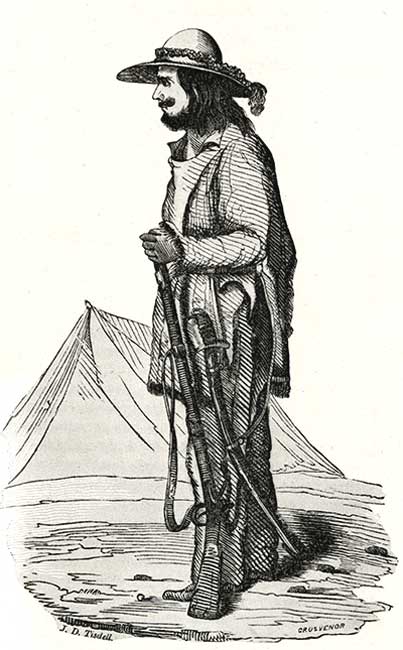
Missouri Mounted Volunteers
About the Article: Much of the historic text in this article comes from Kansas: A Cyclopedia of State History, edited by Frank W. Blackmar, published in 1912 as well as Kansas: History of the State of Kansas, by William G. Cutler, published in 1883. However, other sources have also been used, and the content is combined and heavily edited.
Also See:
Early Expeditions Through Kansas