
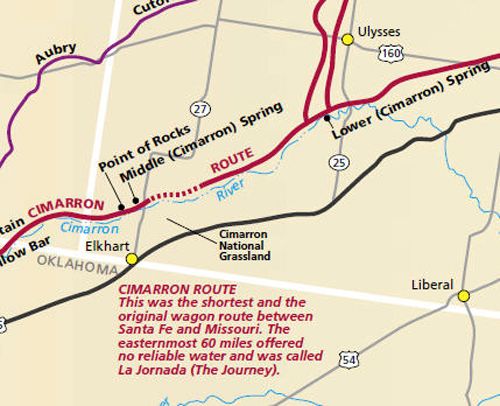
Cimarron Branch of the Santa Fe Trail in Kansas
Wagon Bed Spring, also called Lower Spring or Lower Cimarron Spring, is located in Grant County, Kansas. Situated on the Cimarron Cutoff of the Santa Fe Trail, the spring was well known to travelers because it was the first reliable water supply they encountered after leaving the Arkansas River in present-day Gray County. This 60-mile stretch between the two rivers was known as the “Jornada,” meaning a desert journey without water.
But, long before the white man first traveled the Santa Fe Trail in 1821, it had long been an important spring to the area Native Americans. Decades later, Indian burials were unearthed, and turquoise beads found in the area indicate trade between Plains and Pueblo Indians. It was also a stopping place for some of the Spanish expeditions that traveled onto the Kansas plains, as indicated by metal horse bridle decorations and broken spur pieces used by the Spanish from about 1500 into the 1700s have been found in the area.
The earliest written description of the spring was made by Joseph C. Brown, a civil engineer with a government survey expedition from 1825-1827. Brown described it: “The spring is at the west edge of a marsh green with bull rushes. The marsh is north of the creek and near it. The spring is constant, but the creek is sometimes dry until you ascend it ten or twelve miles, where it will be found running.”
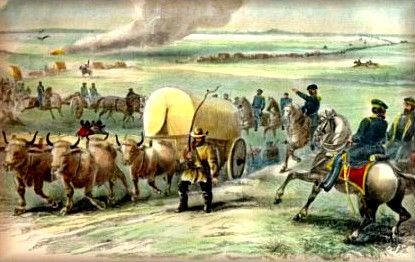
Army Train on the Santa Fe Trail
The Santa Fe Trail entered Grant County midway of its eastern boundary and continued its southwesterly course, crossing the North Fork of the Cimarron River before making its way to the well-known “Lower Springs,” later known as the “Wagon Bed Spring” on the Cimarron River. The Jornada stretch was a perilous route for both men and animals in the dry season as the wagon trains often ran out of water. The spring itself often caused more hardship as it was sometimes difficult to find. Most of these miles to Lower Spring, the Santa Fe Trail ran over the flat prairie with no landmarks or guideposts. Mirages would often lead travelers astray, as it was easy to get lost where the scenery looked the same in every direction. Though this portion of the trail was often plagued with frequent Indian attacks, many hardy pioneers still traveled the cutoff as it was shorter and faster than the Mountain Route of the Santa Fe Trail. The oasis on the prairie was also a watering spot for immense herds of buffalo and prairie animals, providing the travelers with plenty of fresh game.
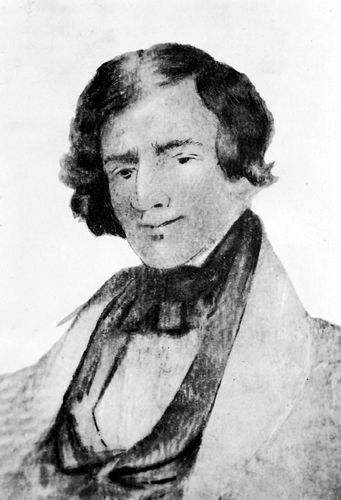
Jedediah Strong Smith
In 1831, fur trader and noted explorer Jedediah Strong Smith began a fatal trek along the Santa Fe Trail. Smith, along with partners, had earlier owned the Rocky Mountain Fur Company, which they sold in 1830. But, Smith had wanderlust running through his veins and soon got involved in the Santa Fe fur trade with partners David Edward Jackson and William L. Sublette.
They left St. Louis, Missouri, in April 1831 with 74 men and 22 wagons. By May, the caravan had progressed to the Jornada stretch of the trail, and after three days without water, the men and the animals were desperate. Along with another mountain man named Thomas Fitzpatrick, Smith rode away from the caravan in search of the spring. The two separated, and Smith never returned.
Jedediah Smith reenactor at Wagon Bed Spring by Kathy Alexander.
The rest of the party continued without him, hoping that Smith would catch up somewhere along the way. When they arrived in Santa Fe, they met up with a Mexican merchant selling some of Smith’s personal belongings. When questioned, the merchant reported that 15-20 Comanche Indians had attacked Smith near Wagon Bed Spring. His body was never found.
Explorer and author, Josiah Gregg in his book Commerce of the Prairies, first published in 1844, related several incidents at or near the spring, including an Indian encounter, where they were sure they would lose their lives. During Gregg’s first trip over the Jornada, he traveled with several men who had never set foot upon the trail. Like others before them, they could not find the Lower Spring and were lost. To make matters worse, they soon found themselves surrounded by Indians. Determined to force their way through, they marched in military ranks right toward the Indians to the beat of a drum and the piping of a fife. Much to their surprise, the Indians did not attack, instead, they seemed to be more delighted than frightened. They even guided the traders to the Spring before escorted them onward.
Mormon Battalion
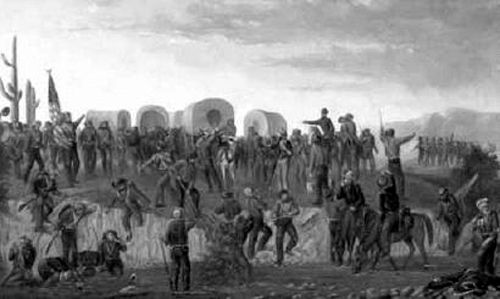
Later, in September 1846, more than 500 men and officers of the Mormon Battalion camped at Lower Cimarron Springs. The soldiers, who were members of the Church of Latter-Day Saints, had volunteered to fight in the Mexican-American War and pledge their army pay to help finance the church’s establishment in Utah. The vast majority of the soldiers had marched on foot all the way from Fort Leavenworth, Kansas to Santa Fe, New Mexico, before making their way to California. A private of the Battalion named Henry Standage would later write about this part of the journey, stating: “We traveled this day across one of the most dreary deserts that ever man saw, suffering much from the intense heat of the sun and for want of water.”
Some years later, a group of traders arrived at the spring to find it inhabited by a band of Arapaho warriors. The travelers were surprised to find that the Indians welcomed them to their camp, which was littered with the dead bodies of other Indians. The traders would relate the tale the Arapaho had shared with them. Ten days earlier, the Arapaho had battled with the Pawnee tribe at the spring, killing more than 70 warriors. They insisted that the traders camp with them on the battleground to help celebrate the victory.
Indian Battle
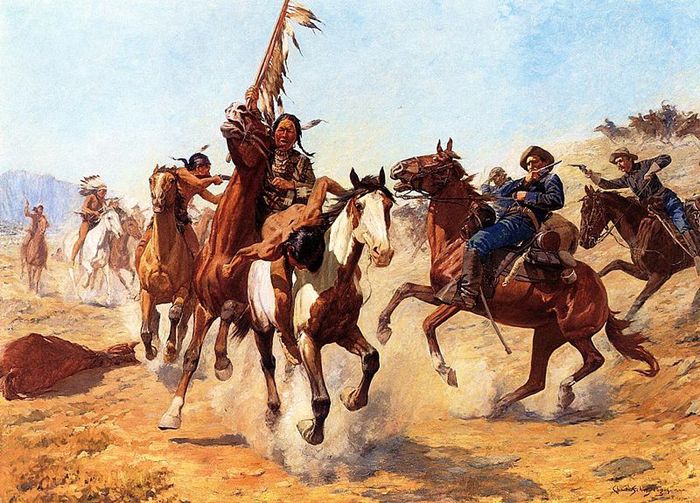
But, the Plains tribes were not usually so friendly. 1864 marked the bloodiest year for Indian attacks along the Santa Fe Trail. Within a two-week period, some 15 men were killed near the spring. As a result, General James H. Carleton, Commander of the Department of New Mexico, sent troops to several locations that summer, stationing Major Joseph Updegraff and 100 men at the Spring with rations for sixty days. Years later, thousands of lead balls and empty cartridges were found at or near the spring, testifying to the soldiers’ presence, as well as traders and buffalo hunters who reportedly headquartered at the Spring.
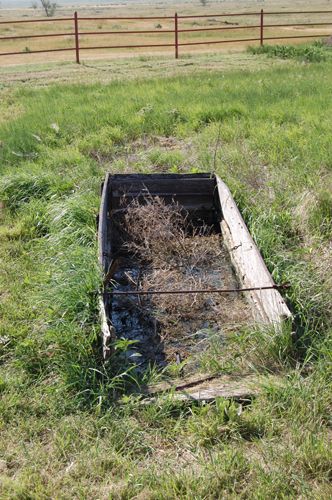
Late in the Santa Fe Trail history, a wagon box was set into the ground to allow fresh, clear water to bubble up through the bottom of the wagon, filtering out the sand and soil. Afterward, the site was known as Wagon Bed Spring.
After travel along the trail had ceased and irrigation began in the area, the spring went dry. Today, its exact location is uncertain, and little remains of the once-famous camping place. However, remnants of wheel ruts of the old trail can still be seen nearby.
Wagon Bed Spring, Kansas
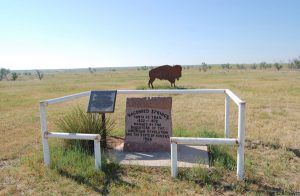
The site was first “officially” recognized by the Daughters of the American Revolution in 1906 when a marker was established. In 1961, Wagon Bed Spring was designated as a National Historic Landmark by the National Park Service. Later, the Wagon Bed Spring Chapter of the Santa Fe Trail Association established a display near what is thought to have been the original Lower Springs location.
Wagon Bed Spring is located on the north bank of the Cimarron River, about 11 ½ miles south of Ulysses, Kansas. The springs are about ½ mile west of U.S. Highway 25. In this vicinity also stood the old townsite of Zionville.
If Wagon Bed Spring’s long history is not enough to thrill a visitor, the spring, along the old Santa Fe Trail, is also said to be the site of an old Indian legend. The story tells of the ghost of a Comanche warrior that will allegedly lead visitors to the site of hidden gold. However, like many ghostly legends, it has a caveat – the warrior will only appear at midnight on an evening with a full moon. Some versions also say that the visitor must also be alone for the Comanche to appear. One report tells of a visitor who made the trip at midnight with a full moon alone. However, when the Indian failed to appear, he returned to his pick-up truck, disgusted. However, as he began to leave, he looked in his rearview mirror and was amazed to see a warrior leaping from a horse into the bed of his pickup. But, when he turned around, nothing was there.
Believe it or not.
Kathy Weiser-Alexander/Legends of America, updated June 2021.
Wagon Bed Spring, Kansas
Also See:
Cimarron Route of the Santa Fe Trail
Ulysses – Born Twice and Still Kickin!