
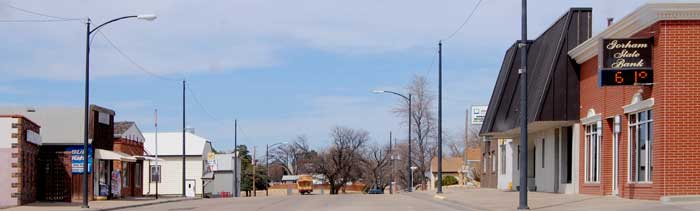
Victoria, Kansas Business District by Kathy Alexander.
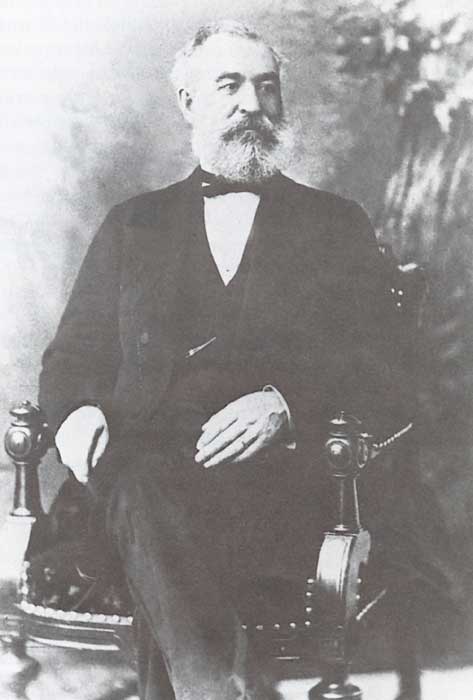
George Grant, 1871.
Victoria, Kansas, in Ellis County, began when a British man named George Grant wished to establish a prosperous colony along the Kansas Pacific Railroad in 1873. Grant purchased more than 69,000 acres of land on the south side of the railroad with hopes of adopting British agricultural methods and stocking the land with improved imported sheep and cattle. The new town was surveyed and platted in 1873 and named Victoria, after Queen Victoria. Under his leadership, the colony was initially settled by 38 Scottish and English immigrants. A post office was established in Victoria in June 1873.
The settlement showed much promise over the next couple of years when several hundred British immigrants, many of them with their families, arrived in Victoria, bringing large numbers of fine sheep and cattle.
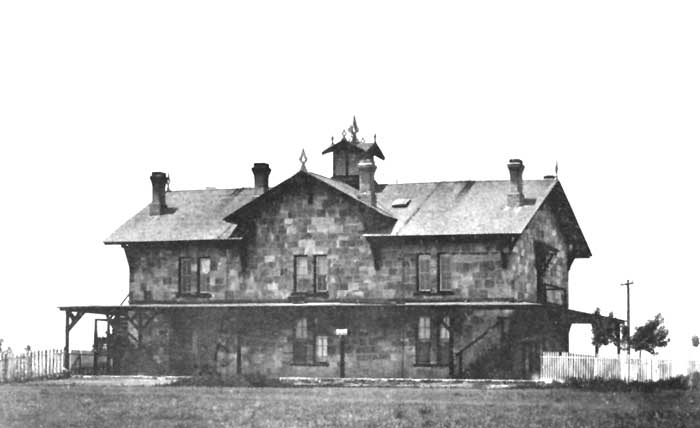
Kansas Pacific Railway stone depot in Victoria, Kansas, 1880.
Soon, a stone depot, a grain elevator, a general merchandise store, and a stone church known as St. George’s Chapel, along with about 25 homes, were built in the new community.
Grant, who wanted to bring a more “genteel quality” to America, recruited numerous noblemen. These men were often sent money from their families, and soon the “Victoria Hunt Club,” a cricket club, and a race track were built. There were dances and other social activities available free of charge, but these men showed little interest in agricultural pursuits. Soon, when their parents realized their sons were not spending their money wisely, they began to reduce their allowances, and many became disenchanted and returned to Britain. Other new settlers who found the land unsuitable for farming also began to return to their home countries.
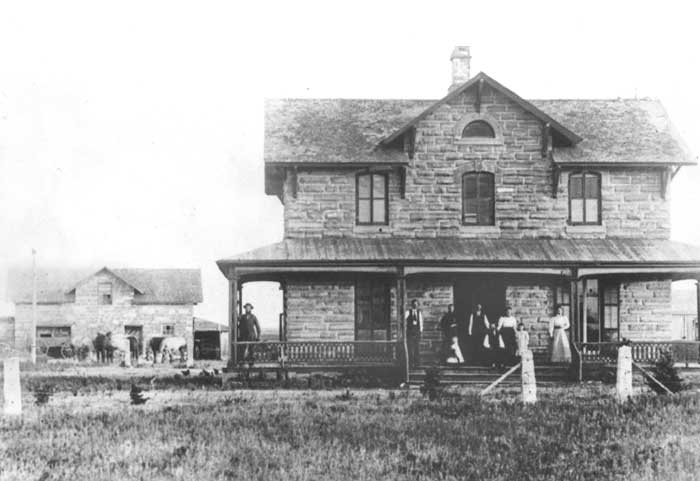
The George Grant home in Victoria, Kansas, still stands today.
In 1876, George Grant moved into an English Manor-style house he acquired through a foreclosure. Today, the house remains a private residence whose ancestors were among the area’s original immigrants. Grant lost most of his fortune when he died on April 28, 1878. He was buried in front of the St. George Episcopal Chapel, and his grave can still be viewed on East 1st Street. He is best known for introducing Aberdeen Angus cattle to the United States.
Though Grant’s plans for a British community failed, the town would not die. Just three years after he had established Victoria, a large group of German-Russians settled just north of the Kansas Pacific Railroad, about ½ miles from Victoria, in 1876. When these immigrants arrived, they quickly began to make improvements. They soon named their new town Herzog, and more and more German Russians joined them over the next two years.
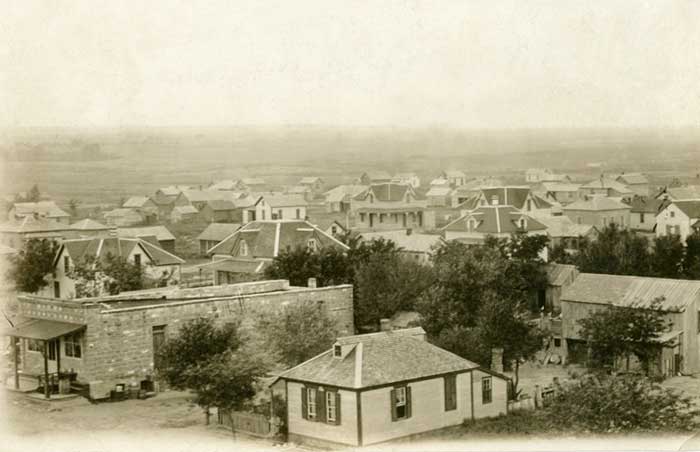
Herzog, Kansas, about 1900.
Because of the large number of people living there, Herzog became the largest and most important of the German colonies in Ellis County. The settlers held religious services at Alois Dreiling’s home, and soon built a frame church adjoining the house. Sir Walter C. Maxwell, a Catholic Englishman living south of Victoria, started plans to build a stone church. That church building was completed in August 1877, but it became too small as the town grew.
Father Anthony Mary founded the St. Fidelis Church, and construction began in November 1881. The new church building, which could hold up to 600 parishioners and was built entirely by immigrants, was dedicated on October 19, 1884. By the turn of the century, the people once again found themselves in need of more room, and under the guidance of Father Jerome Mueller, plans were made beginning in 1905 to build a new one.
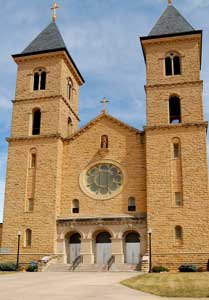
The St. Fidelis Church in Victoria, Kansas, still serves a congregation today by Kathy Alexander.
The plans were revised in 1908, and the cornerstone was laid in October 1909. About 225 families of the St. Fidelis Parish helped build this church, which was completed in 1911. The exterior was constructed of native limestone quarried seven miles south of Victoria. The stone was then loaded on wagons and hauled to the building site. Local masons then laid the 50-100-pound stones. Called the “Cathedral of the Plains,” the church was completed in 1911.
When completed, the church measured 220 feet long, 110 feet wide at the transepts, and 75 feet at the nave. Its ceiling is 44 feet above the ground, and the towers rise 141 feet. At the time of its dedication, the seating capacity of 1,100 made it the largest church west of the Mississippi River. Today, the church is considered one of the “Eight Wonders of Kansas” for its architectural grandeur and impressive craftsmanship.
By the turn of the century, Victoria and Herzog, which had virtually merged, boasted two banks, two mills, a grain elevator, several retail establishments, a telegraph office, a money order post office, and a population of about 500. Herzog was “officially” merged into Victoria in 1913.
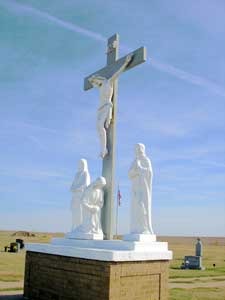
A beautiful monument in the St. Fidelis Cemetery in Victoria, Kansas, by Kathy Alexander.
Today, this quaint little town supports about 1,200 people. Its rich history is evident in its many stone buildings, including St. Fidelis Church, which continues to serve parishioners today.
The St. Fidelis Cemetery, located just north of Victoria, displays several beautiful grave markers.
Victoria is about eleven miles east of Hays, just a few miles south of I-70.
Just off Old US-40, a memorial honors six rail surveyors whom Cheyenne Indians killed in 1867. The killings led to the Battle of the Saline River.
©Kathy Alexander/Legends of Kansas, updated January 2026.
Also See:
See Sources.
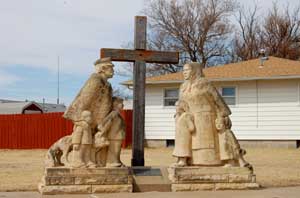
The Volga-Germans of Herzog are honored with a statue. Photo by Kathy Alexander.