|
Legends of Kansas
What's New!!
Also see:
Legends of America


Rocky Mountain General
Store
The
Book Shelf
Exclusive
Products
Postcard
Rack
Route 66 Emporium
Vintage Photographs

12343 W. 79th Terrace
Lenexa,
KS 66215
913-708-5119
Please report
broken links, missing pictures, or other problems online by clicking
HERE
or send us an
email.
Thanks!
| |
|
|
|
More Trails of Kansas |
|
|
|
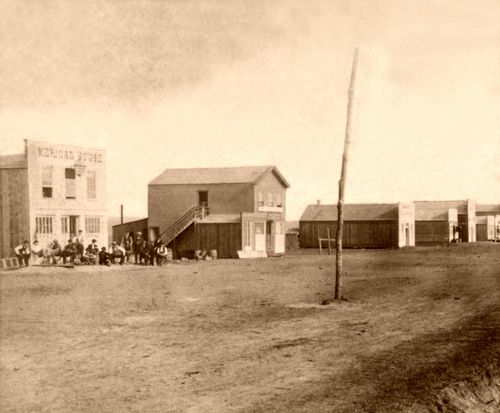
Ellsworth Cattle Trail
– When the city of
Abilene told
Texas cattleman they were no longer welcome in
their town in 1872, primarily due to tick fever, the unruly conduct of the many
cowboys, and the destruction that the big herds did to local land, a number of
Ellsworth residents went down the old Chisholm Trail to urge drovers to bring
their herds to
Ellsworth, about 60 miles southwest of
Abilene. Though
Ellsworth,
in 1871, had already attracted many cattle drovers, with some 30,000 head
shipped from the town, they clearly couldn’t compete with the Queen of Cowtowns.
With
Abilene denying their entry in 1872,
Ellsworth began to thrive and that
year, some 220,000
Texas Longhorns came up the Chisholm Trail to the new
shipping point.
A new offshoot of the trail was surveyed by the Kansas Pacific Railway
Company, led by William M. Cox, General Livestock Agent for the railroad. The
new route, saved the cattle drovers about 35 miles, leaving the original trail
in
Indian Territory halfway between the Salt Fork of the Arkansas River and Pond
Creek.
|

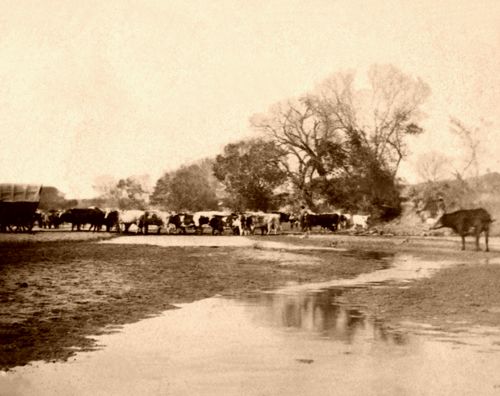
Cattle at the Smoky Hill River near
Ellsworth,
Kansas,
Alexander Gardner, 1867.
This image available for
photographic prints
and downloads
HERE!
|
|
| The trail then crossed the Arkansas River at Ellinwood,
Kansas before making its way to
Ellsworth. The new route was sometimes called
Cox’s Trail or the Ellsworth Trail, but, most of time was referred to as the
middle branch of the Chisholm Trail.
In 1867, a Kansas
law had established a quarantine, prohibiting southern cattle in the state due
to outbreaks of “Texas Fever.” However, because of the high demand for cattle,
Joseph G. McCoy, who had established the cattle market in
Abilene several years
earlier, had convinced the state not to enforce the rule. In 1873, the law was
reinforced but
Ellsworth
thought itself safe, outside the line of quarantine. However, it was
actually a few miles inside the line. The town promoters assured Texans
that they would be exempt from the law and this proved to be the case, but
mainly because it was not enforced. Locals said that it was violated
daily. Like other Kansas cowtowns,
Ellsworth earned a wicked reputation with its many
cowboys. But the prosperity wouldn’t last and its
shipping pens were finally
closed in 1875.
Fayetteville Emigrant
Trail - This trail ran northwest from the
Arkansas
Post, the first semi-permanent European settlement in the Lower
Mississippi Valley. Located on the Arkansas River in southeast
Arkansas,
the trail, which was originally an
Indian Trail, but as people began to move
westward, it began to be utilized to transfer pioneers to the Santa Fe Trail in Kansas.
The trail left Arkansas Post, bearing northwest and passed
through Austin,
Arkansas a few miles northeast of Little Rock, before
continuing between the Arkansas and White Rivers. The emigrant trail was joined
at Fayetteville by a road from Fort Smith on the Arkansas River. It then
traversed the northeast corner of
Oklahoma, crossing the Neosho River and
entered the state of Kansas in what is now Montgomery County. The path
continued on, requiring pioneers to get over the Verdigris River about two miles
north of the Kansas state line, went through the present-day site of Coffeyville
and continued along the northeast side of Onion Creek before making its way
northwest. Finally, it converged with the
Santa Fe Trail at Turkey Creek in
McPherson County, Kansas. In Kansas the trail crossed the counties of
Montgomery, Chautauqua, Elk, Butler, Harvey, Marion and McPherson.
|
|
During the days of
westward expansion, the trail was widely used, also connecting to the Oregon and
California Trails. However, travel dramatically fell off during the
Civil War.
When the Osage lands in southern Kansas were thrown open for settlement, the old
trail was soon obliterated and abandoned and by the end of the 19th
Century, only traces of it could be seen.
|
|

An Army train crossing the plains, Harper's
Weekly,
April 24, 1868
|
Kaw Trail – Another old
Indian Trail
that connected with the
Santa Fe Trail, the Kaw Trail was first utilized by the Kanza
Indians who traversed it regularly during their hunting expeditions. When
it began to be utilized by American pioneers, the trail began at Big John, on
the Kaw Reservation, near Council Grove and passed through the counties of
Morris, Chase and Marion, to present-day Florence. From there, it went to what
was known as Big Timbers on Turkey Creek, where it intersected with the
Santa Fe Trail. By the end of the 19th Century only traces could be found on
the rising ground west of Florence and on Diamond Creek in Chase County.
©
Kathy Weiser/Legends
of Kansas, updated April, 2010.
|
|
|
From the Rocky Mountain General Store
Custom
Greeting Cards - Combining
our great
vintage
photographs with
words,
wisdom
and
proverbs
of the
Old West,
these photo
cards are unique to the
Rocky Mountain General Store.
|
| |
|