
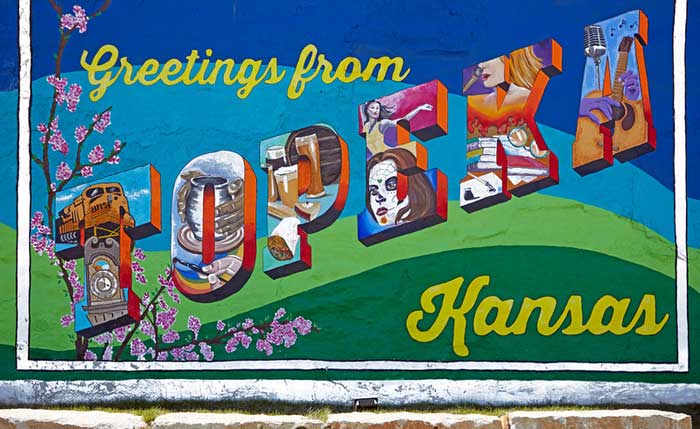
Greetings from Topeka Mural. Photo by Carol Highsmith.
Situated along the Kansas River in northeast Kansas, Topeka is the capital city of Kansas and the county seat of Shawnee County. Having long been the home of the Kanza Indians, the name “Topeka” means “to dig good potatoes” in the Kanza and the Ioway languages. The potato is called the prairie potato, a perennial herb that was an important food for many Native Americans.
Early missionaries were working with the Kanza Indians as early as 1830. However, the first permanent white settlers were the three French-Canadian brothers – Joseph, Ahcan, and Louis Pappan, who married three Kanza Indian sisters and moved to the area from St. Louis, Missouri, in 1840.

Pappans Ferry, Topeka, Kansas
Two years later, they established the first ferry across the Kansas River, long known as Pappan’s Ferry, to accommodate travelers between Fort Leavenworth, Kansas, and New Mexico. Afterward, it became a favorite crossing for the California and Oregon traders and emigrants. Soon, more ferries were established in the area to accommodate the many westward travelers in the early 1850s. Traffic along the Oregon Trail was supplemented by trade on a new military road stretching from Fort Leavenworth through Topeka to the newly established Fort Riley.
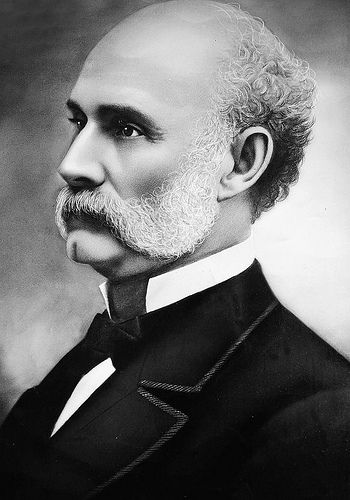
Cyrus K. Holliday
In October 1854, Cyrus K. Holliday, a young Pennsylvanian, arrived at Lawrence, and the following month, in company with Dr. Charles Robinson, agent of the New England Emigrant Aid Society, proceeded up the valley of the Kansas River to locate Free-State townsites for the fast coming Eastern emigrants. Among others, the present site of Topeka was selected as one especially desirable.
On December 5, 1854, nine men met on the banks of the Kansas River. They drew up an agreement, which later became the basis for the Topeka Association, the organization mainly responsible for Topeka’s establishment and early growth. These men included Cyrus K. Holliday, F.W. Giles, Daniel H. Horne, George Davis, Enoch Chase, J.B. Chase, M.C. Dickey, Charles Robinson, and L.G. Cleveland. Soon, the townsite was surveyed and lots divided, and early in 1855, a meeting was held to choose a name for the new town. Topeka was selected after debating several names because it was novel, of Indian origin, and sounded good.
Some of the first buildings constructed were sod huts by Daniel Horne and L.G. Cleveland. More emigrants soon followed, and about 36 people joined the new settlement.
F. J. Case built a log house with a blacksmith shop in the rear; more sod huts and shake cabins were put up by spring, and A.W. Moore established the first boarding house. On January 13, 1855, the town was promoted in the Herald of Freedom, published in Wakarusa, Kansas:
“Topeka – A new townsite with the above name has been selected and is now rapidly filling up with Eastern people. It is located about twenty-five miles above this point, on the Kansas River, and will probably be a place of considerable importance. Several of our most active businessmen are connected with the movement, and they are bound to make it go ahead. It is said there is fine country around it, and nature has been prolific in her bounties. A steam sawmill and all the various appliances of civilization will be introduced, thereupon, the first renewal of navigation in the spring. The name is said to be the original Indian one for the Kansas River.”
In January 1855, M.C. Dickey and Cyrus K. Holliday journeyed to Kansas City as agents of the Emigrant Aid Society to bring up the steam engine for the new sawmill, which was completed and put in operation in the spring.
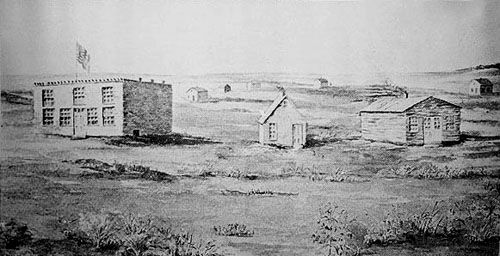
Topeka, Kansas, in 1856
In March, a post office was established in a log cabin serving as a blacksmith shop. Fry W. Giles was appointed postmaster. Also occurring that month, the Methodists organized the first church in town with Reverend A. Still at the “pulpit.” The first religious service was held in a grove on the bank of the Kansas River. Early in the spring, another party of 42 emigrants arrived, and the town was dotted with camps, wagons, farming implements, and household furniture. Another boarding house was opened -The Pioneer Hotel to accommodate the increased population. A simple log cabin with berths one above another, around the sides, and a long table in the center was busy in the short term but soon outlived its usefulness as better buildings took its place. Afterward, it stood for several years, serving as a shelter for cattle and known as the “Pine-away House.”
In April, two new stores were established, one by J.T. Jones and the other by the Farnsworth Brothers (afterward famous as Constitution Hall.) That same month, Enock Chase built the first house with a wooden floor, and J.C. Miller began constructing the first brick home in the city. A brickyard was established by L.W. Horne just outside of town, and Daniel Horne found enough men to form a military company, which he organized and called the Topeka Guards.
When the settlers of 1854 came to the banks of the Kansas River at Topeka, there was no road directly up the river, that part of the country being broken by ravines, ridges, and streams. A new road was laid out early in May 1855 to encourage settlement, branching off from the California Trail a little east of Big Springs and running east to Topeka.
From the beginning, Topeka was a temperance town. On the evening of July 4, 1855, after a temperance demonstration, the mass meeting resolved itself into a committee of the whole and destroyed all the liquor in the vicinity.
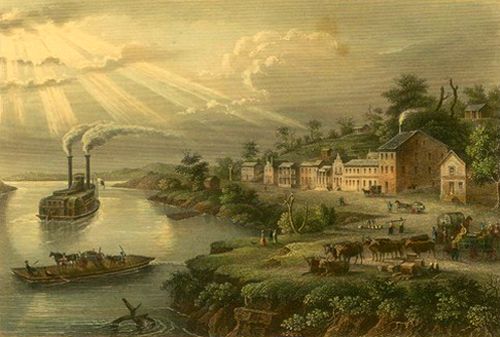
River Boat
During the last week in May 1855, the first steamboat of the season, the Emma Harmon, arrived at the Topeka Levee. That summer, Allen & Gordon completed another store and put in a large stock of goods, and a potential newspaperman named E.C.K. Garvey arrived from Milwaukee. Garvey proposed establishing a newspaper and moving his family and business interests to Topeka if sufficient encouragement could make the project feasible. With the Town Association’s help, a two-story building was erected, and Garvey published the first city newspaper, the Kansas Freeman, on July 4, 1855. Later, the “Garvey House” was enlarged and helped serve other functions, including housing the post office, a hotel, and the town’s political and commercial center. However, the newspaper didn’t last, being suspended in the spring of 1856.
John Speer founded another newspaper called the Kansas Tribune and began publishing in Topeka in December 1855. It would continue periodically through 1868 when it was finally discontinued. Numerous other newspapers would follow throughout the years.
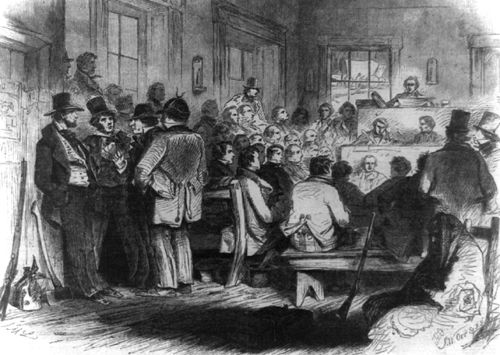
Constitutional Convention, Topeka, Kansas, Frank Leslie’s Illustrated Newspaper, 1855
The Big Springs Convention, held in September 1855, was a prelude to something better for Topeka – it was the beginning of a series of well-concerted and skillfully executed movements to draw attention to the city as the state’s future capital. The following month, a Free-State Constitutional Convention met at Topeka on October 23, 1855, drawing up documents to make Kansas free of slavery. This constitution and the resulting turmoil between the Free-State and pro-slavery factions would lead to the desperate times called Bleeding Kansas. Kansas would have a long way to go before she would become a state in 1861.
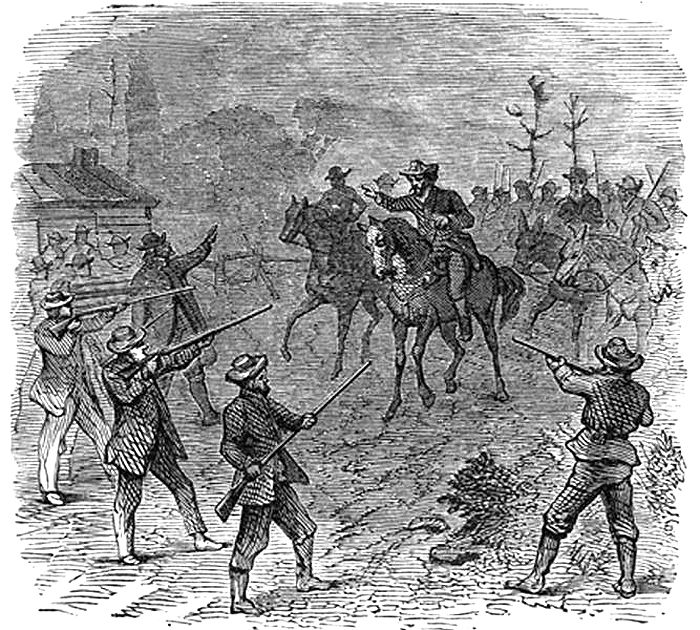
Wakarusa War, Kansas
As the Wakarusa War erupted, the call came to Topeka: “Send men to help Lawrence” in November 1855. The following day, a meeting was held in Constitution Hall, and the Topeka Guards, under Captain Daniel H. Horne, were immediately dispatched to the aid of the sister city. About 100 men shouldered their rifles and marched, leaving, it is said, only one able-bodied man behind to take care of the women and do the necessary chores.
When the Topeka men arrived at Lawrence, they were assigned quarters in the unfinished hotel, and there met John Brown, who supplied some of them with guns. Though only one man was killed in the almost bloodless skirmish, E.C.K. Garvey, Joseph F. Cummings, and Robert L. Mitchell were taken prisoners and carted off to Lecompton. The gentlemen being “newspapermen” and having about their personal copies of the newly-printed “Topeka Constitution,” it was proposed by the mob that Mr. Garvey, being editor of a Free-State paper, should pay the penalty of such crime with his life. Fortunately, better counsels prevailed, and he was spared and, with his companions, liberated when the Wakarusa troubles ended.
In the meantime, the first session of the Kansas Free-State Legislature was planned for March 4, 1856. It was greatly feared that suitable accommodations could not be provided for the many people present, and rival cities had urged objections to that effect. But, Topeka residents argued they could handle the influx of people at the Garvey House, J.B. Chase’s boarding house and another hotel was in the making. Built by Professor Oakley, he struggled valiantly during that harsh winter to complete the hotel. Though it was not ready by spring, Topeka held the convention.
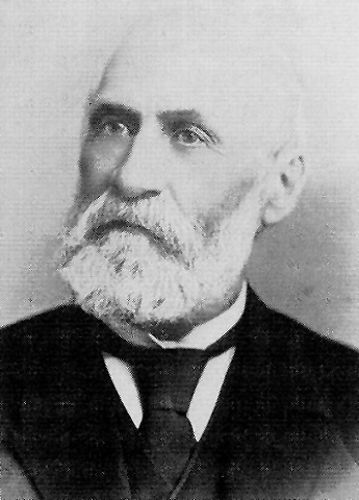
Kansas Governor Charles Lawrence Robinson
The Free-State Legislature adjourned on March 15th, planning to meet again on July 4, 1856. However, shortly after that, Free-State Governor Charles Robinson and other Free-State leaders were indicted and arrested on the charge of treason. When the Free-State Legislature convened again on July 4th, it was dispersed, at the mouth of a loaded cannon, by Colonel Edwin Sumner under the President’s instructions.
After the dispersion of the Legislature, the Free-State citizens of Topeka, like many other Kansas towns, felt that they were completely adrift, having no faith in the Territorial Government and no immediate prospect of a better. The Missouri River towns were in the hands of the pro-slavery party, and it became almost impossible to procure even the necessities of life. To get supplies from Leavenworth or Kansas City, lives were often lost, and the teams were almost invariably captured.
As a result, a group was organized in Topeka to capture and secure supplies from the enemy, which would be stored in the basement of Constitution Hall. The Free-State organization was known as Company B, Second Regiment Kansas Volunteers.
The company made expeditions to various pro-slavery towns in the vicinity of Topeka –Tecumseh, Osawkie, and Lecompton. The troops usually returned with supplies sufficient to feed the troops and often more. This system of foraging and reprisal on the enemy carried on until supplies could be regularly brought to Topeka without danger of attack from border ruffians. During the tumultuous days of the Kansas-Missouri Border War, Topeka men would also be involved in other skirmishes.
The City of Topeka was incorporated on February 14, 1857, with Cyrus K. Holliday as Mayor. By that time, the city supported a population of about 600 people and was the third-largest town in the state. A two-story brick school building was completed in the summer of that year. Before this time, only private schooling was available. At an election held in October 1858, Topeka was made the county seat of Shawnee County. The following year, the first railroad meeting was held in August 1859. A route was surveyed to Topeka, but the building of a railroad, as well as other improvement plans, would be delayed by the Civil War.
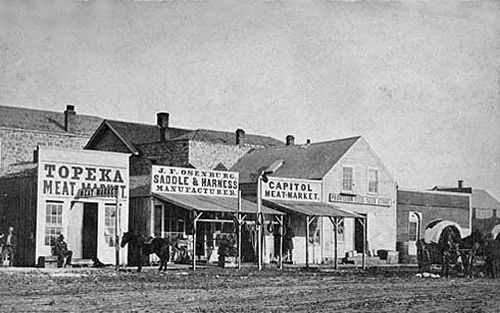
Topeka, Kansas – Kansas Avenue in the early 1860s
By 1860, the city supported a population of 759 people, and several stage lines were established — to Atchison by way of Lecompton, to Kansas City by way of Lawrence, and to Junction City by way of Manhattan. A new bridge was built over the Kansas River, one over the Shunganunga Creek, and steamboats were regularly docking at the Topeka landing, depositing meat, lumber, and flour and returning eastward with potatoes, corn, and wheat.
After a decade of abolitionist and pro-slavery conflict, Kansas was finally admitted as a state on January 29, 1861, just a few months before the Civil War would begin. Charles Robinson became the first governor, and Topeka, which had become the temporary capital under the 1859 Wyandotte Constitution, was the site of the first session of the State Legislature on March 26, 1861.
During that session, it was decided that the people would take a vote for the permanent home of the capitol, which occurred on November 5, 1861. The contest was primarily between Topeka and Lawrence, with Topeka as the victor. By this time, Topeka was called home to almost 800 people.

Lincoln College at Topeka, Kansas by Alexander Gardner, 1867
During 1861-1863, the sessions of the House of Representatives were held in a building that would later become an opera house, and the Senate was held in a building called Richie’ Block, which later burned. At the legislative session of 1862, the Topeka Association, through its president, Cyrus K. Holliday, donated twenty acres of ground for the site of State buildings. In the summer of 1863, the State erected a temporary Capitol building on the west side of Kansas Avenue between Fourth and Fifth Streets, which the State offices occupied in the fall. As border troubles continued in Kansas during the Civil War, a stockaded fort called Fort Simple was erected in the fall of 1864 to protect the city should it be attacked by Confederate forces. When the Civil War was over, it was abandoned by April 1865 and demolished two years later.
During the years of the Civil War, growth in Topeka and the rest of the state was slow. However, when the war was over, growth dramatically picked up, and within six months, the town’s population had doubled. Lincoln College, now Washburn University, was established in 1865. In January 1866, the Union Pacific Railroad reached the city, and new bridges, schoolhouses, sidewalks, churches, business blocks, and dwellings were rapidly built. By 1867, the city had outgrown its original limits, and the outlying claims had been divided into lots. The little town of Eugenia on the north side of the Kansas River was attached to Topeka that year and became North Topeka, and four more additions were made that year.
Construction of the Kansas State Capitol began in 1866. It would take 37 years to build the capitol; however, by 1869, the work had advanced far enough on the east wing to furnish quarters for the State officers. The east wing was completed in 1873; construction began on the west wing in 1879, and the central building in 1886. The dome was finally set in 1889. By the time it was completed, its cost was estimated at over $3 million.
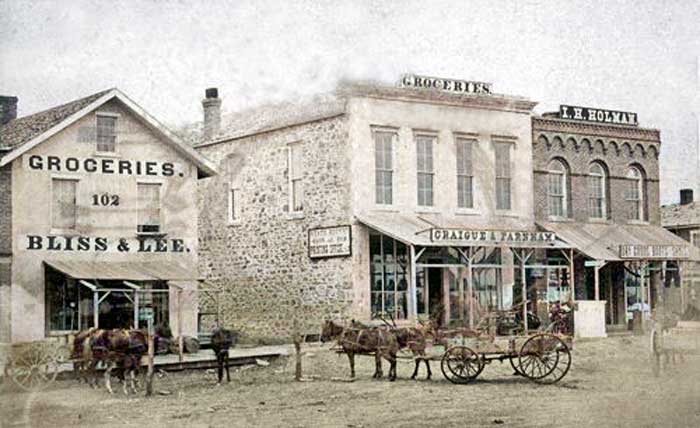
6th Street in Topeka, Kansas, 1869. Touch of color by LOA.
By the late 1860s, Topeka had become a commercial hub with steamboats landing daily numerous stagecoach lines, and in 1869, the railroad had started moving westward from the city. Former mayor Cyrus K. Holliday, at the helm of the Atchison, Topeka & Santa Fe Railroad, had secured lands for the railroad to populate the western portions of the state. Later, the railroad’s general offices and machine shops would be established in Topeka in 1878.
By 1880, the city’s population had risen to more than 15,000 and would double during the next decade, spawning many new improvements, businesses, and a real estate bubble that would eventually burst. In 1886, the Missouri Pacific Railroad was built to this point, and the following year, the Chicago, Rock Island & Pacific Railroad. More than 20 additions were platted and thrown on the market the same year, with real estate transfers averaging $30,000 per day and the banks clearing $1,000,000 a month. In 1888, there were 3,000 new buildings put up at the cost of $3,000,000. The same year, miles of streets were paved, sidewalks installed, sewers laid, and an electric light plant was installed. Unfortunately, it was too much too fast and ended in disaster in 1889 when numerous investors were ruined. The resulting depression caused a loss of 5,000 in population in 1890, and it would not be until 1900 that the population exceeded that of 1889.
Although an amendment to the Kansas constitution prohibited the sale of liquor, carried in 1880, the authorities, for various reasons, had hard work to enforce the law during the first twenty years. A new era of law enforcement was introduced by Carry A. Nation, who smashed several Topeka saloons in 1901, thus arousing public sentiment on the subject.
In the spring of 1903, flooding on the Kansas River inundated North Topeka, marooning hundreds in their homes and drowning 29 people. Property damage was estimated at more than $4 million, including the devastation of several large flour mills, lumber yards, and other industrial properties. Afterward, dikes were constructed to prevent a repetition of the disaster, but residents were uneasy during high water periods in 1908, 1923, and 1935.
By 1910, the city boasted more than 43,000 residents, furnished 65 passenger trains daily, 65 miles of paved streets, and 47 miles of electric street railway. It also featured six hospitals, 72 churches, 26 public school buildings, and Washburn College, one of the leading educational institutions in the Middle West, Bethany College, and six business colleges. The town also supported over 300 manufacturing plants, making everything from wool to vinegar, flour, automobiles, household goods, and more. Numerous retail stores dotted the city, and more than a dozen newspapers and magazines were published in the city, but still, there were no saloons in Topeka.
Growth in the area kept pace with the rest of the nation until 1930, and the Great Depression years saw Topeka’s growth rate fall to its lowest point. By this time, the town had settled into a typical pattern of a medium-sized Midwestern area dependent primarily on its agriculture base.

Kansas Avenue, Topeka, Kansas, the 1930s
However, with the onset of World War II, the railroad, meat packing, and agricultural base shifted to manufacturing and government/military services. These new patterns were more clearly defined and solidified during the post-war years. Forbes Air Force Base was established during the war, bringing many new people to the city.
Again, in 1951, the Kansas River overflowed, permanently closing the Morrell Meat Packing Plant and eliminating over 1,000 jobs. However, other manufacturing facilities remained, keeping the economy diverse.
That same year, a class-action suit was filed against the Board of Education of the City of Topeka, Kansas. The landmark case — Brown v. Board of Education of Topeka, was filed by 13 Topeka parents on behalf of their 20 children, alleging that separate public schools for black and white students were unconstitutional. When the case finally reached the United States Supreme Court in May 1954, declaring state laws establishing separate public schools for black and white students was, in fact, unconstitutional, paving the way for integration and the civil rights movement. Monroe Elementary, a segregated school that figured in the historic Brown v. Board of Education decision, is now the Brown v. Board of Education National Historic Site with interpretive exhibits.
On June 8, 1966, Topeka was struck by an F5-rated tornado, hitting Washburn University and the downtown area, narrowly missing the capitol. Its path of destruction resulted in an estimated $100 million in damages, making it, at the time, one of the most costly tornadoes in American history. Nevertheless, the city was rebuilt and recovered.
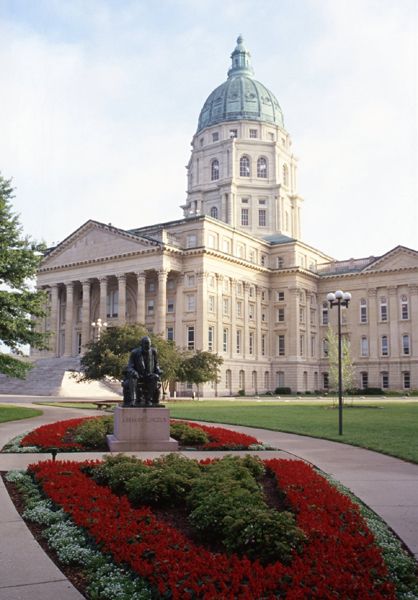
Kansas capitol building in Topeka, Kansas. Work began on the capital in 1866 and continued for 37 years. When complete, the total cost was $3,200,588. Courtesy Kansas Memory.
In 1974, the Forbes Air Base closed, and over 10,000 people left Topeka, resulting in the first population census decrease since the city was founded. However, the city focused on new improvements and attractions over the next several decades and luring new businesses.
Today, the city is called home to about 125,000 people. While continuing to flourish as a modern city, it also focuses on its rich heritage and history. Tours are available at the Kansas State Capitol, numerous museums can be visited, and a walking tour is available for Topeka’s downtown area. Visiting the Kansas History Museum provides a wealth of information regarding the Sunflower State.
Historic Sites:
- Brown V. Board of Education National Historic Site, 1515 SE Monroe Street
- Combat Air Museum, 602-604 J Street
- Great Overland Station, 701 North Kansas Avenue
- Historic Downtown Topeka
- Kansas History Museum, 6425 SW 6th Ave
- Kansas State Capitol Tour Center, 300 SW 10th Ave
- Old Prairie Town at Ward Meade Historic Site, 124 NW Fillmore St
More Information:
Topeka Visitor’s Bureau
1275 SW Topeka Blvd
Topeka, Kansas 66612-1852
785-234-1030
Compiled and edited by Kathy Alexander/Legends of America, updated October 2023.
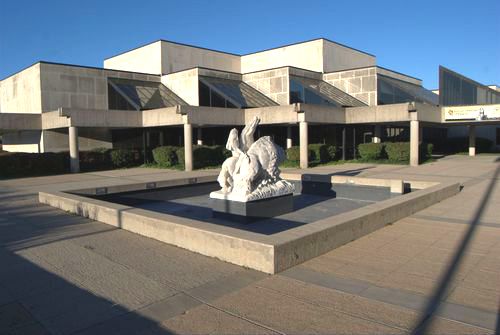
Kansas Museum of History courtesy of Kansas Historical Society.
Also See: