
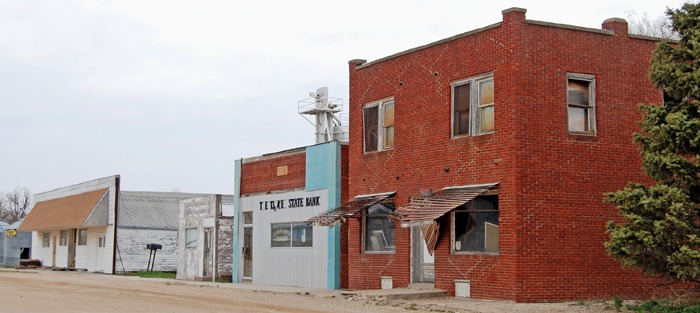
Timken, Kansas Business District by Kathy Alexander.
Timken, Kansas, is a small town on the south bank of Walnut Creek in Rush County. It is also an extinct town, as its post office is long closed. As of the 2020 census, the town’s population was 38 and it had a total area of 0.15 square miles, all of it land.
Timken, Kansas, started when the Atchison, Topeka & Santa Fe Railroad was under construction west of Great Bend in 1886. The land was owned by Henry H. Timken, an inventor who had made a fortune and speculated in lands among future railroad sites, including 4,800 acres near what would become the new settlement.
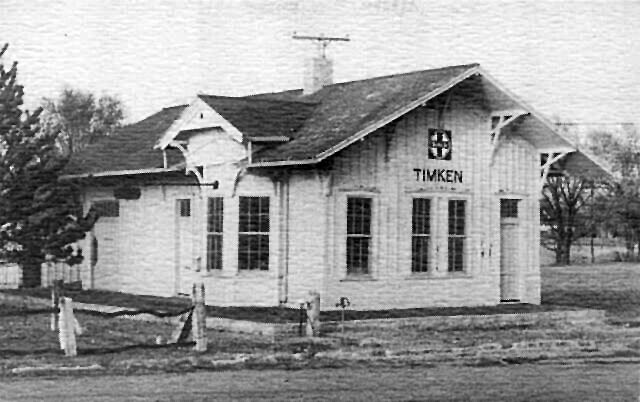
Santa Fe Railroad Depot in Timken, Kansas.
When Timken sold the land to the Railroad Town Site Company, one condition was that the town was named for him. The site company agreed and soon laid out lots along the proposed railroad. In 1887, the depot was built, but no other lots were sold. However, there was enough population in the surrounding area to support a post office that opened on July 23, 1888.
However, that changed a decade later when a merchant purchased most of the town sites and opened a general store to serve the many immigrant settlers from Czechoslovakia, Bohemia, and Moravia. He immediately established a real estate office to sell parcels of land. He worked with the railroad to make an appealing program that offered discounted fares for prospective settlers to travel west to inspect the land. If they purchased a parcel of land, the ticket price was applied toward the sale price of the land.
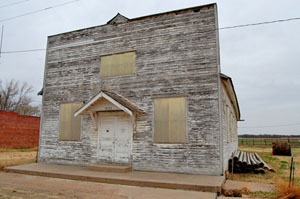
An old commercial building in Timken, Kansas. A reader identified it as the old Bohemian Hall. Photo by Kathy Alexander.
Though the idea worked somewhat, it was probably not nearly as successful as the merchant had hoped. However, in 1904, a community hall and a Catholic Church were built, and the following year, a lumber company was established.
By 1910, the community had only a population of about 50 but had gained a mill, a grain elevator, and several retail establishments. A bank was organized in 1913, and the town slowly grew to the point that it was incorporated as a city in June 1930.
Though the town never grew very large, the railroad continued to provide passenger and freight service, and in the mid-1970s, the depot was abandoned. The Rush County Historical Society then stepped in and purchased the wooden building, which was moved to La Crosse in 1975. Today, the old building serves as the Rush County Historical Museum.
Timken’s post office closed on January 20, 1996.
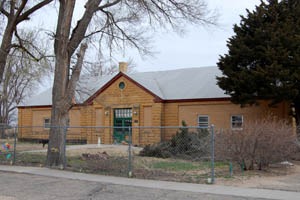
Old Timken, Kansas School by Kathy Alexander.
As of the 2020 Census, Timken is home to only about 38 people. A beautiful National Bohemian Cemetery is located south of the community.
Timken is about seven miles east of Rush Center, just off Kansas Highway 96.
Compiled by Kathy Alexander/Legends of Kansas, updated December 2024.
Also See: