Sterling, Kansas by Kathy Alexander.
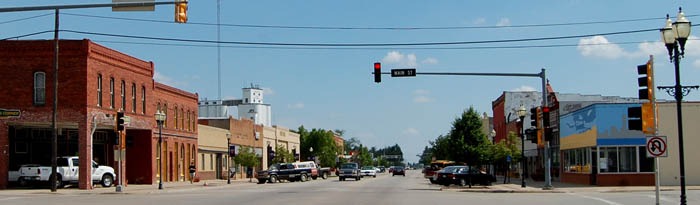
Once the largest town in Rice County, Sterling, Kansas, is located in the southern portion of the county on the Arkansas River, eight miles south of Lyons, the county seat. The settlement was first established in 1871 and called Peace. One of the earliest settlers was A.G. Landis, who built a store in the settlement, which consisted of only about seven families. When the Atchison, Topeka & Santa Fe Railroad built their tracks through the townsite in 1872, the town began to grow.
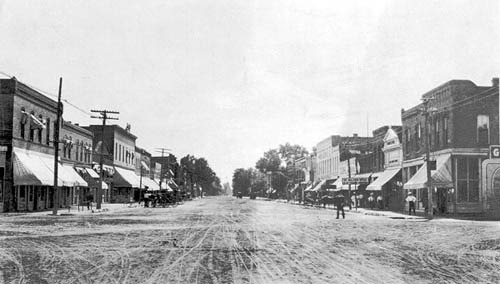
Early day, Sterling, Kansas.
In 1876, the city was incorporated, and its name was changed to Sterling in honor of Sterling Rosan, one of the early settlers. A large business, Landis & Hollinger, was established in May 1876 and carried all manner of goods, including groceries, boots & shoes, dry goods, hardware, lumber, grain, furniture, farm implements, drugs, buffalo hides, and buffalo meat. The business was located on the northwest corner of Broadway and Monroe.
In 1878, the Davenport Elevator was built by Dow, Hancock & Gilman, and soon two flour mills—the Crystal Mills and Keystone Mills — were established.
One of the largest early industries was the Sterling Syrup Works, erected in 1881. Operated by Clements & Eustis, the factory could produce 2,000 gallons of syrup in 24 hours. The company raised its own cane on a tract of 640 acres and, during peak periods, employed about 60 men.
Shortly thereafter, a Sugar Factory was also established by Reginald M. Sandys & Co. of New Orleans.
By 1883, its population had grown to about 1,500. At that time, the town sported three banks, two architects and builders, six grocery stores, three hardware stores, three jewelry and music stores, four dry goods stores, a furniture store, three hotels, a druggist, and two shoemakers.
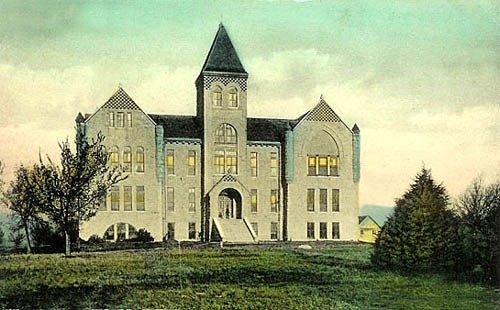
Cooper College in Sterling, Kansas.
In 1886, the Sterling Land and Investment Company was organized and platted the “College Addition” to Sterling. Ten acres of land were donated by an early settler named Pliny F. Axtell, and the first building was erected in October 1886. The site was then offered to the United Presbyterian Church Council of Kansas, with the condition that they endow, operate, and maintain the school. The offer was accepted, and a charter was prepared in the name “Cooper Memorial,” in honor of Reverend Joseph Cooper, a revered former leader of the Presbyterian denomination that founded the College. The original curriculum offered four majors and a preparatory department that offered high school courses for students unable to attend such institutions in their home communities. The major included a “Classical Course,” a general liberal arts emphasis, a “Normal Course” for prospective teachers, an “English Course” for future school administrators, and a business course.
Cooper Memorial College was opened on November 1, 1887. Over the next few years, additional buildings were built, and departments added. By the early 1900s, the school had an enrollment of about 180 students.
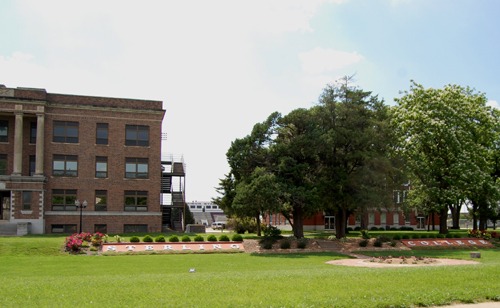
Sterling College by Kathy Alexander.
By then, the town had grown to include more manufacturing facilities, including two broom factories, salt works, machine shops, a washing machine factory, a flour mill, marble works, a feed mill, and a seed cleaner factory. The city also boasted an opera house, three banks, two weekly newspapers (the Bulletin and the Journal), and numerous churches and lodges. By 1910, the population was 2,133.
Cooper College was renamed Sterling College in 1920, but retained its original focus as a Christian college.
Over the next decades, Sterling continued growing while maintaining its small-town atmosphere. As of the 2020 census, the city’s population was 2,248. Sterling College is its biggest employer.
More Information:
City of Sterling
114 N. Broadway
P.O. Box 287
Sterling, Kansas 67579
620-278-3423
© Kathy Alexander/Legends of Kansas, updated May 2026.
Also See:
See Sources.