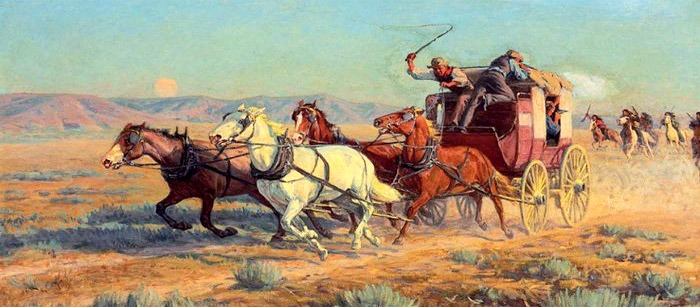
Stagecoach Painting by Richard Lorenz.
The earliest stage route in Kansas was the Santa Fe Trail, over which, in 1849, a monthly stage line ran from St. Louis, Missouri, to Santa Fe, New Mexico. Hall & Porter were the proprietors of the line, and as the line became popular, the eastern terminus was moved westward to Independence, Missouri. To meet increasing business demands, they later established a weekly stage schedule, which reduced the trip to about 15 days. The distance from Independence to Santa Fe was approximately 740 miles; passengers were charged $250 for the trip and were allowed 40 pounds of baggage. This enterprise had approximately $50,000 in investment and carried government mail, for which it received annual compensation of $50,000.
The first overland mail stage West of the Missouri River to Salt Lake City, Utah, was inaugurated on July 1, 1850, as a monthly service and lasted four years.
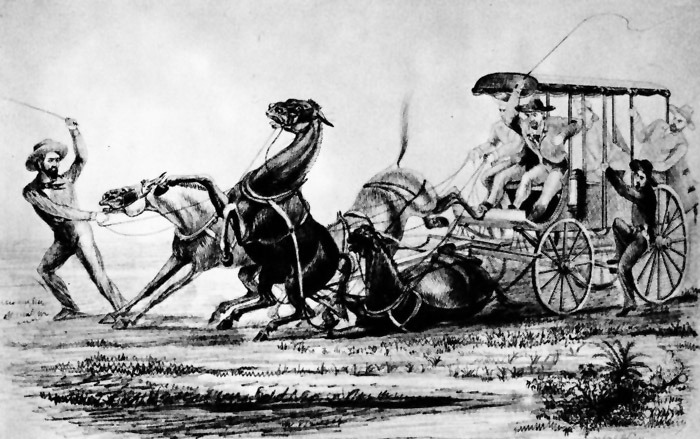
Butterfield Stage Wagon, 1858.
John Butterfield’s Southern Overland Mail operated from St. Louis to San Francisco via El Paso, Yuma, and Los Angeles, thereby avoiding the snows of the Rocky Mountains encountered by routes farther North. This line was 2,759 miles long, and Butterfield had scheduled 25 days for the trip, which was later reduced to 23 days. The first coaches started from each end on September 16, 1858. The line was discontinued when the Civil War broke out, and the equipment was moved North to the central route, starting from St. Joseph, Missouri, and proceeding West via the California Trail. After the war, the field in southern and southwestern Kansas served by the Butterfield Lines was succeeded by the Southern Kansas Stage Company.
Because of its location on the Missouri River, Kansas City was a significant stage center, and during the late 1850s, Moore & Walker operated a line between that city andLeavenworth. Another line ran from Kansas City to the Sac and Fox Agency in Westport, Missouri, and Kansas, via Olathe, Gardner, Bull Creek, Black Jack, Palmyra, Prairie City, Boling City, Centropolis, and Minneola. This route was 75 miles long, and the fare to the Sac and Fox agency was $5.
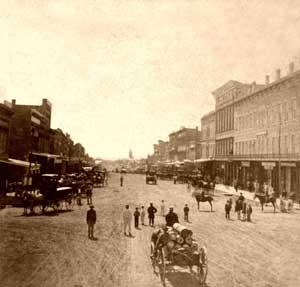
Lawrence, Kansas, 1867.
Colonel Eldridge of Lawrence started a line between Lawrence and Leavenworth in 1857 and another between Lawrence and Kansas City in 1857, running this in opposition to one operated by Mr. Richardson. H.G. Sutherland and H.G. Weibling operated a line between Lawrence and Leavenworth. Samuel Reynolds of Lawrence also started a line in 1857 between Lawrence and Osawatomie via Prairie City, Ottawa, Jones, and Stanton. A tri-weekly line of hacks, operated by Kimball, Moore & Co., ran between Leavenworth and Westport, Missouri.
A man named Cass operated a daily stagecoach line between Leavenworth and Lecompton. This line was about 35 miles long. Fred Emery ran a weekly line of hacks between Leavenworth and Junction City, passing through Salt Creek, Easton, Hardtville, Ozawkie, Indianola, Silver Lake, Louisville, Manhattan, Ogden, and Fort Riley. A.G. Lewis of Leavenworth operated a line between that city and Atchison, commencing about July 1, 1863, and another line between Leavenworth and Atchison, running via Kickapoo. In 1864, J.C. Crall of Atchison started a line of hacks to Leavenworth.
A line of stages was operated between Topeka and Manhattan beginning in March 1857. Coaches left Topeka every Thursday morning and returned the following Monday morning. In the same month, a line was also established from Topeka to Lawrence, with service triweekly. Following the Pike’s Peak gold excitement, a daily stage line was established from Topeka to the gold mines, beginning as early as April 1859.
In 1859, the Territorial Legislature granted articles of incorporation to the Kansas and Missouri River Stage Company. In March 1860, the Western Stage Company had a daily line of stages running between Atchison and Topeka via Lecompton. The fare was $4 from Topeka to St. Joseph, Missouri, via stage line to Atchison and by rail the rest of the way.
In April 1860, four lines of stages reached Topeka, three from the Missouri River and one from Junction City. One of these lines from the Missouri River was operated by the Kansas Stage Company, which had offices in Kansas City, with L.G. Terry as superintendent and James H. Roberts as the agent. This route from Kansas City to Junction City was 150 miles long and cost $10. The line passed through Westport, Shawnee, Chillicothe, Monticello, Lexington, Eudora, Franklin, Lawrence, Lecompton, Big Springs, Tecumseh, Indianola, St. Marys, Manhattan, Ogden, and Fort Riley.
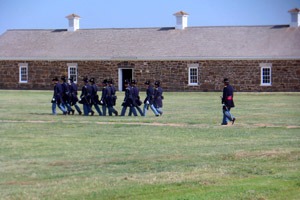
Fort Larned, Kansas, on the Santa Fe Trail.
In about 1862, the Kansas Stage Company started a line from Junction City to Fort Larned, making a 300-mile through route from Leavenworth to Fort Larned. This line ran up the Kaw Valley through Topeka, Manhattan, Fort Riley, Junction City, Abilene, and Salina, and crossed the Smoky Hill River near the present city of Ellsworth.
From about 1864 to 1868, the Barlow & Sanderson Overland Mail Company operated a line from Fort Larned to Fort Lyon, Colorado. Colonel Robert M. Wright, of Dodge City, built most of the stations along this route, generally dugouts about 14 by 20 feet, cut into the side of a hill, and located about 30 miles apart. The line ran along the North side of the Arkansas River, and the stations, commencing with Fort Larned, were at Coon Creek; on the Little Coon on a line drawn direct between Fort Larned and Fort Dodge; a temporary station between Coon Creek and Blanco Arroyo; Fort Dodge; Cimarron Station (about four miles West of the present town); Bluff Station, near the site of Pierceville; Fort Aubrey on the boundary between Hamilton and Kearny Counties; Pleasant or Pretty Encampment, about four miles East of the Kansas line in Hamilton County and located in a nearly enclosed bend of the river; Sand Creek, at the mouth of that stream, and Fort Lyon, Colorado between Graveyard and Limestone Creeks.
In 1866, the Southern Kansas Stage Company operated a line of coaches from Lawrence and Topeka that connected with the Union Pacific Railroad to all the principal villages in southern and southwestern Kansas. A daily line left Lawrence for Baldwin City, Ohio City, Iola, Twin Mound, Waterloo, Paola, Prairie City, Garnett, Humboldt, Ridgeway, Emporia, Mound City, Ottawa, Carlyle, Burlingame, Burlington, Council Grove, and Fort Scott. Henry Tisdale was the superintendent, and Jacob Pike was the agent at Lawrence. G.L. Terry was the superintendent at Leavenworth.
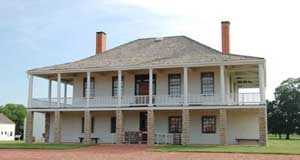
Fort Scott Visitors Center by Kathy Alexander.
The Fort Scott Stage Company operated a line between Fort Scott and Kansas City, the route from the latter city south passing through Westport, Little Santa Fe, Squiresville, Spring Hill, Paola, Osawatomie, Twin Springs, Brooklyn, Paris, Moneka, Mound City, Dayton, Mapleton, Osage, Fort Scott, and Warrenton. The distance from Fort Scott to Kansas City was 122 miles, and the fare was $11.
Fort Scott was once a vital stage center. As late as 1869, ten stage lines ran out of there as follows: One to the Missouri River operated daily along the line of the Fort Scott & Gulf Railroad; another daily line to Pleasant Hill, Missouri, by Barlow, Sanderson & Co.; A.P. Bland ran a line to the Missouri River; Parker & Tisdale, a daily line to Humboldt on or near the 5th standard parallel, and a tri-weekly line to Ottawa and Chetopa; the Kansas Stage Company a daily line to Fort Gibson, Indian Territory; William Smalley, a daily line to Osage Mission; Parker & Smith, a tri-weekly line to Carthage, Missouri, and a man named Arnold, a tri-weekly line to Lamar, Missouri.
The Jones Express ran from Leavenworth up the North side of the Kansas River to Fort Riley and Junction City. The enterprise began around 1859, and a daily coach departed Junction City for Denver. This route was located on the divide between the Republican River and Chapman’s Creek, making it as close as possible to an airline to Denver, Colorado.
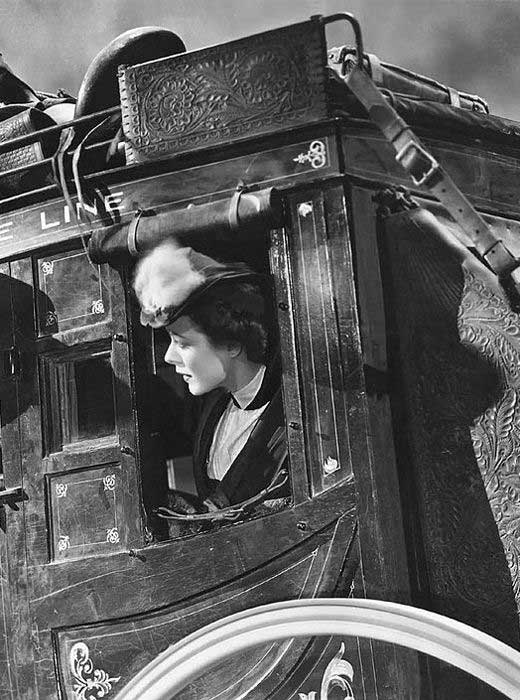
A lady on a Stagecoach.
Compiled and edited by Kathy Alexander/Legends of Kansas, updated July 2026.
Also See:
Stagecoaches of the American West
Source: Kansas: A Cyclopedia of State History, Volume I, 1912.