
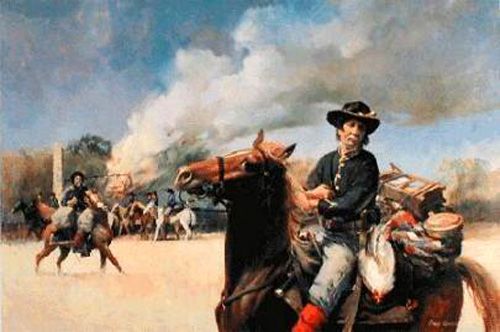
Kansas Red Legs
Although the “Red Legs” are commonly associated with the Jayhawkers of the Bleeding Kansas era and the Civil War, they were a separate guerilla unit that only fought during the Civil War.
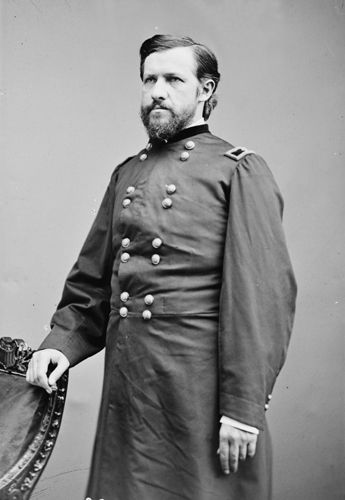
General Thomas Ewing during the Civil War
During the early part of the war, western Missouri was infested with bands of guerrillas, and it was not uncommon for some of these lawless gangs to cross the border and commit depredations in Kansas. To guard against these incursions and to aid the Union cause, a company of border scouts was formed in late 1862. As it was an independent organization, never regularly mustered into the United States service, no official record of their actions was preserved. The men composing the company became known as “Red Legs” because they wore leggings of red or tan-colored leather.
This secret Union military society was organized by General Thomas Ewing and James Blunt for desperate service along the border and numbered as many as 100 men.
The qualifications for membership in the company were unquestioned loyalty to the Union cause, undaunted courage, and the skillful use of the rifle or revolver. Their headquarters were at the “Six-mile House,” so-called because it was six miles from Wyandotte (Kansas City) on Leavenworth Road. This house was erected in the winter of 1860-61 by Joseph A. Bartels, whose son, Theodore, was one of the best pistol shots on the border and a member of the Red Legs.
The company was commanded by Captain George H. Hoyt, the lawyer who defended John Brown at Charles Town, Virginia (present-day West Virginia), after he attacked Harpers Ferry, West Virginia. Other members were Jack Harvey, a brother of Fred Harvey, of the Santa Fe Railroad Hotel chain; Joseph B. Swain, nicknamed “Jeff Davis,” afterward captain of Company K. Fifteenth Kansas; “Red” Clark, of Emporia, Kansas whom General Ewing said was the best spy he ever had; John M. Dean, who was one of the organizers; and W. S. Tough, for many years proprietor of the horse market at the Kansas City stockyards. Still others, of less note, were Harry Lee, Newt Morrison, Jack Hays, James Flood, Jerry Malcolm, and Charles Blunt, often called “One-eyed Blunt.”
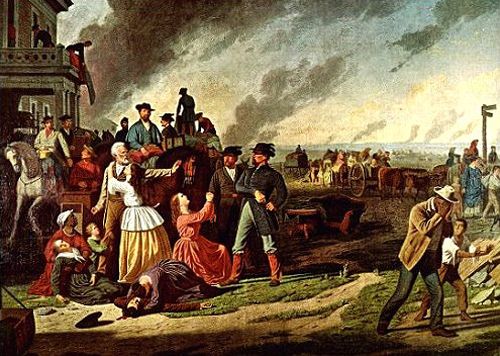
Evacuation of Missouri Counties under General Order No. 11, painting by George Caleb Bingham, 1870.
William W. Denison, assistant adjutant-general of Kansas some years after the war, was a private soldier in the Eleventh Kansas and was one of the details to enforce General Thomas Ewing’s General Order No. 11. On that occasion, he wore the red leggings of the organization, which came to be recognized as “a badge of desperate service in the Union army.” Generals Ewing and Blunt usually had several of the Red Legs on their payrolls, where they often received as much as $7 per day because of the hazardous service they were required to render.
Over time, the term “Red Leg” became general along the border. William E. Connelley, in his Quantrill and the Border Wars, said:
“Every thief who wanted to steal from the Missouri people counterfeited the uniform of the Red Legs and went forth to pillage. This gave the organization a bad name, and much of the plundering done along the border was attributed to them when, in fact, they did little in that line themselves. There were some bad characters among them—very bad. But they were generally honest and patriotic men. They finally hunted down the men who falsely represented themselves to be Red Legs, and they killed every man found wearing the uniform without authority.”
Albert R. Greene, a member of the Ninth Kansas Cavalry, was personally acquainted with many of the Red Legs and was well acquainted with the nature of their service. Concerning them and their work, he said:
“There was not one of them but performed valuable service for the Union cause, and, so far, as I know and believe, always within the rules of civilized warfare. That the organization was disbanded before the close of the war was owing more to the fact that the necessity for its existence had ceased than because a few of its members had thrown off the restraints of discipline… It is enough to say for the propriety and wisdom of such an organization as the Red Legs that it did more to protect the homes of Kansas than any regiment in the service and was the organization of all others most dreaded by William Quantrill.”
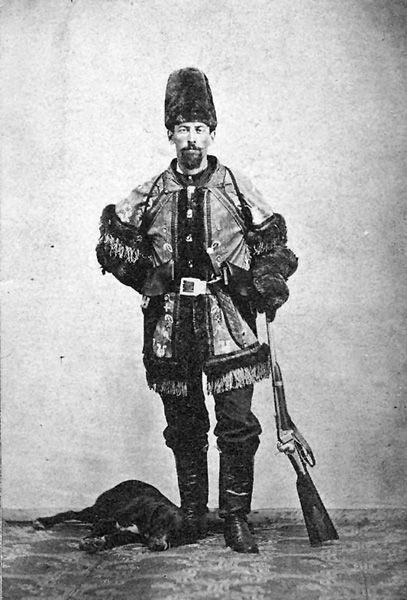
Charles R. Jennison, Kansas Red Leg
Such was the character of the Red Legs — men who did not know the meaning of the word cowardice and left their fields and firesides to defend their homes against the irregular and predatory warfare of the guerrilla and the bushwhacker.
After the Civil War, most members returned to peaceful occupations and became law-abiding citizens.
Compiled by Kathy Alexander/Legends of America, updated October 2023.
Also See:
Kansas Jayhawkers – Terror in the Civil War
Pro-Slavery Movement in Kansas
Six-Mile, Kansas – A Red Leg Stronghold
Source: Blackmar, Frank W.; Kansas: A Cyclopedia of State History, Standard Publishing Company, Chicago, IL 1912