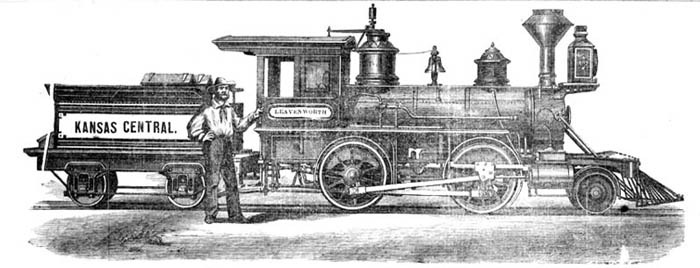
Kansas Central Railway.
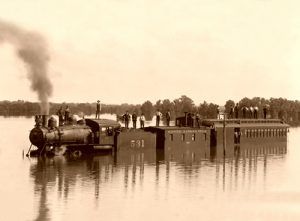
Missouri-Kansas-Texas train under several feet of water, 1904.
In 1834, many people viewed steam railroads as impractical and an innovation unworthy of adoption by any civilized community.
When Kansas was organized as a territory in 1854, transportation west of the Mississippi River was minimal. Immigrants came by water from St. Louis to Kansas City, Missouri. From that point, the trip westward toward the state’s interior had to be made with wagons over a country where even wagon roads had not yet been established. Under these conditions, the question of better transportation facilities was one that early engaged the attention of the Kansas pioneers.
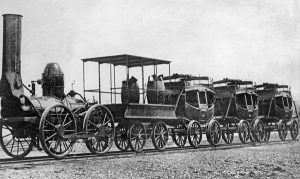
Early American Railroad.
In 1834, 20 years before the passage of the Kansas-Nebraska Bill, Dr. Samuel K. Barlow of Massachusetts advocated for building a railroad through the western country he had just visited. In a communication to the New York Courier and Inquirer three years later, Dr. Hartwell Carver suggested a railroad from the Mississippi River to the Pacific Coast, if possible, and at least to the head of navigation on the Columbia River.
But the public was not yet ready to accept the scheme as feasible and laughed at the idea of a railroad across the continent. Many people viewed steam railroads as impractical and an innovation unworthy of adoption by any civilized community. In 1828, only nine years before Carver wrote the article mentioned, the school board of Lancaster, Ohio, replied as follows to some young men who asked for the use of the schoolhouse in which they desired to debate the railroad problem:
“You are welcome to use the schoolhouse to debate all proper questions, but such things as railroads and telegraphs are impossibilities and rank infidelity. There is nothing in the Word of God about them. If God had designed that His intelligent creatures should travel at the frightful speed of 15 miles an hour by steam, He would have foretold it through His holy prophets. It is a device of Satan to lead immortal souls down to hell.”
Notwithstanding the attitude of opposition, Dr. Carver went to Washington to try to interest Congress in the subject of a transcontinental railway. There, he met Asa Whitney, a New York merchant with extensive trade with China and a desire to find a shorter route to the Orient. But Congress was not yet ready to act on a proposition of such magnitude. Again, in 1845, Whitney presented a memorial to Congress asking for a donation of a tract of land 60 miles wide from the west shore of Lake Michigan to the Pacific Ocean, through the corner of which he and his associates would build a railroad and remunerate themselves through the sale of the lands on either side. Whitney was regarded as a speculator, but he continued his efforts to raise public awareness of the importance of his project and even influenced the legislatures of 20 states to endorse his plans. From 1853 to 1861, exploring surveys were made under the direction of General Grenville M. Dodge.

President Lincoln signed a bill.
On July 1, President Abraham Lincoln signed the bill authorizing the construction of a Pacific Railroad. One feature of the bill was that it empowered the president to designate the road’s eastern terminus after consultation with General Grenville Dodge. Lincoln named Council Bluffs, Iowa. While this bill did not directly affect Kansas, it marked the beginning of a major railroad system that, in 1912, operated more than 1,000 miles within the state.
The Union Pacific Company was organized in Chicago, Illinois, on September 2. By an act of March 3, the government granted to the company alternate sections of land for ten miles on each side of the road — about 3,000,000 acres in all — and authorized the issue of bonds payable in 30 years in the amount of $16,000 per mile to aid in the construction of the road.
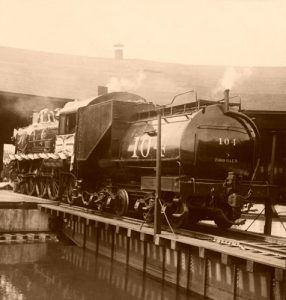
Union Pacific Railroad Engine by H.C. White, 1905.
As late as 1857, there was but one line of railroad west of the Mississippi River, extending from St. Louis to Jefferson City, Missouri, a distance of 125 miles. In the meantime, however, the territorial authorities of Kansas had not been idle in their efforts to secure the building of railroad lines in the territory. >The first legislature of 1855 granted charters to five railroad companies: the Kansas Central, Southern Kansas, Leavenworth, Pawnee & Western, Leavenworth & Lecompton, and Kansas Valley Railroad.
Among the incorporators of the Kansas Central were John Calhoun, Samuel D. Lecompte, A. S. White, and John Duff. The company’s capital stock was fixed at $1,000,000, and it was authorized to build a road “from any point on the Missouri River to any point on the western boundary.”
The Southern Kansas Railroad’s capital stock was fixed at $3,000,000. The company was given a franchise to build a road “from the Missouri state line due west of Springfield to the west line of Kansas Territory.” A. J. Dorn, William J. Godfroy, James M. Linn, Joseph C. Anderson, and others were named as the incorporators. The act stipulated that road construction would begin within nine years.
Some of the leading projectors of the Leavenworth, Pawnee & Western were W.H. Russell, J.M. Alexander, Samuel D. Lecompte, E.H. Dennis, and C.H. Grover. The company’s authorized capital stock was $5,000,000. The road was to run “from the west bank of the Missouri River in Leavenworth to the town of Pawnee, or some point feasible and next to the government reservation for Fort Riley, with the privilege of extending the same to the western boundary of the territory.”
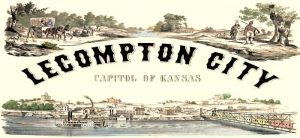
Lecompton – Capitol of Kansas.
H. D. McMeekin, John A. Halderman, R.R. Russell, Daniel Woodson, Samuel D. Lecompte, and C.H. Grover were among the Leavenworth & Lecompton Road incorporators. The road was to run between the points named. The capital stock was $3,000,000, and the company was authorized to issue stock in the Lecompton Bridge Company to secure access to the territorial capital. Work was to begin on the road within five years.
The first board of directors of the Kansas Valley Company was Thomas Johnson, H.J. Strickler, A.J. Isaacs, Rush Elmore, John P. Wood, Johnston Lykins, Andrew McDonald, Thomas N. Stinson, and Cyprian Chouteau. The capital stock was fixed at $5,000,000. The charter provided for the construction of a line of the railroad “from the western boundary line of the State of Missouri, on the south side of the Kansas River, commencing at the western terminus of the Pacific Railroad, near the mouth of the Kansas River, running up the valley of the river on the south bank thereof, by way of Lawrence, Benicia, Douglass, Lecompton, Tecumseh, and terminating at or near the town of Pawnee.”
Sixteen charters were granted to railroad companies by the legislature of 1857 — the second legislative session to be held in the territory. Governor JGovernor John W. Geary, Samuel J. Jones, John Calhoun, J. A. Halderman, P. T. Abell, and several others incorporated the Grand Central Gulf Company, with a capital stock of $10,000,000 and authority to build a road from the northern to the southern boundary of the territory, to connect and cooperate with roads in Nebraska on the north and Texas on the south, thus forming a line from the interior to the coast.
The act incorporating the Marysville or Palmetto & Roseport Railroad named 13 directors, fixed the capital stock at $5,000,000, and granted the company a franchise to build a road from Marysville to Roseport in Kansas “to connect with the Hannibal & St. Joseph Railroad.”
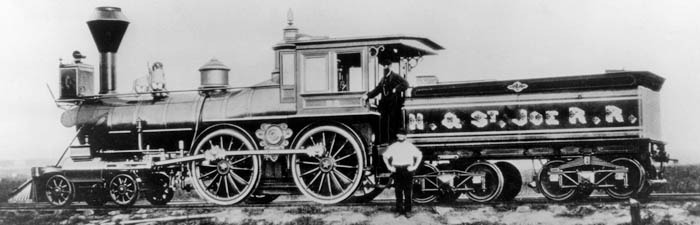
Hannibal & St. Joseph Railroad.
P.T. Abell and John H. Stringfellow were the chief promoters of the Atchison & Fort Riley Company, which was granted a charter to build a road between the named points, with work to begin within five years. The company’s capital stock was $1,000,000.
The Missouri River & Rocky Mountain Company, with a capital stock of $1,000,000, was authorized to build a road from any point on the Missouri River between Leavenworth and Delaware City to any point on the territory’s western boundary. John Calhoun and D.A.N. Grover were at the head of this company.
The Delaware & Lecompton Company was incorporated by amending the act of the previous session relating to the Kansas Central, transferring the latter’s powers, rights, and privileges to the Delaware & Lecompton Company, along with its original incorporators and capital stock.
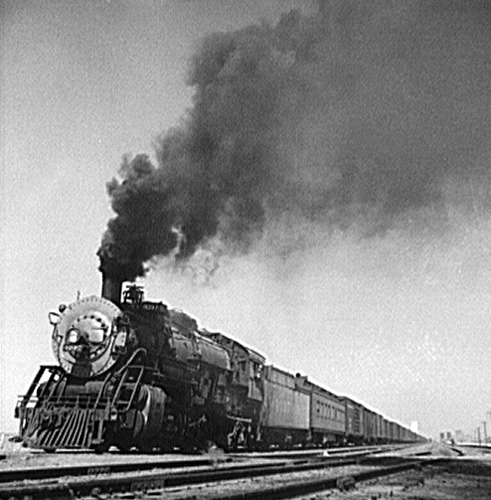
Kansas Freight Train.
The Mine Hill Railroad and Mining Company was incorporated with a capital stock of $5,000,000 and a franchise to commence mining or construct a railway within five years. However, the act of incorporation did not resolve the issues with the railroad terminals.
A charter for the Atchison & Palmetto authorized the issue of $1,000,000 in capital stock to build a railroad from Atchison to Palmetto “on the Big Blue River.”
An amendment was made to the charter of the Leavenworth, Pawnee & Western Company, giving it the power to build a branch “beginning at some favorable point on the Leavenworth, Pawnee & Western and follow the most practicable route southwardly, to terminate on the southern boundary of Kansas at some point where an easy connection may be had with a line of railroad extending through the Indian Territory and the State of Texas to the Gulf of Mexico.”
Thomas Johnson, Johnston Lykins, John C. McCoy, David Lykins, and A. M. Coffey secured a charter for the Eastern Kansas & Gulf Railroad Company. The company’s capital stock was $5,000,000, and it had the right to build a road from the western boundary of the State of Missouri, on the south side of the Kansas River, to connect at its western terminus with the Pacific Railroad.
The Palermo & Lecompton, the Atchison & Lecompton, and the Prairie City & Missouri State Line companies were chartered to build lines between the points named in the respective acts of incorporation, and the last-named company was also authorized to build “two branches to any point in the territory.”
The Central Railroad Company of Kansas received a charter in 1857 to build a road from Roseport, opposite St. Joseph, Missouri, southward via the Neosho Valley to Galveston Bay. The authorized capital stock of this company was $5,000,000, and among the incorporators were Aristides Rodrique, Daniel Woodson, W.P. Richardson, and John W. Forman.
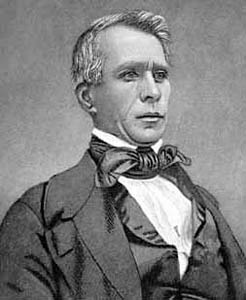
Kansas Governor Wilson Shannon.
Wilson Shannon, John Calhoun, R. R. Rees, L.J. Eastin, and their associates secured a Missouri River & Nemaha Valley Railroad charter to run from the Missouri River in Doniphan County toward Fort Kearny, Nebraska. The company’s capital stock was $5,000,000.
The St. Joseph & St. George Company, composed primarily of citizens of Hannibal, Missouri, was given a franchise to construct a road from St. Joseph, Missouri, to St. George on the Kansas River in Pottawatomie County. The St. Joseph & Topeka, with a capital of $1,500,000, was authorized to construct a road “with one or more tracks” from a point on the Missouri River opposite St. Joseph to Topeka.
A glance at the charters mentioned above shows that the principal promoters of proposed railroads during the first three years of the territorial existence of Kansas were prominent pro-slavery men — John Calhoun, Daniel Woodson, Samuel D. Lecompte, etc. However, after the Free State Party passed the election for legislature members in the fall of 1857, a new set of railroad promoters came to the front. The legislature of 1858 — the first one controlled by Free-State men — granted charters to several railroad companies, and in every instance, the incorporators were members of that party.
In the act incorporating the Delaware & Lawrence Company, S.B. Prentiss, Cyrus K. Holliday, James Blood, O.E. Learnard, John Hutchinson, E.B. Whitman, J.S. Emery, S.C. Harrington, J.W. Pennoyer, George Q. Twombly, J.A. Finley, and William Hutchinson were named as the first board of directors. The company’s capital stock was set at $1,506,000, work was to commence within six years, and the road was to be completed within ten years from the date of the charter.
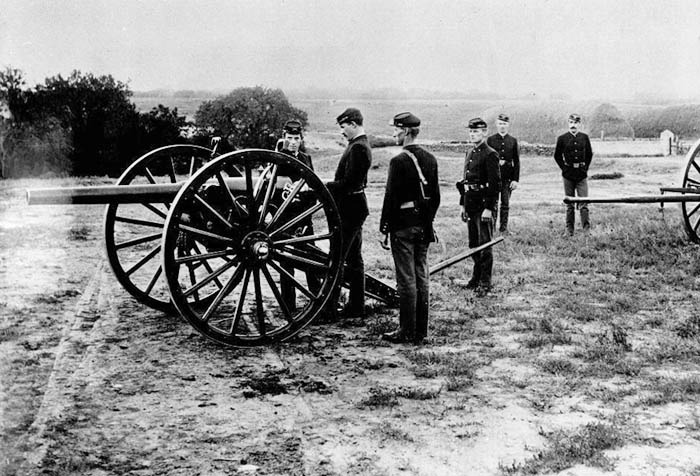
Fort Riley, Kansas, Soldiers.
Among the incorporators of the Kansas Central, which was also chartered by the legislature of 1858, were Charles Robinson, J.P. Root, W.Y. Roberts, and Henry J. Adams, all Free-State leaders. This company, whose capital stock was $3,000,000, was authorized to build a railroad from the Missouri River, “at or near the mouth of the Kansas River, to a point at or near Fort Riley.”
The act incorporated the Elwood, Palermo & Fort Riley Railroad and named 40 incorporators, including Cyrus K. Holliday, Thomas Ewing, Jr., James H. Lane, H. Miles Moore, J.P. Root, and A.L. Lee. This company’s capital stock was $3,000,000. Work on the road between the terminals would commence within five years and be completed within 20 years.
Another company chartered by the legislature of 1858, and one with a high-sounding name, was the Leavenworth City, Delaware City & City of Lawrence Railroad Company, with a capital stock of $1,500,000. The act named 25 incorporators, including Gaius Jenkins, M.J. Parrott, George W. Smith, George W. Deitzler, and H. Miles Moore.
The Missouri River & Rocky Mountain road charter was amended at this session. The names of the 27 incorporators of the Leavenworth, Hamlin & Nebraska Railroad included H.M. Moore, J.H. Lane, Gaius Jenkins, W.Y. Roberts, J.P. Root, and E.N. Morrill. The company’s capital stock was $2,000,000.
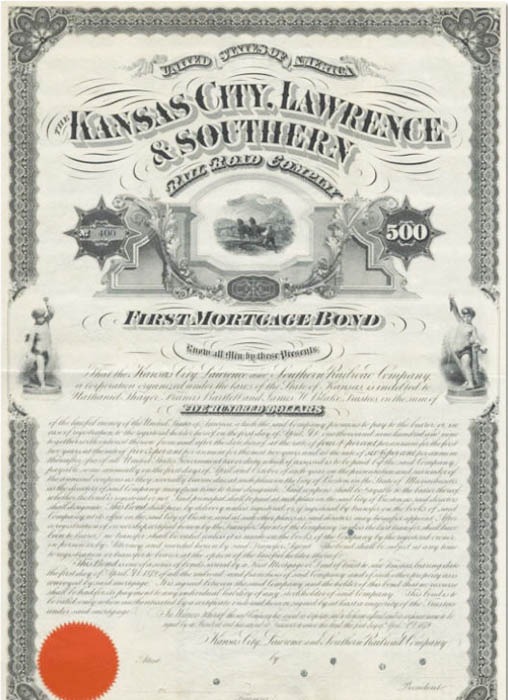
Kansas City, Lawrence & Southern Kansas Railroad.
The Leavenworth, Lawrence & Fort Gibson (also called the Kansas City, Lawrence & Southern Kansas) railroad received its charter on February 12, authorizing the construction of a road from Leavenworth to the southern boundary and from Lawrence to Emporia. Several years were spent securing land grants and subsidies to fund the road’s construction. By an act of Congress approved on March 3, the state was granted alternate sections for a distance of 10 miles on either side of a road from Leavenworth toward Galveston Bay. On February 9, the Kansas legislature transferred this grant to the Leavenworth, Lawrence & Fort Gibson Company. In 1867, Douglas County voted to issue bonds totaling $300,000, and Franklin County voted to issue bonds totaling $200,000 for road construction. Work commenced at Lawrence soon after these bonds were authorized, and on January 1, the road was completed to Ottawa. In 1871, it was finished in Coffeyville. The line became part of the Atchison, Topeka & Santa Fe system. The original stock of the Leavenworth, Lawrence & Fort Gibson Company was valued at $2,000,000, and among the incorporators were H.J. Adams, R.B. Mitchell, G.W. Deitzler, and John Speer.
Charles Robinson, James H. Lane, M.J. Parrott, J.P. Root, and their associates asked for and received a charter for a company to be known as the Missouri River Railroad Company, which was authorized to build a road from the Missouri River near the mouth of the Kansas River to the line between Kansas and Nebraska near Roy’s Ferry, via Leavenworth and Palermo. The capital stock authorized by the charter was $500,000.
The act of 1857 chartering the St. Joseph & Topeka Company was amended so that the company might increase its capital stock to $5,000,000 and extend its line from Topeka “to such point on the southern or western boundary of said territory, in the direction of Santa Fe, New Mexico, as may be most suitable and convenient for the construction of said railroad.” Authority was also granted by the supplemental act to construct a branch of said road to any point on the southern boundary of Kansas in the direction of the Gulf of Mexico.
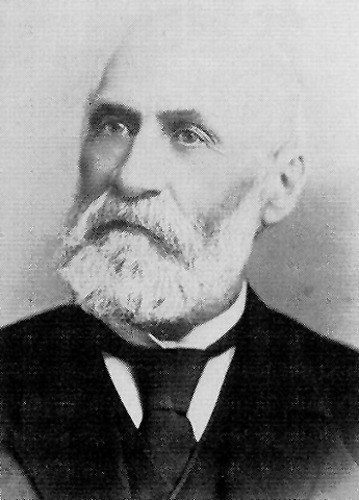
Governor Charles Robinson.
Charles Robinson, M.J. Parrott, and Robert Crozier were the incorporators of the St. Joseph, Sumner & Lawrence Railroad Company, with a capital of $2,000,000. Parrott, Crozier, and George S. Hillyer received a charter to build the Sumner, Manhattan & Fort Riley railroad, with the same rights and privileges as the St. Joseph, Sumner & Lawrence Company.
Cyrus K. Holliday, W.F.M. Arny, R.B. Mitchell, George W. Deitzler, and W.A. Phillips obtained a charter to build the Topeka & Emporia railroad. The company’s capital stock was fixed at $3,000,000, and the right-of-way was designated as a strip of land 200 feet in width.
The Wyandotte, Minneola & Council Grove Railroad was incorporated with a capital stock of $5,000,000 to build a road from Quindaro via Wyandotte, Olathe, and Minneola to Council Grove, with the privilege of extending the line to the western boundary of the territory. The incorporators included Alfred Gray, George S. Park, J.P. Root, and James M. Winchell.
Only four railroad companies were chartered by the legislature of 1859 — the Atchison & Pike’s Peak, the Lawrence & Fort Union, the Wyandotte & Osawatomie, and the Atchison & Topeka. The last-named deserves more than passing mention because it was the forerunner of the Atchison, Topeka & Santa Fe Railway system. Its incorporators were Cyrus K. Holliday, Samuel C. Pomeroy, P.T. Abell, L.C. Challis, M.C. Dickey, Asaph Allen, Samuel Dickson, N.L. Gordon, George S. Hillyer, L.D. Bird, Jeremiah Murphy, George H. Fairchild, and R.L. Crane. The original capital stock was $1,500,000, with the privilege of increasing the same from time to time, provided the increase should never exceed the amount already expended in the construction of a railroad from Atchison to Topeka, “and to the southern or western boundary in the direction of Santa Fe.”
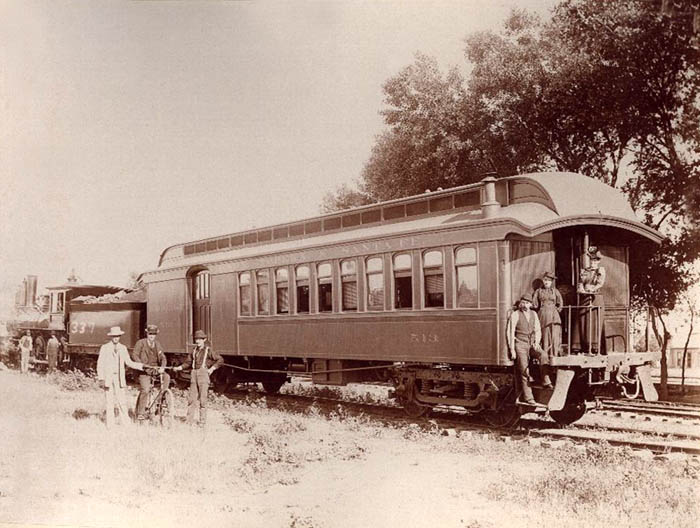
Atchison, Topeka, & Santa Fe Railroad passenger train in Ellinwood, Kansas.
Ten railroad companies were incorporated by the territorial legislature of 1860. Some of the preceding legislatures had created larger corporations, but none had been as liberal in capital stock as this one. Following is a list of the companies chartered by this session, with the capital stock of each: Fort Scott, Neosho & Santa Fe, $10,000,000; Iowa Point & Denver City, $2,000,000; Leavenworth City & San Francisco, $100,000,000; Marysville & Denver, $5,000,000; Missouri River (from Wyandotte to White Cloud via Iowa Point), $2,000,000; Olathe & Southern Kansas, $3,000,000; Southern Kansas Pacific, $5,000,000; State Line, Osawatomie & Fort Union, $5,000,000; Troy & Iowa Point, $1,000,000; Topeka & Southern Kansas, amount of stock not fixed by the act of incorporation. This legislature also passed acts amending the Leavenworth, Lawrence & Fort Gibson charters and the Wyandotte & Osawatomie roads.
Some of the incorporators of railroad companies during the territorial era were earnest in their efforts and sincere in their desires to secure railroads for Kansas. Others, and probably the majority, were motivated by speculative interests. Recognizing the future possibilities of railroad building in the development of the West, they hurried to acquire charter rights through legislative enactments in the hope that, in the event they were unable to finance and construct the roads themselves, they could sell their franchises for handsome profits to companies financially able to carry out the original purposes of the charters. Nor was this condition peculiar to Kansas. During the quarter-century preceding the Civil War, as civilization and settlement extended westward, practically every state west of New York was at some point afflicted with the craze for chartering railroad companies.
The convention met in Topeka on October 17, with 125 delegates present, representing 20 counties of the territory. W.Y. Roberts was elected to preside. Among the vice presidents were Charles Robinson, Samuel Medary, Thomas Ewing, Jr., P.T. Abell, and W. F.M. Arny. The secretaries were John A. Martin, J.F. Cummings, and C.F. de Vivaldi. The principal work of the convention was the adoption of a resolution to the effect that a petition was presented to Congress asking for an appropriation of public lands to aid in the construction of railroads in Kansas, as follows:
-
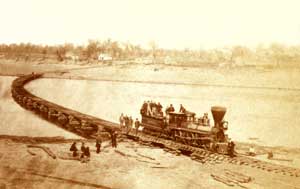
Leavenworth, Lawrence & Galveston Railroad Bridge across the Kansas River, Lawrence, Kansas, by Alexander Gardner, 1867.
A railroad from the western boundary of the State of Missouri, where the Osage Valley & Southern Kansas railroad terminates, westwardly via Emporia, Fremont, and Council Grove, to the Fort Riley Military Reservation.
-
A railroad from Kansas City, Kansas (connecting with the Pacific Railroad) up the Kansas Valley via Lawrence, Lecompton, Tecumseh, Topeka, Manhattan, and the Fort Riley Military Reservation to the territory’s western boundary.
-
A railroad from Lawrence to the southern boundary of Kansas, toward Fort Gibson, Oklahoma, and Galveston Bay.
-
A railroad from Atchison, via Topeka, through the territory toward Santa Fe.
-
A railroad from Atchison to the western boundary of Kansas.
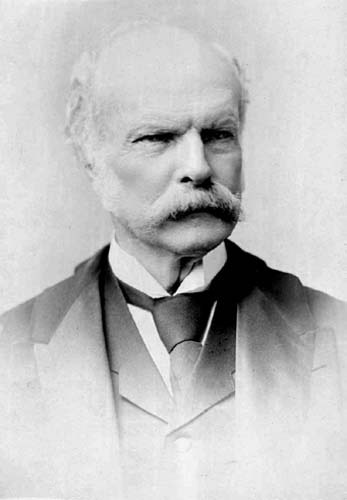
Benjamin F. Stringfellow.
The petition authorized by the resolution was prepared by Benjamin F. Stringfellow and forwarded to Congress. It undoubtedly influenced the national legislation enacted over the next few years. In February, the railroad convention was succeeded by the Kansas State Government. The first state legislature passed an act giving all railroad companies whose charters had not been declared forfeited the legal right “to hold by grant or otherwise any personal or real estate.” The companies were also given two years to begin work on the roads as defined in their respective charters. This legislation was intended to stimulate railroad construction. Soon after the law was passed, the Civil War began, and the preservation of the Union became the all-absorbing question. Even while the war was in progress, Congress passed the acts of July 1, March 3, and July 1 and 2, 1864, granting large tracts of land in the West to railroad companies and authorizing bond issues to aid in building the roads.
In February 1859, the city of St. Joseph celebrated the completion of the Hannibal & St. Joseph Railroad, the first line to reach the Kansas border. A year later, the ground was broken at Wyandotte for the Kansas Central Railroad. The first track in Kansas was on the Elwood & Marysville road on March 20. Within a month, several miles of track were laid, and on April 23, the locomotive “Albany” arrived.
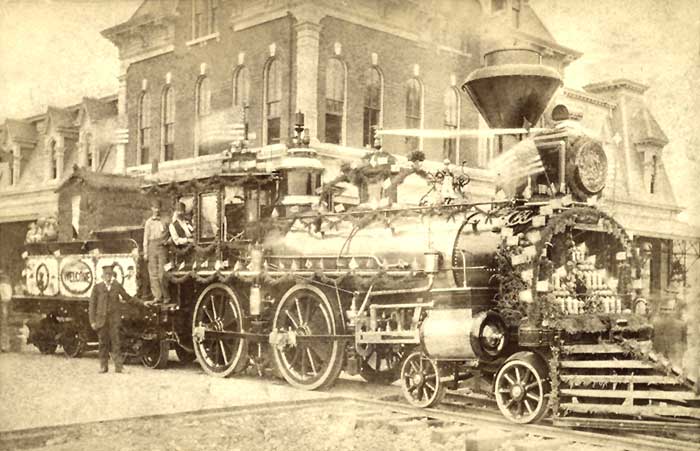
Central Branch Union Pacific Railroad at Atchison, Kansas.
M. Jeff Thompson, afterward an officer in the Confederate Army, was president of the company that opened the first railroad in the State of Kansas. During the war, railroad construction was effectively at a standstill nationwide, but immediately after the restoration of peace, it was resumed with renewed vigor. In July 1866, Congress passed several acts granting railroad companies large tracts of land, in alternate sections on either side of the line for a distance of 10 miles. In his message to the legislature of 1867, Governor Samuel Crawford announced that 300 miles of railroad were in operation in the state. That work on the eastern division of the Union Pacific Railroad was being prosecuted with energy and success. “The road,” said he, “was completed from Wyandotte to Lawrence in 1864, a distance of 40 miles; from Lawrence to Topeka in 1865, a distance of 27 miles; and during the year 1866, from Topeka westward nearly 100 miles, and grading mostly completed for 50 or 60 miles further; also the branch road from Leavenworth to Lawrence, a distance of 33 miles, making for the year 1866 about 133 miles of road, or one-half mile for each working day.”
He also stated that work was being pushed on the Central Branch from Atchison westward, that 15 miles of the St. Joseph & Denver had been completed, that the Leavenworth, Lawrence & Galveston directors had transferred the franchise of that company to a new corporation that promised to complete the road to the southern boundary of the state within two years, and that the Union Pacific Company expected to complete 200 miles of the eastern division during the ensuing year. This expectation was realized: in his 1869 message to the legislature, the governor announced that the road had been completed within 35 miles of the state’s western boundary. The same year, the Leavenworth, Lawrence & Galveston Railroad was completed to Ottawa. The Missouri River Railroad was put into operation between Wyandotte and Leavenworth, and 90 miles of the Central Branch were finished.
By the treaty of April 19, the Leavenworth, Pawnee & Western Railroad Company was given the refusal to buy a particular portion of the Pottawatomie lands. When the Eastern Division of the Union Pacific was organized in 1863, the new company acquired the Leavenworth, Pawnee & Western rights, which granted it the authority to construct a road through Kansas to a point 50 miles west of Denver, Colorado. On May 31, the Eastern Division was renamed the Kansas Pacific. On January 24, the Union Pacific, Kansas Pacific, and Denver Pacific were consolidated into the present Union Pacific. According to the Kansas Railroad Commission report for 1910, the Union Pacific Company was reorganized on July 1, under an act of the Utah legislature of the preceding January, and operates 1,165 miles of road in Kansas.
The Atchison, Topeka & Santa Fe Railroad originated from the charter granted to the Atchison & Topeka Railroad Company by the territorial legislature in 1859. The Atchison & Topeka Company was organized on February 11, and on November 24, the name was changed to the Atchison, Topeka & Santa Fe Railroad.
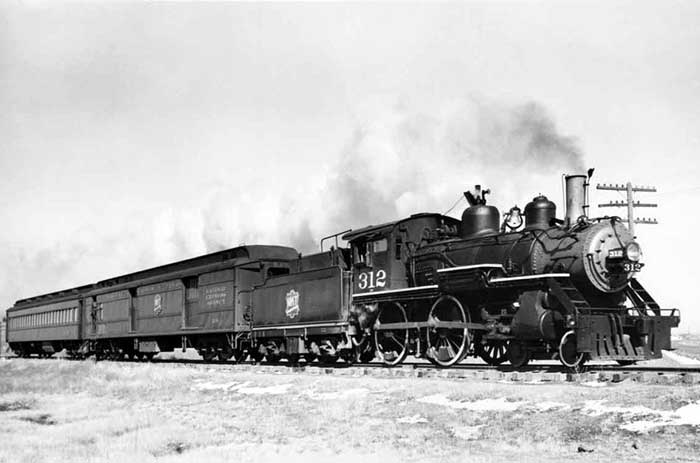
Missouri, Kansas & Texas Railroad.
In 1864, Congress made a large grant of land to benefit the roads and counties through which it was to run, and voted bonds to aid in its construction. Work commenced at Topeka in the fall of 1868, and the following year it was completed at Burlingame, a distance of 27 miles. When the track was completed to Wakarusa, 13 miles from Topeka, an excursion was run from Topeka to celebrate the event. In a speech on that excursion, Cyrus K. Holliday, the projector of the enterprise and first president of the company, predicted that one day, the western terminus of the road would be on the Pacific coast. It is said that when the prophecy was uttered, one incredulous individual, unable to control his joy at the thought of that little crooked road becoming a great transcontinental thoroughfare, threw himself on the grass and exclaimed, “Oh, the old fool!” Yet the prediction was verified. In 1869, they constructed the company’s first general office building in Topeka. This building also served as a passenger station and freight depot. In January 1872, the division between Atchison and Topeka was graded, but the track was not laid until later. In 1873, the main line of the road was completed to the state’s western boundary. The Atchison, Topeka & Santa Fe Railroad encompassed nearly 10,000 miles of road by 1912, of which, according to the railroad commissioner’s report already alluded to, 2,659 miles are in Kansas, and the company had invested over $3,000,000 in shops and office buildings in the city of Topeka.
The Missouri, Kansas & Texas Railroad, originally known as the southern branch of the Union Pacific, was organized in Emporia in 1867. Work was commenced on the road at Junction City in the summer of 1869, and in November, the line was completed to Council Grove, a distance of 37 miles; in December, it was finished to Emporia, 24 miles farther; in February 1870, it was completed to Burlington, 30 miles farther down the Neosho valley; in April another 30 miles took the road to Humboldt, and on June 6 he entered the Indian Territory, thus securing the sole right of way, with a land grant, through that territory.
“The race for the Indian Territory, between the competing lines, the Missouri, Kansas & Texas and the Missouri River, Fort Scott & Gulf roads, will ever be a memorable event in the history of railway construction.”
— Kansas Historical Collection Writer
The Missouri River, Fort Scott & Gulf, began in Kansas City and ran to the state’s southern boundary, a distance of 161 miles. It received a grant of 125,000 acres of land from the state, as well as 1,500 acres from individuals and town companies, and $750,000 in subsidies from county and city bonds. This road and the Leavenworth, Lawrence & Galveston were known as the “Joy roads” because James F. Joy purchased the Cherokee Neutral Lands, of which about 3,000,000 acres were sold at an average price of $6.50 an acre for the benefit of the road.
In 1870, there were 1,283 miles of railroad in Kansas, the more significant portion of which had been constructed during the three preceding years.
Ten years later, the mileage reached 3,104, with 1879 being the highest year in the state’s railroad history. The Kansas Monthly for November of that year gives the following lines, either finished or almost finished, that were built during the year: Kansas Pacific branches from Salina to Lindsborg, Junction City to Concordia, and from Minneapolis to Beloit; Atchison, Topeka & Santa Fe Railroad branches from Emporia to Eureka, Florence to McPherson, and Wichita to Arkansas City; the Union Pacific extended the main line to Kirwin, Phillips County; and built branches to Osborne City and Jewell Center, and a line from Concordia to Scandia; the Kansas City, Fort Scott & Gulf extended its line from Baxter Springs to Joplin, Missouri, via Empire City; the Kansas City, Lawrence & Southern constructed its line from Independence to Winfield; the St. Louis and San Francisco Railroad extended its line from Wichita via Cherryvale and Fredonia; the road from Holden, Missouri, to Paola was extended beyond Garnett; and a line was built from Osawatomie to Ottawa; the Lawrence & Southwestern was engaged in running a line from Lawrence to Carbondale; a narrow gauge road was built from Parsons to Weir City, and surveys were under way for other roads. Altogether, 498 miles of track were laid in Kansas during the year, giving the state the first place in railroad construction, with Minnesota standing second with 349 miles. Another piece of railroad not included in the magazine article quoted was the completion of the Central Branch to Cawker City.

Missouri Pacific Railroad at Wilsey, Kansas.
Of the Missouri Pacific Railroad system, which next to the Atchison, Topeka & Santa Fe Railroad operates the most significant number of miles in Kansas, the railroad commissioners’ report for 1910 says: “The Missouri Pacific Railway Company was organized by articles of agreement and consolidation dated May 29, May 29filed in the office of the secretaries of the states of Missouri, Kansas, and Nebraska, August 9. The report then listed the constituent companies forming the consolidation, which numbered around 25. Before long, this company operated 2,379 miles of road in Kansas.
The Interstate Commerce Commission, in its statistical report for the fiscal year ending on June 30, gives the railroad mileage for Kansas as 8,947.09 miles. In its biennial report for 1909-10, the state railroad commission reported 11,272 miles, including central lines and sidetracks. Of the mileage reported by the Interstate Commerce Commission, the four great systems — the Atchison, Topeka & Santa Fe Railroad, the Union Pacific, the Chicago and Rock Island & Pacific, and the Missouri Pacific — operated 7,370 miles, leaving less than 2,000 miles of mainline operated by the smaller railway companies. The Chicago, Burlington & Quincy system had 260 miles within the state; the Missouri, Kansas & Texas Railroad, 441 miles; the St. Louis & San Francisco, 370 miles; the Kansas City, Fort Scott & Memphis, 259 miles; the St. Joseph & Grand Island, 145 miles; and the remaining mileage was under the control of a few independent and terminal companies.
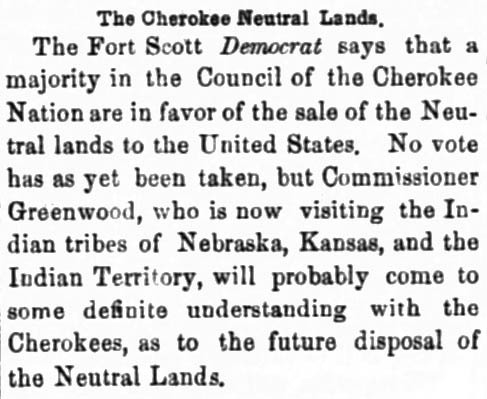
Newspaper article.
Concerning government aid extended to Kansas railroads, Poor’s Manual of Railroads for 1873 gave the following acreage of the land grants made to seven of the leading companies: Kansas Pacific, 6,000,000; Atchison, Topeka & Santa Fe Railroad, 3,000,000; Missouri River, Fort Scott & Gulf, 2,350,000; St. Joseph & Denver, 1,700,000; Missouri, Kansas & Texas Railroad, 1,520,000; Leavenworth, Lawrence & Galveston, 800,000; Union Pacific (Southern Branch), 500,000; Union Pacific (Central Branch), 245,166, making a total of 16,115,166 acres.
In addition to these grants, railroad companies purchased large tracts of land at low prices. In October 1867, the Cherokee Neutral Lands were sold to James F. Joy for $1.00 an acre. When the Atchison & Pike’s Peak railroad reached Waterville in January 1868, the company received a grant of 187,608 acres of land, along with bonds amounting to $16,000 per mile. The same company also purchased 24,000 acres of Kickapoo lands at $1.25 per acre. In May 1868, the Osage Indians sold 8,000,000 acres of their land to the Leavenworth, Lawrence & Galveston Company at $0.20 per acre. In August of the same year, the Atchison, Topeka & Santa Fe Railroad bought 338,766 acres of the Potawatomi lands.
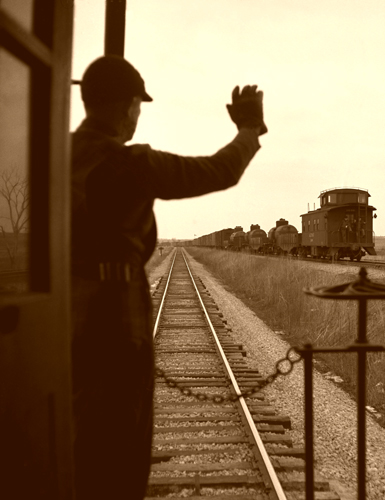
Atchison, Topeka, and Santa Fe Railroad between Marceline, Missouri, and Argentine, Kansas, by Jack Delano, 1843.
The Kansas Pacific received $6,303,000 in bonds from the national government, and the Central Branch received $1,600,000 in bonds. Immediately after the war, when railroad construction was advancing rapidly in the West, the Federal Government guaranteed bonds for railroad companies totaling $27,806,000, a large portion of which benefited Kansas lines. In addition to national assistance, counties, cities, townships, and towns voted to issue large-scale bonds to fund road construction.
Compiled and edited by Kathy Alexander/Legends of Kansas, updated March 2026.
Also See:
A Century of Railroad Building
Railroads & Depot Photo Gallery
About the Article: Most of this historic text was published in Kansas: A Cyclopedia of State History, Volume I; edited by Frank W. Blackmar, A.M. Ph. D.; Standard Publishing Company, Chicago, IL, 1912. However, the text on this page is not verbatim; it has been added to, updated, and edited.