
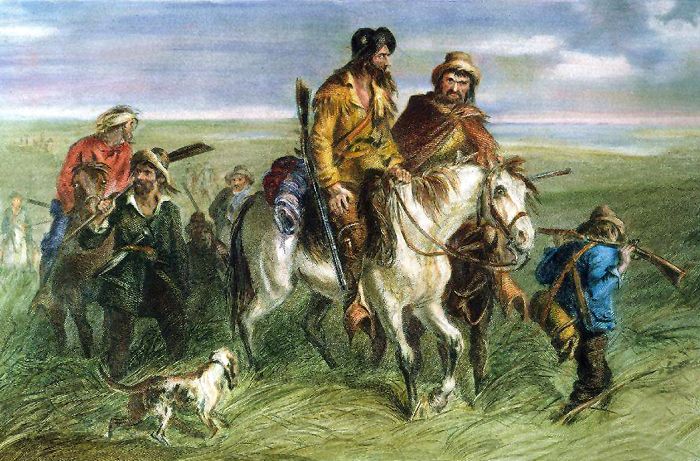
People Flooding Kansas after the passing of the Kansas-Nebraska Act
Only days after the Kansas-Nebraska Act was passed in 1854, pro-slavery and anti-slavery supporters rushed in to settle Kansas, with both sides hoping to affect the outcome of the first election. Because the act stated that the future status of slavery in the two territories was to be decided by popular vote, the two sides competed to win the region for their political beliefs. Nebraska was not affected like Kansas, as it was too far north to attract slave owners.
Even before the Kansas-Nebraska Act had been passed, Eli Thayer, a member of the Massachusetts House of Representatives, had organized the New England Emigrant Aid Company to promote the emigration of abolitionist New Englanders to Kansas. Numerous other societies were also formed after the act had passed, all with the same objective – to ensure that Kansas would become a Free-State. By the summer of 1855, more than 9,000 Free-State advocates had settled in Kansas.

Ho for the Kansas Plains
Not to be outdone, the Southerners fought just as hard to make Kansas a slave state. With Missouri right next door, numerous pro-slavery settlers flooded across the border, many of whom established Town Association Companies and formed some of the earliest cities, such as Leavenworth and Atchison. At risk in the South was their way of life and culture and, more importantly, their economy, which was largely based on the plantation system, which, of course, needed slaves to survive.
For seven years, pro-slavery and Free-State factions fought in Kansas as popular sovereignty degenerated into violence.
Several “Blue Lodges,” a secret pro-slavery organization, were formed in the South to promote the interests of the slave power. The society was known by different names, such as the “Friends Society,” the “Social Band,” “Dark Lantern Society,” and the “Sons of the South,” but, by whatever name it might be known, the object was always the same. Each member took a solemn oath, after which he was given the signs, handshakes, and passwords of the order. Severe penalties were provided for any violation of the oath or for divulging the organization’s secrets, and in a few instances, these penalties were executed upon offending members. The order was a branch of the famous Knights of the Golden Circle, the shared object being the same — the extension of slavery.
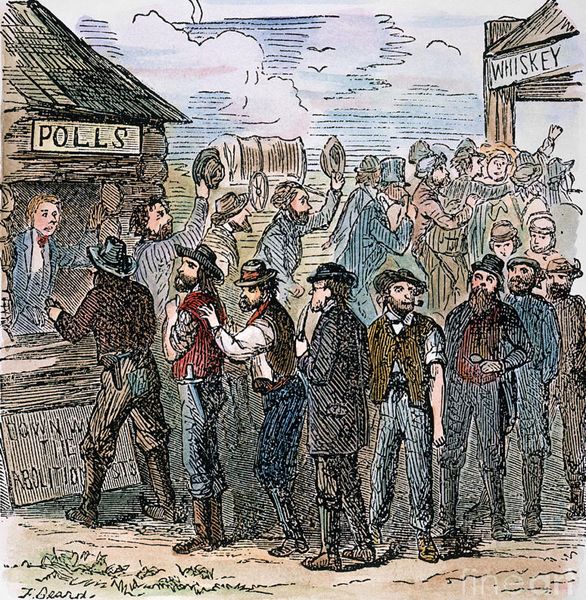
Kansas Voting
Competition between pro-slavery and anti-slavery factions reached a climax on May 30, 1855, when Kansas held territorial elections. Although only 1,500 men were registered to vote, 6,000 ballots were cast, many of them by pro-slavery “border ruffians” from Missouri. As a result, a pro-slavery legislature was elected, which passed laws stipulating that only pro-slavery men could hold office or serve on juries. One statute imposed five years imprisonment for anyone questioning the legality of slavery in Kansas.
The “Free-Staters” were incensed, but the U.S. Federal Government recognized the new territorial government, which the Free-Staters referred to as the “Bogus Legislature.” Free Soilers then held their own “Free State” convention in Topeka in the fall of 1855 and drew up a constitution that prohibited slavery in Kansas. They submitted the Topeka Constitution to the territory’s voters, who approved it by an overwhelming majority. The Topeka government then asked Congress to admit Kansas as a free state.
Kansas then had two legislatures — one pro-slavery, the other against. However, President Franklin Pierce threw his support behind the pro-slavery legislature and asked Congress to admit Kansas to the Union as a slave state. However, the president was denied.
Another group called the Law and Order League, also known as the Army of Law and Order, was formed in 1855. From the name of this organization, one would naturally suppose that it was formed to promote peace, prosperity, and good government among the Kansas people. But, such was not the case. It was an armed force, the strength of which has been variously estimated at from 500 to 1,100 men, organized by David R. Atchison and John H. Stringfellow, whose policy was banishment or extermination Free-State men in the territory.
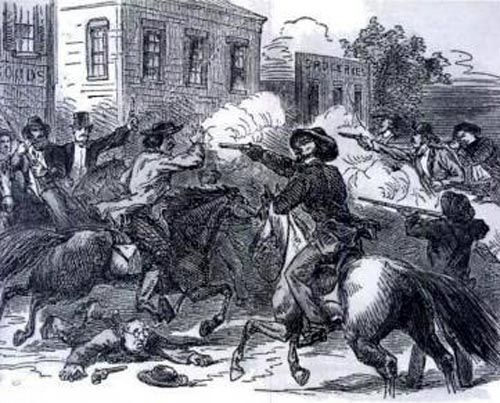
The Sacking of Lawrence, Kansas
Popular sovereignty degenerated into violence on May 21, 1856, when 800 pro-slavery men, many from Missouri, marched into Lawrence, Kansas, to arrest the leaders of the Free-State government.
The posse burned the local hotel, looted several houses, destroyed two anti-slavery printing presses, and killed one man.
A war of revenge erupted in Kansas, led primarily by abolitionist John Brown. In reprisal for the Sacking of Lawrence, Brown and six companions dragged five pro-slavery men and boys from their beds at Pottawatomie Creek, split open their skulls with a sword, and cut off their hands. More battles and skirmishes followed, including the Battles of Black Jack and Franklin in June, the Battles of Fort Saunders, Titus, and Osawatomie in August, and the Battle of Hickory Point in September 1856.
Both sides, with armed men, ransacked farms, stole horses and cattle, and attacked men of the opposing faction. Before it was over, guerilla warfare in eastern Kansas left 200 dead, leading to the nickname “Bleeding Kansas.”
In June 1856, the Law and Order League wrote an eight-page manuscript appealing to southerners to support the pro-slavery cause in Kansas Territory in emigration, financial donations, and moral support. Sending it to various newspapers and Southern organizations, the appeal was eight pages long. Listed here is only a part but provides a peek at the pro-slavery sentiments.
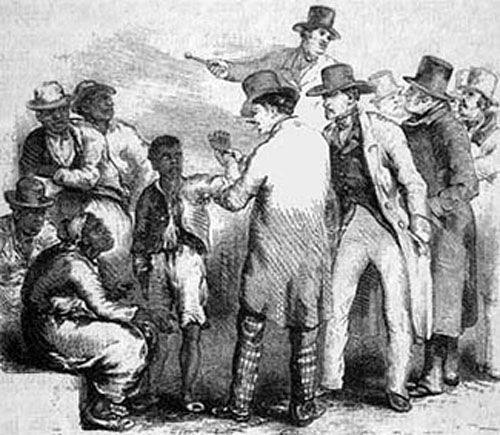
Several early organizations were dedicated to the promotion of slavery in the state of Kansas.
Appeal by the Law and Order Party of Kansas Territory to Their Friends in the South and to the law-abiding people of the Union.
The undersigned, at a recent meeting of the party, were constituted a committee, charged, among other things, with the publication of this address.
That a state of insurrection and civil war exists among us is abundantly evident: the “Law and Order Party” on the side, opposed on the other by the abolitionists, sent out and sustained by the Emigrant Aid Societies of the North. A brief review of the points at issue and their controlling circumstances may be useful to justify our appeal for aid.
In territorial politics, the question of free or slave state has swallowed up. The abolitionists, on the one hand, in accordance with their early teaching, regard slavery as the greatest possible evil; they deem it a monstrous national crime, which their false theories of government impute equally to every portion of the Confederacy, and thus believing themselves individually responsible for its existence, they feel bound each to struggle for its overthrow. To such extremes have wicked demagogues stimulated their fanaticism, that their perverted consciences justify any mode of warfare against slaveholders, however much in violation of the law, however destructive of property or human life, and however atrociously wicked it may seem to others; nay, many of them already go so far as to oppose all law, religion, property, order, and subordination among men, as subversive of that they are pleased to call man’s natural and inherent equality. And with them, it is no mere local question of whether slavery shall exist in Kansas or not, but one of far wider significance, a question of whether it shall exist anywhere in the Union.
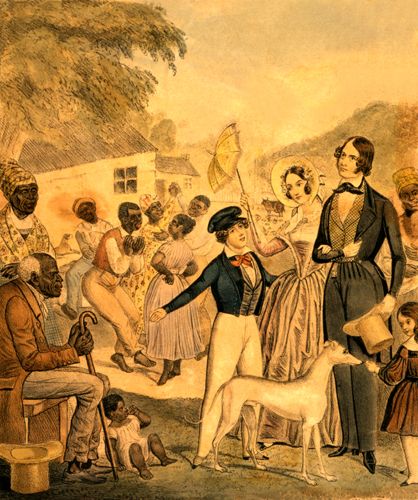
American Slavery, Edward Williams Clay, 1841
Kansas, they justly regard as the mere outpost in the war now being waged between the antagonistic civilizations of the North and the South; and winning this great outpost and stand-point, they rightly think their march will be open to an easy conquest of the whole field.
On the other hand, the pro-slavery element of the “Law and Order Party” in Kansas, looking to the Bible, find slavery ordained of God; they find there, as, by our law, slavery made “an inheritance to them and their children forever.” Looking to our national census, and to all statistics connected with the African race, and considering, too, their physical, intellectual, and moral natures, we see that slaver is the African’s normal and proper state; since, in that state, that race multiples faster, has more physical comfort, less vice, and more moral and intellectual progress than in any other.
There are radical and marked differences in the theory between the two parties, and not less so their difference in practice. While we, in good faith, sustain and uphold the laws, the abolitionists, on the other hand, in effect, repudiate and set them at defiance; with open disloyalty, they assert the invalidity of the territorial laws, while they render our national insignia only the mockery of hollow respect; indeed, more than once, they have openly resisted the marshal in the service of process, and, in some places, their organized armed resistance to the territorial laws is so overwhelming that ministers of the law there never attempt the discharge of their official duties; they have repudiated payment of taxes, and have held and published the proceedings of large public meetings in which they have resolved to resist, even to blood, the territorial laws.
They have secret military organizations for resisting the laws and for carrying out their abolition designs upon Kansas — organizations in which the members are bound by the most solemn oaths to obey their leaders, in all cases, not excepting even murder and treason.
It is widely reported and generally believed that the northern abolitionists are now raising large bodies of armed men, under military organization and discipline, to be surreptitiously introduced into the territory for the objects of driving out the peaceable inhabitants, setting the laws at defiance, and overwhelming the Law and Order Party at the decisive election for a Territorial Legislature in October.
We must have your help. Appoint agents, responsible, trusty, reliable men for every state, district, and neighborhood, whose whole business shall be to canvass for aid. Friends of the cause must contribute according to their several gifts — we must not meanly abandon our birthright, and without a struggle, yield to grasping monopoly this fairest Eden of our common domain — this land of flowing brook and fertile lain. Kansas is indeed the garden spot of America and in every way adapted to Southern institutions; in no other part of the Union is slave labor more productive; and, in the present imperiled state of our civilization, if we do not maintain this outpost, we cannot long defend the citadel. Then rally to the rescue.
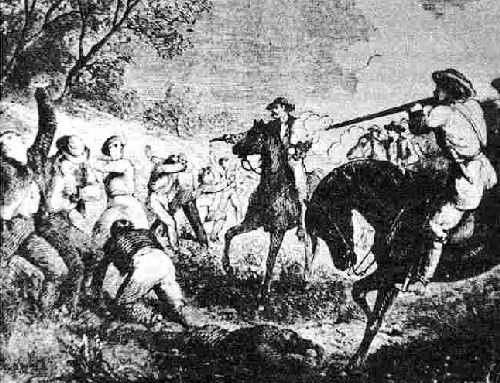
Bleeding Kansas Fight
As a result of the internal strife in Kansas, Congress refused to adopt either party’s constitution, and Kansas would not be allowed to become a state for several years.
When the new territorial governor, John Geary, finally arrived in Kansas, he ordered on September 12, 1856, that all state militias be disbanded. As part of the state militia, the Army reorganized.
The battles between the opposing parties continued until a referendum was finally authorized by the English Bill of 1858, which dashed all pro-slavery hopes of Kansas Territory becoming part of the “South.” However, continued struggles would delay the admission of Kansas as a free state until January 1861. In the meantime, the bitterness between the factions continued on into the Civil War.
© Kathy Alexander/Legends of America, updated June 2022.
Also See:
Kansas Jayhawkers – Terror in the Civil War