|
Legends of Kansas
What's New!!
Also see:
Legends of America


Rocky Mountain General
Store
The
Book Shelf
Exclusive
Products
Postcard
Rack
Route 66 Emporium
Vintage Photographs

12343 W. 79th Terrace
Lenexa,
KS 66215
913-708-5119
Please report
broken links, missing pictures, or other problems online by clicking
HERE
or send us an
email.
Thanks!
| |
|
|
|
Price's Raid and the Battles of Linn County |
|

|
|
During
the early years of the
Civil War
guerrilla raids into Kansas were
frequent, but the event which caused the greatest excitement in the state was
the Price Raid of 1864.
In
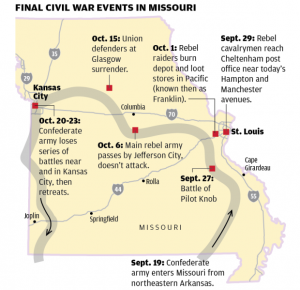
September, 1864, Confederate General Sterling Price, with an army of from 5,000
to 10,000 men, started from
Arkansas to
march through
Missouri and
into Kansas. In
Missouri he
formed a junction with the commands of Generals Marmaduke and Shelby, and there
were other additions to his force until it numbered 15,000 men or more. General
W.S. Rosecrans was in command of the Union troops at
St. Louis, and
General Ewing was in command of the southeast district of
Missouri. The
latter engaged Marmaduke at Pilot Knob on September 26th. His command numbered
about 1,000 men, with 13 pieces of artillery, and Marmaduke's strength was at
least three times as great. |

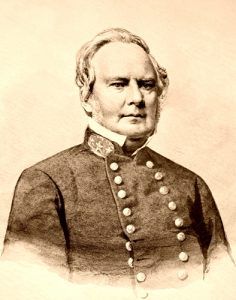
General Sterling Price
This image available for photographic prints
and downloads
HERE! |
|
|
During the night, Ewing managed to
extricate himself from a perilous position and fell back to Harrison,
where he was surrounded the next day and retreated to
Rolla.
It began to look as if Price would sweep
everything before him. General Samuel R. Curtis, commanding
the Department of
Kansas,
which included the states of
Kansas,
Nebraska
and
Colorado,
had less than 5,000 men, and they were scattered over the
entire district guarding frontier settlements and the overland
mail routes. When news of the threatened invasion reached
Kansas,
Curtis was in
Nebraska,
General Blunt was west of
Fort Larned,
and General Sykes was in command of the District of Southern
Kansas
with headquarters at
Lawrence.
Curtis hurried to
Fort
Leavenworth, recalled Blunt from the west, and began
preparations for the defense of the
Kansas
border. On September 24th he notified Governor Carney of
Price's advance and requested him to call out the militia. A
telegraph from General Rosecrans on October 2nd advised Curtis
that Price's army was at Washington,
Missouri, 70
miles west of
St. Louis,
and rapidly moving westward. On the 8th, the governor issued
his proclamation calling out the militia and the next day
Curtis issued an order calling all troops in the department to
the border to resist Price's advance. General Blunt arrived
that day at Olathe and relieved General Sykes. By the 11th,
pursuant to orders issued by General George W. Deitzler,
commanding the militia, some 12,600 of the state troops were
assembled at Atchison, Olathe, Paola, Mound City,
Fort Scott
and Wyandotte, more than one-half of them being mobilized at
Olathe.
In the meantime General Alfred Pleasonton had taken command at
Jefferson City on the 8th and had sent General John B. Sanborn with
4,100 mounted men to follow Price. On the 14th Blunt moved to
Hickman's Mills,
Missouri,
with three brigades commanded by Colonels
Jennison, Moonlight and Blair. Price was now between two armies.
In the rear were Rosecrans and Pleasonton in close pursuit, while in
front were Curtis' army and the Kansas Militia waiting to give him a
warm reception. General Blunt moved to Lexington, where he engaged
Price's advance guard on the 19th and fell back to Independence,
Moonlight's brigade being forced back to the Little Blue River. Here,
Blunt's whole force was engaged on the 20th against ten times its
number and fell back in good order to the Big Blue, where another
engagement was fought on the 22nd, resulting in a decisive Union
victory. Pleasonton and Sanborn joined Blunt that night and occupied
Independence, Price's army resting near Westport.
|
|
|
The citizens of
Kansas
had responded nobly to Governor Carney's call, and on October 23rd
some 20,000 of them were under arms. That day was fought the Battle of
Westport, which ended in a complete defeat of the Confederates. On the
24th, Price crossed the state line into
Kansas
and that night encamped near Trading Post,
Linn County, on the Marais des Cygnes, where his men committed a
number of outrages, murdering old and unarmed men, robbing women and
children of their food, and wantonly destroying property. Early on the
morning of the 25th, the enemy was driven from his camp at Trading
Post and across the ford, leaving behind the sick and wounded.
Price, Fagan and Marmaduke, with some 15,000 men, formed a line of battle on the
north bank of Mine Creek soon after evacuating Trading Post, and Curtis was
reinforced by Colonels Crawford and Blair. In the engagement that followed the
Confederates were again ingloriously defeated, Generals Marmaduke, Cabell,
Graham and Slemmon, with about 800 men and 9 pieces of artillery, being
captured.
This practically ended the raid. Price was
vigorously pursued and another victory was won at the crossing of the
Osage River on the 25th. Three days later occurred the Battle of
Newtonia, after which Price retreated precipitately beyond the
Arkansas River. Governor Carney issued orders on the 27th for the
militia to return to their homes, but the volunteer troops followed
Price to the Arkansas River, where the pursuit ended. Claims
aggregating several hundred thousand dollars were filed for services
rendered and losses sustained during the Price Raid, and some of these
claims were still unsettled in 1911.
Linn County Civil War Battles
|

Marais des Cygnes Massacre in May, 1858 |
Battle of
Trading Post/Marais des Cygnes (October 25, 1864) -
Also known as the Battle of
Osage and the Battle of Trading Post, this skirmish took place on October 25,
1864 in
Linn County,
Kansas during Price's Raid in the American
Civil War.
When Major General Sterling Price was leading an expedition into
Missouri,
he encountered Union troops under Major General Samuel R. Curtis and Major
General Alfred Pleasonton around Kansas City,
Missouri.
Price withdrew south into Kansas
and Pleasonton, commanding in the field, engaged the rebel troops at the Marais
des Cygnes River in
Linn County.
|
|
After an artillery bombardment that began around 4:00 am, Pleasonton’s men
attacked furiously. Although outnumbered, they hit the Rebel line, forcing them
to withdraw. Casualties for this skirmish are unknown. The Union troops would
once again pursue the southerners some six miles south and engage in a larger
battle later in the day at Mine Creek.
The Battle of
Mine Creek (October 25, 1864) - Also known as the Battle of the Osage,
the Battle of Mine Creek was one of the largest cavalry engagements of the
Civil War. In
the fall of 1864 General Sterling Price led some 8,000 troops in a raid through
Kansas. Arriving in the free state on October 24th, the
Confederate forces camped on the Marais des Cygnes River where early the next
morning they found themselves in a battle with Union Forces and withdrew six
miles to the south. However, they were followed by the federal brigades under
the command of
Colonel Frederick W.
Benteen and Colonel John F. Phillips, of Major General Alfred Pleasonton’s
Provisional Cavalry Division. The Union troops overtook
the rebels as they were crossing Mine Creek where they were slowed by their
wagons crossing the ford.
|
|
Though the Confederates
quickly formed a line on the north side of Mine Creek, the Union troops,
numbering about 2,500 commenced an attack on the far larger rebel army.
The speed of the attack did not allow time for the cavalrymen to dismount,
making the battle one of the largest mounted cavalry fights of the war. The
southerners, overwhelmed by the rapid attack, were soon surrounded. Though the
battle lasted only about 30 minutes, when it was over the Union troops captured
about
600 men and two generals –
Brigadier General John S. Marmaduke and Brigadier General William L. Cabell. The
Confederates, having some 1,200 casualties, retreated with their remaining men
back into
Missouri.
The Union casualties were about 100.
|

The Battle of Mine Creek by Samuel Reader,
1865.
|
|
Compiled by
Kathy Weiser/Legends
of Kansas, updated April, 2010.
About the Article: Much of this historic text
was first published in Kansas: A Cyclopedia of State History,
Volume I; edited by Frank W. Blackmar, A.M. Ph. D.; Standard Publishing
Company, Chicago, IL 1912. However, the text that appears on this page is not
verbatim, as additions, updates, and editing have occurred. |
|
|
|
From the Rocky Mountain General Store
Kansas
Postcards -
If you're like we are and can't get enough of
Kansas, take a virtual tour through our many
Kansas Postcards. Each one of these is unique and, in many cases, we
have only one available, so don't wait. To see them all, click
HERE!
 |
| |
|