|
Legends of Kansas
What's New!!
Also see:
Legends of America


Rocky Mountain General
Store
The
Book Shelf
Exclusive
Products
Postcard
Rack
Route 66 Emporium
Vintage Photographs

12343 W. 79th Terrace
Lenexa,
KS 66215
913-708-5119
Please report
broken links, missing pictures, or other problems online by clicking
HERE
or send us an
email.
Thanks!
| |
|
|
|
|
|
Arikaree River - A tributary of the North
Fork of the Republican River, it flows east out of Yuma County,
Colorado
through the extreme northwestern corner of Kansas through Cheyenne County for about 10 miles, before making its way through
the southwestern portion of
Nebraska to its mouth near the town of Haigler,
Nebraska where it joins the North Fork of the
Republican River. It is named for
the
Arikara
Indian tribe. The
Battle
of Beecher's Island, sometimes called the Battle of Arickaree, was fought
on a small island in the middle of the Arickaree River in what is now
the state of
Colorado , near the west line of Cheyenne County, Kansas. This
action terminated the Indian wars on the plains.
Arkansas River -
See full article
HERE.
Beaver Creek - There are
actually four streams in Kansas that bear this name. The first flows in a
southeasterly direction through Clark County and empties into the
Arkansas River; the second rises in the northern part of Barton County and flows north to
the
Smoky Hill River ; the third flows south across the western part of Smith
County and empties into the Solomon River near the town of Gaylord; and the
fourth and largest is composed of two forks, one of which rises in Sherman and
the other in Cheyenne County. They unite near the town of Atwood, Kansas, from
which point the main stream follows a northeasterly course and empties into the
Republican River at Orleans,
Nebraska. This last named Beaver creek was so named
by James R. Mead's exploring party in 1859 on account of the large number of
beaver dams along its course.
During the
Indian troubles in the summer of 1867, the
Eighteenth Kansas Volunteer Cavalry left
Fort Hays on August 20th for the
headwaters of the Solomon and
Republican Rivers . On the evening of the 21st
Captain George B. Jenness
of Company C was sent out with a detachment to ascertain the cause of a light
seen at some distance across the prairie. He found the remains of an old
Indian
campfire, but when he attempted to return to his regiment, he became confused in
the darkness, and finally decided to camp on the open prairie. Early the
next morning he reached the river, about eight miles below the camp.
|
|
|
Upon reaching the river he pushed on toward the troops, but
after going about three miles his detachment was attacked by a large body
of
Indians . Forming a hollow square, he managed to hold the
Indians at
bay. His men were armed with Spencer repeating carbines and each man
carried 200 rounds of ammunition, so they were well equipped for a heroic
defense. After a short skirmish Captain Jenness again began to move
up the river toward the camp, but after going about
½
mile, saw more
Indians . He then returned to the river and
threw up a breastwork of driftwood and loose stones, behind which his
little band fought valiantly for three hours. All the horses except four
were either killed or wounded; two of the men were killed and 12 seriously
wounded. The detachment withdrew to a ravine, where they found water and
remained under cover of the willows and banks of the ravine until dark.
The
Indians then drew off and Jenness and his men, under the guidance of a
scout, followed a buffalo path for 5 miles until they came to the river.
The
Indians renewed the attack the next morning, but the main command came
to Jenness' rescue. This affair is known as the Battle of Beaver Creek.
The event was said to have occurred on Prairie Dog Creek in the
northwestern part of Phillips County.
|
|
Big Blue
River - The largest tributary of the Kansas River,
the waterway flows for approximately 250 miles from central
Nebraska into Kansas , where it intersects with the Kansas River
east of Manhattan. One of the principal water-courses of
northeastern Kansas , is composed of two branches. The north fork rises in
Hamilton County,
Nebraska and the south fork in Adams County,
Nebraska .
They unite near the town of Crete, from which the main stream follows a
southerly course, flowing through the western part of Marshall County, Kansas , forming the boundary between the counties of Riley and
Pottawatomie, and emptying its waters into the
Republican River at
Manhattan. It was given its name by the Kanza
Indian
tribe, who camped at its mouth from 1780 to 1830.
|

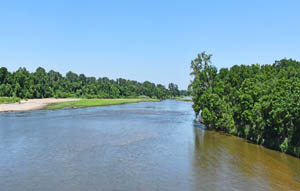
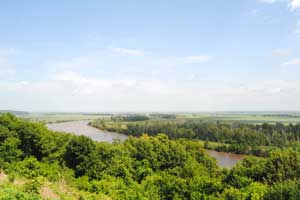
Big Blue River above Manhattan,
Kansas,
photo courtesy
Wikipedia.com |
|
As it makes its
way through
Nebraska and Kansas
, it passes through mostly agricultural
land and shortly before intersecting with the Kansas River,
the Big Blue discharges its waters into a reservoir called Tuttle Creek
Lake, near Manhattan. The land surrounding the reservoir is a state park
area.
Black Vermillion River - A stream of
northeastern
Kansas, it was in the past, also called the Black River.
Consisting of two forks, the north fork rises in northeast Marshall County
and flows south; the south fork rises in the southern part of Nemaha
County and flows northwest, the two forming a junction near the little
village of Vliets. From this point the main stream follows a southwesterly
course until it empties into the Big Blue River near the southern boundary
of Marshall County.
Chikaskia River
-
Usually pronounced chi-KAS-kee-uh but often pronounced chi-KAS-kee, the
river is a tributary of the Arkansas River
system. It is formed by the union of Sand Creek and another small stream
in the southern part of Kingman County. Its general course is southeast,
across the southeast corner of Harper County and through Sumner County,
crossing the southern boundary of the state near the town of Hunnewell,
and finally emptying into the Salt Fork of the
Arkansas River near the
town of Tonkawa,
Oklahoma
. It is about 145 miles long and is known for its
large catfish.
Cimarron River - See full article HERE.
Continued Next Page
|
|
|
<< Previous 1 2
3 4
5 6
Next >> |
|
From the Rocky Mountain General Store
Custom
Greeting Cards - Combining
our great
vintage
photographs with
words,
wisdom
and
proverbs
of the
Old West,
these photo
cards are unique to the
Rocky Mountain General Store.
|
| |
|