
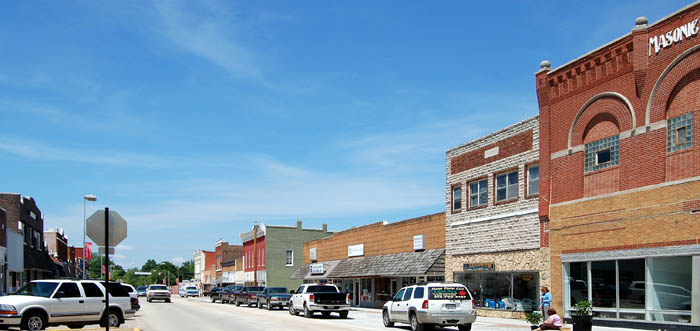
Osawatomie, Kansas Main Street by Kathy Alexander.
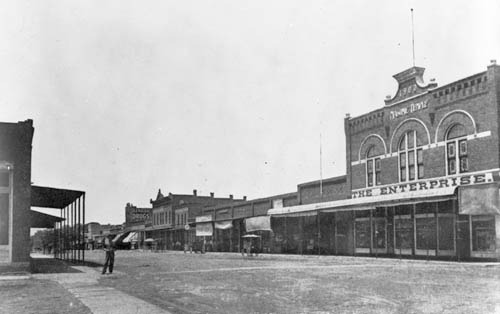
Early day, Osawatomie, Kansas.
Osawatomie, Kansas, located in southwest Miami County on the Marais des Cygnes River, sits amid numerous trees and rolling hills.
The town was established by agents of the Emigrant Aid Society as Kansas was seeking statehood. It was surveyed in February 1855, and the name was formed by combining Osa of the Osage Indians with “watomi” of the Potawatomi tribe
The first building was erected by Samuel Geer, who used it as both a dwelling and a boarding house. The Emigrant Aid Company established a sawmill about ½ mile below the townsite on the south bank of the Marais des Cygnes River, from which much of the lumber came for more new buildings.
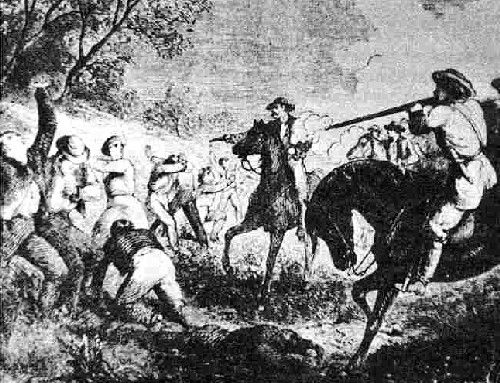
Bleeding Kansas Fight.
These were soon followed by a blacksmith named Mr. Holdridge, and Dr. Darr opened a drug store. Samuel Geer opened the first store and hotel in 1855 and was appointed the first Postmaster in December when a post office was established in the store.
The first church organized was the Congregational, in April 1856, by Reverend Samuel L. Adair, John Brown’s brother-in-law, but it would be several years before a church was built. A Methodist Church congregation would also be established that year, meeting in private homes.
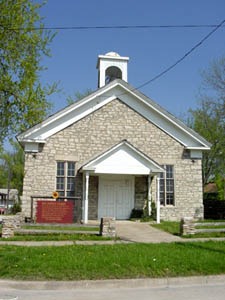
Old stone church in Osawatomie by Kathy Alexander.
The settlement, established during the years of the Kansas-Missouri Border War, quickly became a target of the pro-slavery faction. The first attack was made on the town on June 7, 1856, when a party of about 150 Missourians, under the command of John W. Whitfield, learned that most of the men of the Free-State forces were occupied elsewhere and converged on the settlement. No resistance was made, and no significant damage was done beyond plundering some houses and running off horses. At this time, the village consisted of about 30 buildings, and the population was about 200. But this was to be just the first attack.
On August 30, 1856, Frederick Brown, son of abolitionist John Brown, left Osawatomie before sunrise to travel to Lawrence. On his way, he was killed by men of the pro-slavery faction. Messengers were dispatched to notify the people in the village, including Captain John Brown, who quickly made plans to defend the settlement. With 41 men, John Brown took a position in the timber on the south side of the Marais des Cygnes River. As the Missourians passed by the settlement, the Free-State men fired upon them. Armed with a cannon, the pro-slavery men returned the fire, and Brown’s men were forced to retreat. The Missourians then entered the town and commenced to pillage and burn it. They first fired at the blockhouse, in which several men were stationed, and only four houses escaped being destroyed. When the ruffians left, they had two wagons filled with their wounded and ten loaded with the plunder taken from the citizens’ homes.
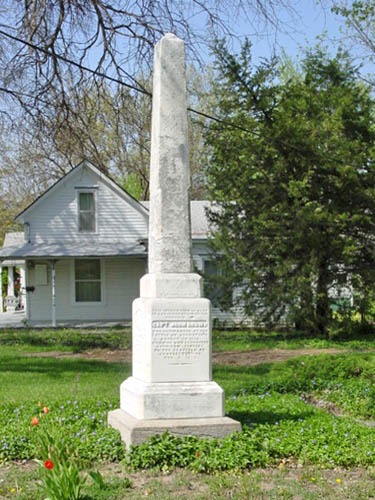
Osawatomie Soldiers Memorial.
The Free-State men lost about six men killed or captured, and several more were seriously wounded. It is supposed that the Missourians suffered about the same number of dead and wounded, although it was never known.
Notwithstanding these battles and the general troubles of the times, Osawatomie grew and prospered, and in 1857 it had about 800 people. The first school was taught in the winter of 1857-58 by Mr. Squires in a frame schoolhouse. The Congregational Church also met in the school building. The community’s first newspaper, The Southern Kansas Herald, was established in 1857.
Having lost his original hotel in the Battle of Osawatomie, Samuel Geer built a more prominent two-story frame hotel in 1858. Here, Horace Greeley, Republican Party founder and New York Times editor, made a speech to an assembly of about 5,000 people at the first convention of the Kansas Republican Party in the spring of 1859.
In 1860, the town’s only newspaper, the Southern Kansas Herald, was sold and moved to Paola. It would be several years before another was established in the community. In 1861, the Reverend Samuel L. Adair built a new stone Congregational Church.
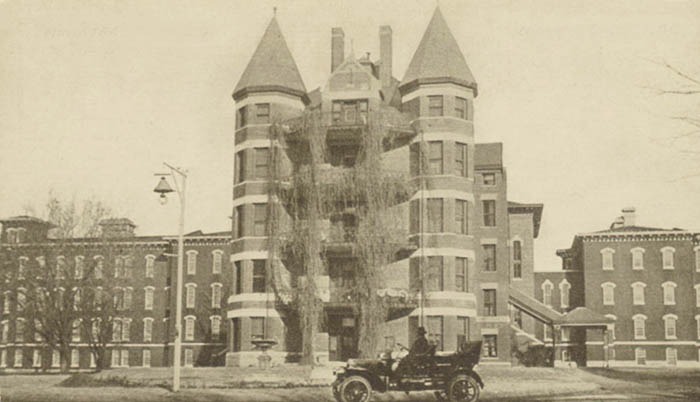
Kansas Insane Asylum in Osawatomie, Kansas.
In 1866, the first state hospital for the insane was established about a mile northeast of Osawatomie. It would eventually become one of the largest institutions in the state. Though no longer called the “Kansas Insane Asylum,” the psychiatric hospital still exists and, since 1901, has been called the “Osawatomie State Hospital.”
Before the Civil War, the mentally ill were placed in poor houses, workhouses, or prisons when their families couldn’t care for them. However, by the 1860s, Americans wanted better assistance for the less fortunate, including the mentally ill. Between 1825 and 1865, the number of insane asylums in the United States increased from nine to 62. “The Lodge,” as familiarly called in the beginning, was simply a farmhouse that admitted its first patient on November 5, 1866. It soon grew to an average patient population of 13.
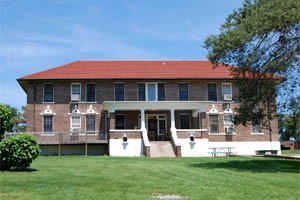
Osawatomie State Hospital Building today by Kathy Alexander.
The two wards, which could accommodate 12 patients each, plus the employees who cared for them, were filled in no time. Two years later, construction of the Main Building began. When it was completed in 1886, the large brick structure ranged from two to five stories and contained two wings where patients lived. In the center were the administrative offices, pharmacy, dental clinic, canteen, and patients’ library. Afterward, the “Lodge” was used first as an isolation building for patients with smallpox and then as a farm building before it was torn down.
Additional buildings were added over the years. By the turn of the century, it included employee dormitories, shops, an electric power plant, an ice house, a bakery, laundry, barns, greenhouses, and a reservoir. In 1912, it could serve more than 1,000 patients. By the mid-20th century, newspapers began to run reports on the deplorable conditions of state-run hospitals, including neglect, brutality, overcrowded facilities, and restraints. Soon, the Governor and the legislature acted, and reform began, including new facilities and staff training programs.
A “rehabilitation center” with a swimming pool, a well-equipped auditorium, and a modern gymnasium was completed in 1963. Sadly, the main building was razed in 2002, but several other historic buildings remain. On the outskirts of the property sits a sad little cemetery, where no names are contained on the tombstones — only numbers. The hospital is much smaller today, serving only 176 patients. We have read reports that the grounds are allegedly haunted and were not surprised. However, we could find no detailed reports of activity.
Railroads arrived in the early 1870s, when the town prospered as a shipping point for the rich agricultural country surrounding it. The town gained another newspaper, The Osawatomie Times, in 1881, but it was only published for a year. That same year, the Methodist Church congregation built the community’s second church. By the early 1880s, the town had a stone schoolhouse, two general stores, two grocery stores, two hardware stores, a drug store, a furniture store, a lumberyard, two hotels, three blacksmith shops, a wagon shop, and about 600 inhabitants.
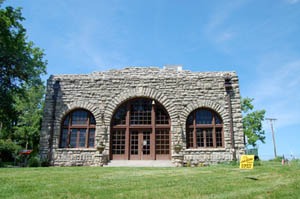
John Brown Museum in Osawatomie, Kansas, by Kathy Alexander.
By the early 1900s, the town had gained newspapers, including the Graphic and Globe, both weeklies. A larger school building was constructed in 1906. By 1910, the town boasted more than 4,000 people.
Over the next century, though Osawatomie moved into the future, it always maintained its small-town atmosphere and agricultural economic base and held tightly to its rich history. Today, this community of about 4,600 people provides several historic sites for visitors.
Commemorating the Kansas-Missouri Border War and John Brown is the 1877 Soldiers Monument, erected to honor the five men killed in the Battle of Osawatomie, located at 9th & Main Street.
At the John Brown Memorial Park and State Historic Site, on the land where the Battle of Osawatomie took place, is the old Adair Cabin, now a museum. The site is located at 10th and Main Street.
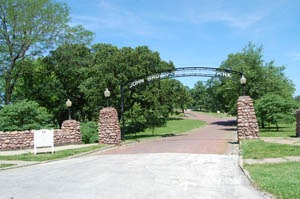
John Brown Memorial Park, Osawatomie, Kansas, by Kathy Alexander.
The History Museum at 628 Main Street commemorates Osawatomie’s history as a railroad center. On a driving tour of the city, several other historic buildings and bridges can be seen throughout.
More Information:
City of Osawatomie
439 Main Street
Osawatomie, Kansas 66064
913-755-2146
©Kathy Alexander/Legends of Kansas, updated February 2026.
Also See:
John Brown – Crusading Against Slavery
See Sources.