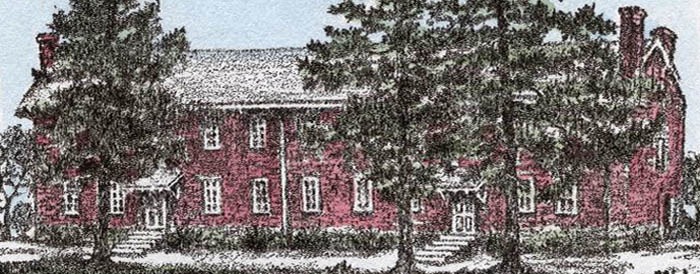
Shawnee Mission in Fairway, Kansas.
Soon after the first settlements in North America were established, missionaries began visiting Native Americans to instruct them in Christianity and persuade them to adopt the customs of civilization. The Catholic Church was especially active in this work. Early in the 17th century, Jesuit missionaries crossed the ocean and began establishing missions. While the Jesuit father was somewhat of a fanatic in his religious views, he was generally courageous, deeply devoted to his calling, and loyal to his king. As white settlements grew in number and strength, Protestant denominations also became interested in the welfare of Native Americans and sent missionaries among them.
Noble L. Prentis, in his 1899 book, A History of Kansas, said: “The missionaries were heroic pioneers of Kansas. They invented phonetic alphabets; they created written languages, wrote dictionaries and songbooks, and gave the Indians the Bible and the Christian religion.”
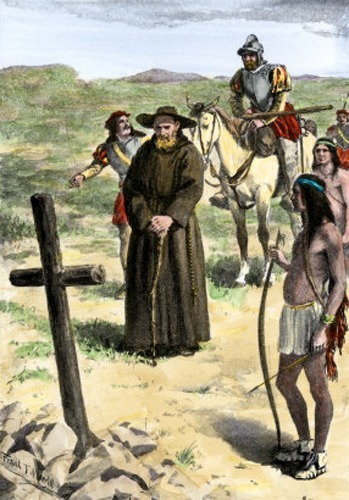
Francisco Juan De Padilla.
They went into the rude lodges and wigwams and cared for the sick and dying. They suffered from poverty and often from savage cruelty; they sacrificed home and friends, and many died alone on the prairie that the Indians might know the better way and the higher life.”
The first missionary to the Indians in Kansas was Father Juan de Padilla, who accompanied Francisco Vasquez de Coronado to Quivira in 1540-41. A year later, he returned to that province as a missionary and died among the Indians. However, it was not until the early 19th century that any organized movement to establish missions among the western tribes was undertaken. In 1820, Bishop Dubourg of Louisiana sent Father Charles de la Croix as a missionary to the Osage Indians in Missouri, which formed the northern part of the diocese. The first baptism of Kansas Indians was probably at the Harmony Mission, just across the state line from the present city of Fort Scott, where Father La Croix baptized several natives in the fall of 1820. He visited the Osage in the Neosho Valley two years later, where he baptized two children—James and Francis Chouteau. The Harmony Mission was founded by the Presbyterians, among the first Protestant denominations to establish missions among the Indians. In June 1824, Father La Croix was succeeded by Father Van Quickenborn, who visited the Neosho Valley in 1827, a year before his death.
Hopefield Mission was established among the Osage in 1823 by the American Board of Commissioners for Foreign Missions of the Presbyterian Church. It was first located on the Neosho River in Indian Territory, but was relocated twice, the second time near White Hair’s village in Labette County, Kansas. It was discontinued in 1837. Two other Presbyterian missions were located among the Osage in 1824. One of these was the Boudinot Mission, which was situated on the Neosho River near the mouth of Four-mile Creek, and the other was on the West side of the Neosho River, with the Reverend Benton Pixley in charge. Both these missions were abandoned in 1837.
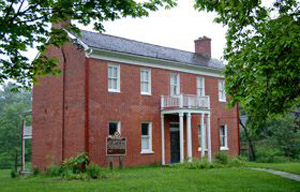
The Shawnee Methodist Mission still stands in Fairway, Kansas, by Kathy Alexander.
In 1829, the Methodist Church took the necessary steps to establish a mission among the Shawnee Indians, and the Missouri Conference selected Reverend Thomas Johnson to lead it. The mission was located in Johnson County, Kansas, about three miles from Westport, Missouri, and a mile from the state line. A year or two later, William Johnson, Thomas’ brother, was appointed a missionary to the Kanza Indians and traveled to their villages about 10 miles West of Topeka. He remained until the fall of 1832, when he went to the Delaware Mission.
In 1835, when the government established farms for the Kanza Indians, he returned to his mission work with that tribe. He died in 1842 and was succeeded by Reverend J.T. Peery in 1844.
In 1839, a manual-labor school was established at the Shawnee Mission. It was located a short distance Southwest of the original mission and was attended by children of other tribes. In the first year, enrollment was 72, including 27 Shawnee, 16 Delaware, 8 Peoria, 7 Potawatomi, 6 Kanza, 3 Kickapoo, and 1 each of the Munsee, Osage, and Gros Ventre. Attendance in 1851 exceeded 100 and included several Wyandot, Omaha, and Ottawa students. The building also served as a temporary capital of the Kansas Bogus Legislature for a brief time. It is a Kansas State Historic Site with three historic buildings, period rooms, and exhibits in Fairway, Kansas.
The Methodist Mission among the Delaware tribe was located in western Wyandotte County, near the now-extinct village of Maywood. It was founded in 1832 by William Johnson and Thomas B. Markham and successfully operated for several years. Another Methodist mission was established among the Kickapoo by Reverend Jerome C. Berryman in the fall of 1833 in northeastern Leavenworth County. The following year, the Catholics established a manual-labor school there. However, the Kickapoo did not take kindly to the idea of working, and the school was effectively abandoned; one of the buildings was subsequently used as the Pioneer’s publication office in Kickapoo City.
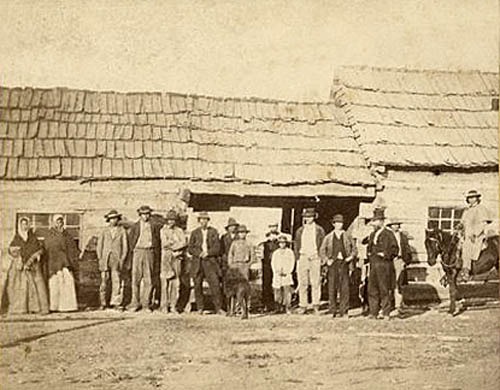
Potawatomi Mission at St. Mary’s, Kansas by Alexander Gardner, 1867.
A Baptist Shawnee Mission was established in 1831, about two miles northwest of the Methodist Mission mentioned above, and the Friends had a mission about three miles West, established in 1834. Reverend Isaac McCoy founded the Baptist Mission, and Dr. Johnston Lykins and his wife were appointed to oversee it. In April 1832, the Baptist Board of Missions appropriated funds for buildings, and in 1833, Dr. Lykins and his wife were joined by Jotham Meeker and Robert Simerwell. The mission was abandoned in 1855 or 1856. Henry Harvey was the leading worker at the Friends Mission. This denomination never undertook to print books in Indian dialects, as some others did, but sought to teach Indian youth to speak and write English. The Friends became engaged in missionary work about the beginning of the 19th century, and no sect was more earnest in trying to elevate the natives.
The Catholics, however, founded a mission among the Kickapoo in 1836, with Reverend Christian Hoecken and Felix Verreydt in charge. Two years later, these two zealous workers went to the Potawatomi mission on Sugar Creek, not far from Centerville, Linn County, where they remained until the Potawatomi were removed to their new reservation on the Kansas River. This removal was effected under the 1846 treaty. A new mission was established where the town of St. Mary’s now stands, and the mission school developed into St. Mary’s College. In September 1848, Father Maurice Gailland succeeded Father Hoecken and remained in charge of the institution until he died in 1877.
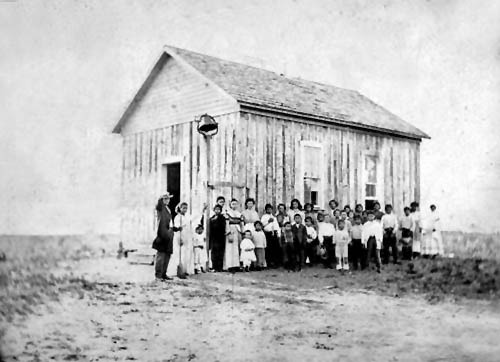
Baptist Mission at Ottawa, Kansas.
Three Protestant missions were started in 1837. The Methodists established one among the Potawatomi where Osawatomie now stands; the Baptists opened one on the Marais des Cygnes River near the present city of Ottawa, and Reverends S.M. Irvin and William Hamilton started a Presbyterian mission among the Ioway and Sac and Fox not far from the present town of Highland in J.B., on the emigrant road from St. Joseph, Missouri, westward. This mission remains a museum.
The Methodist mission was discontinued when the Potawatomi were removed to their new reservation. Under the management of Reverend Jotham Meeker, the Baptist Mission continued until his death on January 11, 1854. The Presbyterian Mission remained in successful operation for several years. A 115-acre tract of land was obtained, a mission house was erected for $8,000, and in 1846, a school was opened. Of the three missions, only the Presbyterian mission among the Ioway and the Sac and Fox continues to stand as a Kansas State Historical Site about three miles East of Highland, Kansas.
A Baptist mission was opened among the Wea Indians in 1840 by Dr. David Lykins. It was located approximately one mile East of Paola and remained a valuable and successful institution for many years. From this time until 1847, there is no record of the establishment of new missions in Kansas. In 1847, there was a revival of mission work. A Baptist mission was opened in Miami about ten miles Southeast of the present city of Paola, near the site of the old Miami village on the Marais des Cygnes River. The same year, the Catholics established a mission among the Osage. This mission, founded by Reverend John Schoenmaker, was located just East of the Neosho River, where La Croix and Van Quickenborn had engaged in missionary work approximately 20 to 25 years earlier. A school was established, and the place was known as “Osage Mission” for almost 50 years, until it was renamed St. Paul by legislative act on April 12, 1895.
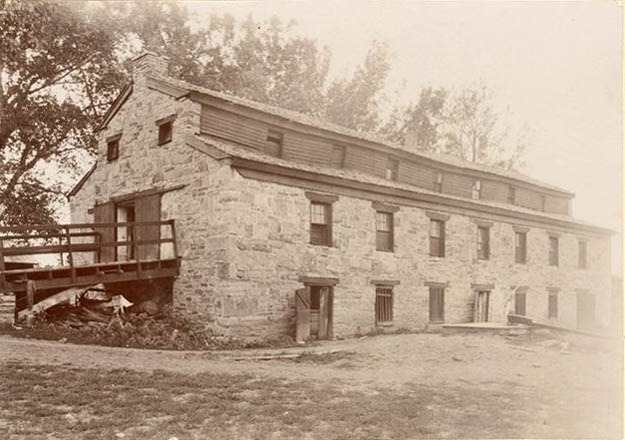
Pottawatomi Baptist Mission near Topeka, Kansas.
In 1848, after the Potawatomi were settled upon their new reservation, a Baptist mission was opened there under the direction of Reverend Isaac McCoy. It was located on the South side of the Kansas River, about six miles West of Topeka, and not far from the Menoken station on the Union Pacific Railroad. Traces of the mission buildings remained in the late 19th century. Reverend Robert Simerwell, who began mission work among the Potawatomi in 1833, was stationed at this mission for an extended period. Under the treaty of April 19, 1862, the mission was granted a 320-acre tract of land, which was sold to the Baptist Missionary Society of New York, which in turn sold it to actual settlers when the mission was abandoned some years later. The land was used for agricultural purposes.
A Methodist mission was opened among the Shawnee in Douglas County in 1848, with Reverend Abraham Still in charge. It was located near the mouth of the Wakarusa River and was abandoned in 1857.
In 1850, the Methodists erected the Kaw Mission school building at Council Grove, where a school was opened the following year by T.S. Huffaker and Henry Webster, who also engaged in missionary work among the Kanza Indians, the treaty of 1846 having appropriated $1,000 of the annuity for educational purposes on the “diminished reserve.” This mission continues to stand as the Kaw Mission Museum and is a designated Kansas Historic Site. The historic stone mission recounts the building’s history and includes exhibits on the Santa Fe Trail, a Kanza Indian photo gallery, and early-day Council Grove artifacts.
In 1850, Catholics also established a mission among the Miami Indians. Six years later, the Presbyterian Missionary Board established a boarding school for Kickapoo in Brown County, which continued until 1860. From 1866 to 1871, a day school was held there, and its maintenance revenue was derived from the Indian fund. The building was then torn down.
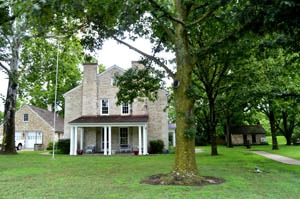
Kaw Mission in Council Grove by Kathy Alexander.
In about 1860 or 1861, a Methodist minister named Duvall and his wife established a mission among the Sac and Fox on the Osage River about six miles East of the line between Osage and Franklin Counties. Some years later, it was relocated to a point approximately one mile Southwest of the present-day town of Quenemo. This was the only Indian mission ever established in Osage County.
Compiled and edited by Kathy Alexander/Legends of Kansas, updated August 2026.
Also See:
Council Grove – Supplying the Santa Fe Trail
About the Article: Most of this historic text was published in Kansas: A Cyclopedia of State History, Volume I; edited by Frank W. Blackmar, A.M., Ph.D.; Standard Publishing Company, Chicago, IL, 1912. However, the text on this page is not verbatim, as additions, updates, and edits have been made.