
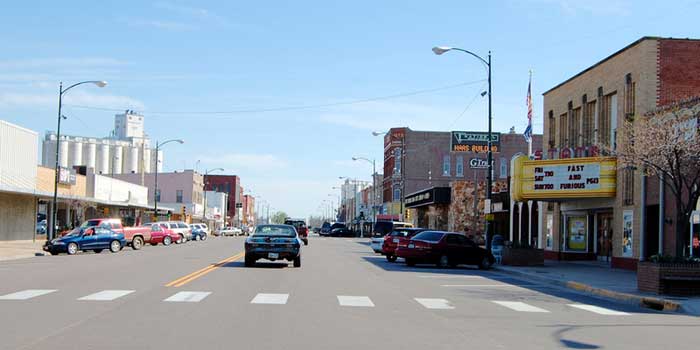
Main Street in Larned, Kansas, by Kathy Alexander.
The county seat of Pawnee County, Larned, was built on the Atchison, Topeka & Santa Fe Railroad at the confluence of the Pawnee and the Arkansas Rivers. Named for nearby Fort Larned, it was laid out in December 1873 on land granted by Jerry Toles and John W. and Mary Adams. John Adams became the president of the Larned Town Company. Soon, his wife’s parents, Reverend and Mrs. Charles Sturdevant, joined them. The pastor would later become one of the first ministers of Larned’s Presbyterian Church.
The first home in Larned was built by Captain Henry Booth, who had served as the postmaster at Fort Larned since 1869. When Larned was founded, he resigned his position as postmaster and, with several others, was instrumental in establishing the new settlement. The first newspaper, the Larned Press, was established by W. C. Tompkinson.
Several new additions in the next five years marked the town’s growth. In less than ten years, it was an incorporated city of the third class with about 50 business establishments. Several churches were established, including two Baptist Churches (one for African-Americans and one for whites), a Methodist Church, two Presbyterian organizations, and others.
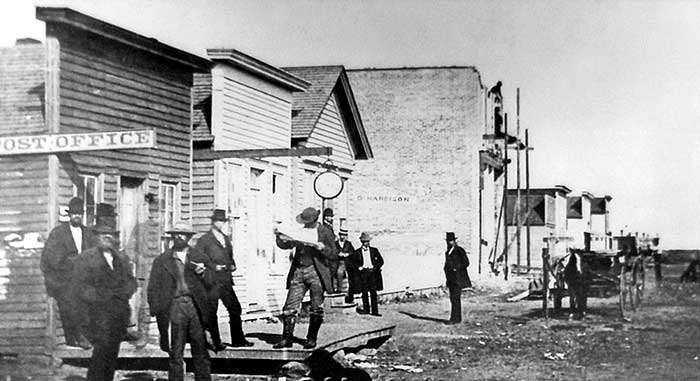
Larned, Kansas, 1876.
In the meantime, several other newspapers were established, including the Larned Republican in 1876, which was published for about a year, and the Pawnee County Herald, beginning in January 1877, which lasted until November 1878 when it was merged with the Larned Optic. In April 1878, the Larned Press was merged into the Enterprise, with Henry Inman, one of the state’s best journalists, as its editor. By 1883, it had changed its name to the Chronoscope.
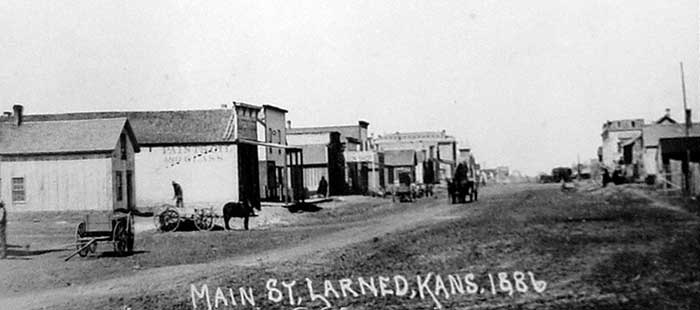
Larned, Kansas, Main Street 1886
In the 1880s, Larned had several good hotels, four grain dealers, five dry-goods houses, four grocery stores, three druggists, two hardware stores, three jewelry establishments, two boot and shoe dealers, two blacksmiths, two wagon makers, two meat markets, two lumber dealers, three livery stables, two harness, and saddle makers, six confectioners and bakers, two banks, two barbers, three coal dealers, five physicians, four attorneys, two tailors, two millinery establishments, and three real estate and insurance agents. Several larger enterprises, including the Larned Broom Factory and the Larned Pottery Company, also existed.

Larned, Kansas, around 1900.
By the turn of the century, Larned, which boasted more than 1,300 residents, had become a trading and shipping point for its area farms and ranches. There are several blocks of substantial business houses, two newspapers — Chronoscope and the Tiller and Toiler (which still exists), three banks with combined deposits amounting to over $850,000, a fine city hall, an opera house, a hospital, a city park, waterworks, electricity for lighting and power, a fire department, all the leading church denominations, a creamery, two flour mills, a foundry, and several grain elevators. The next decade saw significant growth for the city, as its population reached almost 3,000 in 1910.
In 1914, the Larned State Hospital was established for the mentally ill in western Kansas. In 1939, it took on additional responsibilities with the opening of the State Security Hospital. Before 1960, the Hospital accommodated only adult patients, general psychiatric and forensic, but beginning in 1966, treatment programs were added for children, adolescents, the chemically dependent, and security behavior males. Presently, the Hospital operates three separate services, including Youth, Adult, and Security Behavior Services, on its 98-acre campus.
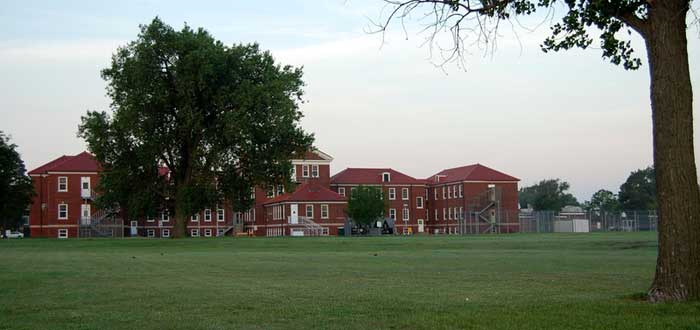
Larned State Hospital, by Kathy Alexander.
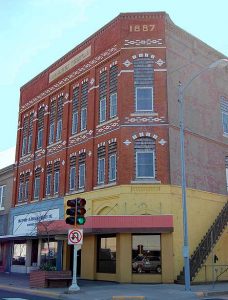
The Masonic Temple was built in 1887.
Today, Larned is home to over 100 different types of businesses and some 4,200 residents. The city hosts numerous annual celebrations, such as Living History Weekend, Santa Fe Trail Days, and the Pawnee County Fair. During the summer, nearby Fort Larned also hosts many living history days where volunteers reenact life at the Fort.
For history buffs, the nearby Santa Fe Trail Center and Fort Larned National Historic Site are “must-sees” when visiting the area.
Contact Information:
Larned Chamber of Commerce
502 Broadway
Larned, Kansas 67550
©Kathy Alexander/Legends of Kansas, updated May 2026.
Also See:
Fort Larned – Guarding the Santa Fe Trail
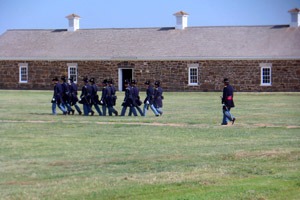
Fort Larned, Kansas, on the Santa Fe Trail.
History Along the Arkansas River
Santa Fe Trail in Pawnee County
See Sources.