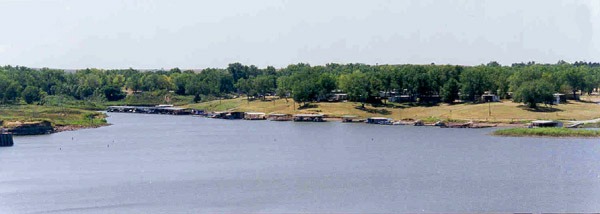
Kanopolis Lake Marina.
Kansas’ oldest recreation area, Kanopolis State Park, includes more than 11,000 acres of rolling hills, bluffs, and woods, as well as the 3,400-acre Kanopolis Reservoir. Managed by the U.S. Army Corps of Engineers, the lake not only provides benefits in flood control and numerous recreational opportunities, but the area is also rich in Kansas history.
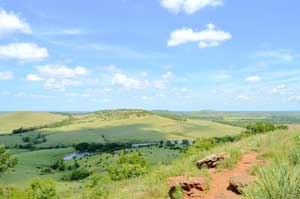
Smoky Hill River Valley in Saline County, Kansas by Kathy Alexander.
Long before the lake was developed, the Smoky Hill River Valley served as a lifeline for its inhabitants for many centuries. Many millions of years ago, Kansas was covered by a warm, shallow sea, which left behind limestone and Dakota sandstone deposits from aquatic life, as well as numerous sea creature fossils and shark teeth as evidence. Prehistoric wildlife, such as woolly mammoths and mastodons, migrated to the upper reaches of the river valley, along with various vegetarian dinosaurs. More notable travelers, such as pronghorn antelope, elk, and bison, moved with the changing seasons and often frequented the river valley.
Early Native American tribes, including the Pawnee, Cheyenne, Apache, and Kiowa, followed game trails for centuries and camped within the deep sandstone canyons and along the Smoky Hill River. They left rock art, known as petroglyphs, as pictorial evidence of their tribal lifestyles.
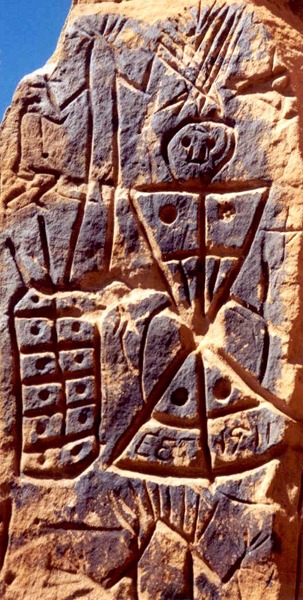
Kanopolis Petroglyphs
The first introduction of European explorers to the river valley was documented in 1541 as the Spanish Conquistadors led by Francisco Vasquez de Coronado in their search for gold in the Seven Cities of Cibola. Native American rock art depicted trade with the Spanish by the introduction of decorated horses and mules into a tribal lifestyle. The French followed suit with explorers of the Trans-Mississippi West from the 1700s to the early 1800s, introducing fur trapping to the tribes and blocking Spanish influence.
The California Gold Rush and the Homestead Act increased European westward expansion through the river valley during the mid-1800s. The Smoky Hill Trail and Fort Zarah Road were European transportation routes of the time that drew retaliation from Native American tribes. Frontier forts were erected to house hundreds of soldiers to fend off the Indians from attacks on settlers and supply routes. Fort Ellsworth, later Fort Harker, was established on the riverbank in 1864 near present-day Kanopolis. Famous military men and scouts for Fort Harker included George Custer, Buffalo Bill Cody, and Wild Bill Hickok.
Mass transportation began as stage lines through the river valley, such as the Butterfield Overland Despatch. The Kansas Pacific Railroad later followed it. Settlers homesteaded civilizations along the river valley as the masses drove the Indian tribes to near extinction and later to reservations. The massive buffalo herds of the prairie, which served as the main diet for tribes and early settlers, were driven to extinction on the prairie by market hunting and waste. From 1870 to 1880, Ellsworth rivaled Abilene, Wichita, and Dodge City as a prosperous cowtown location where cattle driven from Texas met the railheads along the Smoky Hill River for shipment east.

Butterfield Overland mail coach at Atchison, Kansas by Harpers Weekly, 1866.
The prairie of the Smoky Hill River Valley was introduced to barbed wire fences between 1880 and 1890. The valley developed some of the largest cattle ranches in Kansas, with some spanning up to 40,000 acres and employing more than 100 people. In 1886, Kanopolis was founded and touted as the future capital of Kansas, but that was not to be. In the 1900s, the valley was turned with the introduction of the plow, and cropland agriculture expanded and flourished until the economic depression of the 1930s. The discovery of oil along the valley and its royalties saved many farms and ranches.
The 1938 flood on the Smoky Hill River ravaged the homesteads in the area, and Kansas congressional leaders successfully passed legislation in Washington, D.C., which authorized the construction of the Kanopolis Dam in 1940. However, construction was suspended during World War II, and the first man-made lake in Kansas wasn’t completed until 1948.
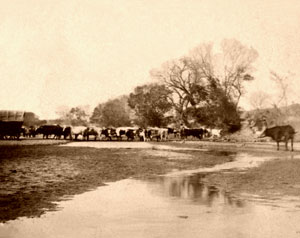
Cattle at the Smoky Hill River in Ellsworth County, Kansas by Alexander Gardner, 1867.
Today, Kanopolis Lake is but one unit in a system of lakes in the Smoky Hill and Kansas River Basins, operating in tandem with upstream Cedar Bluff Reservoir to regulate flows in the Smoky Hill River Basin. The Corps of Engineers manages lands around the lake to preserve their natural value. A portion of the lake storage is used to provide water to the Post Rock Rural Water District, which in turn, supplies many Kansas farms and communities.
The park features a full-service marina, beaches, picnic areas, cabins, and trails for horseback riding, mountain biking, and hiking. More than 200 primitive campsites and 119 utility sites are located throughout the 14 campgrounds in the Langley Point and Horsethief areas.
When visiting Kanopolis Lake, be sure to stop by the U.S. Army Corps of Engineers Information and Visitor Center, located at the southeast end of the dam. The center features an interactive touchscreen video that chronicles the many scenic and historic features of the Kanopolis Lake area. Memorable characters such as Zebulon Pike, General George Armstrong Custer, Captain John C. Fremont, Wild Bill Hickok, and Buffalo Bill Cody lived and traveled over the Smoky Hills during their adventures on the western frontier. Other displays depict some of the local history, natural resources, and recreation activities available.

Kanopolis Lake by the Kansas Geological Survey
Kanopolis State Park also manages nearby Mushroom Rock State Park.
The park is located approximately 31 miles southwest of Salina, Kansas, in Ellsworth County.
More Information:
Kanopolis State Park
200 Horsethief Rd.
Marquette, KS 67464
785- 546-2565
Compiled and edited by Kathy Alexander/Legends of Kansas, updated July 2025.
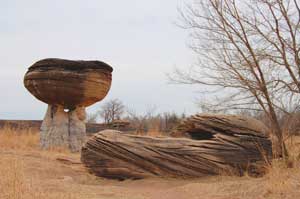
Mushroom Rock State Park in Ellsworth County, Kansas by Kathy Alexander.
Also See:
See Sources.