
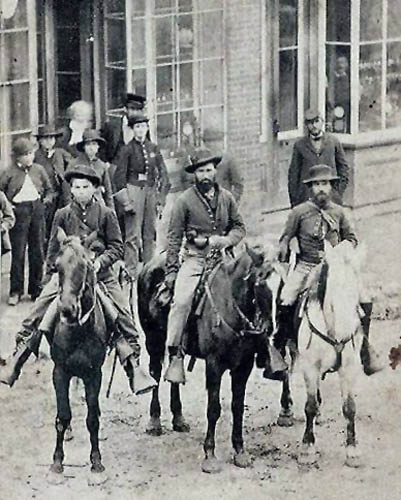
Jayhawkers in the Civil War
Today, “Jayhawk” refers to a mythical bird of Kansas. It is utilized as the University of Kansas’ mascot and often applied to anyone from the state. However, a different type of Jayhawker was very real during the Kansas-Missouri Border War and the Civil War.
The term was first known to have been used in 1849 by a group of California-bound travelers passing through Kansas who called themselves Jayhawkers. The term was thought to have been inspired by a cross between a hawk and a blue jay, taking on the former’s predatory habits and the blue jay’s noisy nature.
By the 1850s, the term was widely accepted in the region as anyone from Kansas. When the new territory was opened for settlement in 1854 and was flooded by both anti-slavery advocates and pro-slavery residents, mostly from Missouri. Tensions were immediate between the opposing factions, which soon led to the Kansas-Missouri Border War, often called “Bleeding Kansas,” in the years before the Civil War.
As tension mounted between the two groups, several skirmishes and battles occurred between the two factions, with the anti-slavery proponents referred to as Jayhawkers and the pro-slavery advocates referred to as Bushwhackers or Border Ruffians.
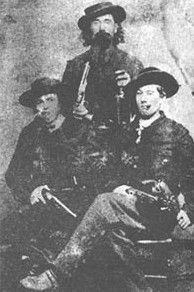
Missouri Border Ruffians also called Bushwhackers.
The battles between the Jayhawkers and Bushwhackers continued even after Kansas was declared a “Free-State” and into the Civil War. By this time, the term was so well-known that many Confederates referred to any Kansas troops as Jayhawkers, but this was not the case. The true Jayhawkers were guerilla fighters that were often undisciplined, unprincipled, thieving, and murderous. Because of their ruthless ways and tendency towards theft, the term “Jayhawking” became widely used as a synonym for stealing. “Jayhawk” was also used as an epithet for any marauder, robber, or thief.
Liking the tough image the term conveyed, Kansas soldiers continued to use the term, and members of the Seventh Kansas regiment, commanded by Colonel Charles R. Jennison, were widely known as Jayhawkers. Jennison’s troops wore red breeches and were called “Redlegs.” Other prominent Jayhawkers of the time were the renowned politician James H. Lane who commanded what was known as “Lane’s Brigade,” and Daniel R. Anthony, an ardent abolitionist and the brother of suffragette Susan B. Anthony. In many cases, true Jayhawkers and Redlegs refused to join units officially sanctioned by the U.S. Army; however, guerrillas on both sides of the Missouri-Kansas border achieved some legitimacy through sanction from the Federal and Confederate governments.
During the Civil War, Jayhawker bands invaded Missouri, often committing some of the most notorious atrocities of the conflict, including the Sacking of Osceola on September 23, 1861, led by James H. Lane, in which the entire town was set aflame, and at least nine male residents were killed.
Two years later, when William Quantrill attacked Lawrence, Kansas, in August 1863 in what has become known as the Lawrence Massacre, Confederate guerillas could be heard shouting, “Remember Osceola!” Lane was in residence in Lawrence then, but he .escaped the attack by racing through a cornfield in his nightshirt.
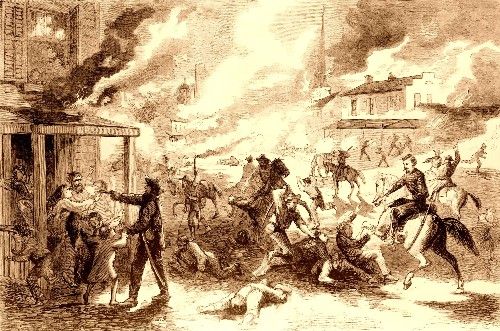
The Lawrence, Kansas Raid illustrated in Harper’s Weekly, September 1863.
Afterward, these Jayhawker bands received much criticism from the Union leaders and were “reigned in.”
As the Civil War continued and the Jayhawk raids diminished, the ruffian image gave way to a patriotic symbol. Kansas Governor Charles Robinson raised a regiment called the Independent Mounted Kansas Jayhawks. Jayhawks were synonymous with the passionate people who made Kansas a Free-State by the war’s end.
In 1886, the mythical bird “appeared” in a cheer during a University of Kansas athletic event — the famous Rock Chalk chant. Later it was adopted as the school’s mascot.
Today, the term applies to Kansas natives and serves as the University of Kansas’ mascot.
©Kathy Alexander/Legends of America, updated March 2023.
Also See:
Pro-Slavery Movement in Kansas
Sources:
Blackmar, Frank W.; Kansas: A Cyclopedia of State History, Standard Publishing Company, Chicago, IL 1912.
Cutler, William; History of the State of Kansas, A.T. Andreas, Chicago, IL, 1883.
The Kansas Collection
Kansas Memory
Kansas State Historical Society
National Park Service
Territorial Kansas
Wikipedia
More Kansas Resources