|
Legends of Kansas
What's New!!
Also see:
Legends of America


Rocky Mountain General
Store
The
Book Shelf
Exclusive
Products
Postcard
Rack
Route 66 Emporium
Vintage Photographs

12343 W. 79th Terrace
Lenexa,
KS 66215
913-708-5119
Please report
broken links, missing pictures, or other problems online by clicking
HERE
or send us an
email.
Thanks!
| |
|
|
|
Indian Battles,
Skirmishes and Massacres |
|
|
|
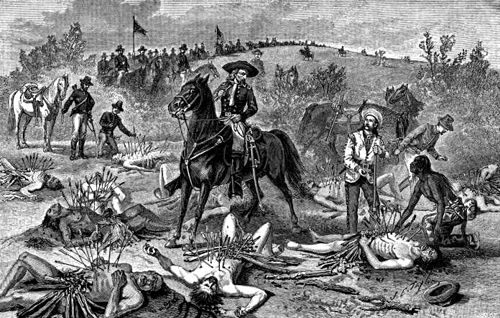
Battle of Beaver Creek (1867)
- During the
Indian troubles in the summer of 1867, the
Eighteenth Kansas Volunteer Cavalry left
Fort Hays on August 20th for the
headwaters of the Solomon and
Republican Rivers. On the evening of the 21st
Captain George B. Jenness
of Company C was sent out with a detachment to ascertain the cause of a light
seen at some distance across the prairie. He found the remains of an old
Indian
campfire, but when he attempted to return to his regiment, he became confused in
the darkness, and finally decided to camp on the open prairie. Early the
next morning he reached the river, about 8 miles below the camp.
Upon reaching the river he pushed on toward the troops, but
after going about three miles his detachment was attacked by a large body
of
Indians. Forming a hollow square, he managed to hold the
Indians at
bay. His men were armed with Spencer repeating carbines and each man
carried 200 rounds of ammunition, so they were well equipped for a heroic
defense. After a short skirmish Captain Jenness again began to move
up the river toward the camp, but after going about
˝
mile, saw more
Indians. He then returned to the river and
threw up a breastwork of driftwood and loose stones, behind which his
little band fought valiantly for three hours. All the horses except four
were either killed or wounded; two of the men were killed and 12 seriously
wounded. The detachment withdrew to a ravine, where they found water and
remained under cover of the willows and banks of the ravine until dark.
The
Indians then drew off and Jenness and his men, under the guidance of a
scout, followed a buffalo path for five miles until they came to the river.
The
Indians renewed the attack the next morning, but the main command came
to Jenness' rescue. The event was said to have occurred on Prairie Dog Creek in the
northwestern part of Phillips County.
Battle of Chouteau's Island
(1816) -
In the winter of 1915-1916,
August P.
Chouteau and Jules de Munn tried to extend the
Chouteau
trading territory into the upper Platte and
Arkansas River
valleys and overland to
Santa Fe,
New Mexico,
blazing parts of what would later be known as the
Mountain
Branch
of the
Santa Fe Trail.
In the spring of 1816, they were making their
way back to
Missouri with
the furs collected during the previous winter. Shortly after traveling
east of present-day
Colorado/Kansas
state line, they were attacked by about 200
Pawnee
Indians
near the
Arkansas River.
Chouteau
and his men quickly crossed the shallow water of the river to a large
island of timber where they took refuge.
|
|
The trappers utilized their packs of furs for
barricades. One trapper was killed and three were wounded. However, seven
of the
Pawnee
Indians
died in the battle. The
Pawnee would
later say that it was the most fatal affair in which they were ever
engaged, having never seen guns in the past.
The island was afterwards known as “Chouteau’s
Island” to travelers along the
Santa Fe Trail and described as
a "beautiful spot, with a rich carpet of grass, delightful groves, and and
a heavily timbered bottom." Located about six miles west of Lakin, Kansas
in Kearny County, Chouteau’s Island has long since disappeared due to
erosion by the
Arkansas River.
Battle of Coon Creek (1848) - In
May, 1848, a company of about 140 soldiers left
Fort
Leavenworth to join
the
Santa Fe battalion in Chihuahua, Mexico. On June 17th they camped on
Coon Creek, on the
Santa Fe Trail, not far from the present town of Kinsley, and the next morning
were attacked by some 200
Comanche
and
Apache
Indians. The troops were
armed with breech-loading carbines, but the bullets rattled harmlessly
from the raw-hide shields of the savages who came on in a charge that
looked as though the troops might be exterminated. When they were almost
upon the camp the soldiers turned their attention to firing upon the
horses, and with their breech-loading guns soon turned the tide of battle.
Nearly all the horses in the front rank were killed at the first volley
and the remaining
Indians sought safety in flight. After this inconclusive
battle, according to the official report, an
Indian woman "who seemed to
be their queen, mounted on a horse, decorated with silver ornaments on a
scarlet dress, rode about giving directions about the wounded." Her
identity is unknown. The campsite is thought to have been along the
Arkansas River approximately two miles northeast of present day Kinsley, Kansas. At
this location a limestone post
marker has
been placed. Near this location is said to be where the battle took place.
|
|
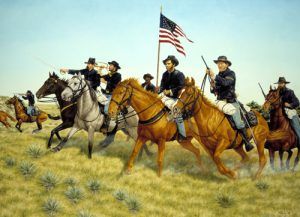
Battle of Prairie Dog Creek
(1867) - In the summer of 1867,
Indians were regularly attacking
travelers and settlements in
Kansas and the frightened
citizens of Kansas demanded military help. The War Department responded by
authorizing volunteer militia units on active duty during the emergency. On July 15,
1867, four companies of the 18th Kansas Volunteer Cavalry
were mustered into Federal service to protect settlers from attack.
The volunteers set out on July 18th for a month of vigorous campaigning
before returning to
Fort Hays. They then joined forces with the
10th U.S. Cavalry of "Buffalo
Soldiers," making a combined force of more than 250 men led by
Captain George A. Armes of
the 10th and
Captain Horace L. Moore
of the 18th.
|

Battle
of Prairie Dog Creek, painting by Ralph Heinz for
the
National Guard Bureau.
|
|
Armes led his men down
Prairie Dog Creek in present-day Phillips County, while Moore scouted upstream.
While separated, Armes group was attacked on August 21, 1867 by about 300
Kiowa and
Cheyenne under the leadership of
Satanta
and
Roman Nose.
As Armes' troops valiantly fought off the attack, the other soldiers began to
make their way to provide assistance. Captain Armes then gathered the
troops and charged the
Indians , who then broke and scattered. The cavalry suffered 3 men
dead and 36 wounded; the
Indians, 50 dead and 150 wounded. This battled ended the U.S.
offensive operations on the
Kansas frontier for the year, and in the fall
treaties were signed with the tribes of the Southern Plains. Today, the 18th
Kansas Volunteer Cavalry continues its efforts as the Kansas Army
and Air National Guard.
Battle of the Saline River
(1867) - In August, 1867, P.S. Ashley
and a crew of six were surveying the route for the Union Pacific
Railway when they were attacked by a group of about 30
Cheyennemargin-bottom: 0">
warriors, attempting to
stop the construction of the iron rails through their homeland. All
six of the railroad workers were killed, but one man named William
Gould survived and was brought to
Fort Hays
where he told his story, before he too, died of his wounds. At that time,
one of
Fort Haysmargin-bottom: 0">'
main functions was to protect the railroad workers and Captain Henry
Corbin, commanding the Thirty-eighth
Infantry and Tenth Cavalry, known as the "Buffalo
Soldiers," immediately
ordered Captain George Armes, Company F, Tenth Cavalry, in pursuit of
the
Cheyenne.
Armes and his men then began to follow the trail and soon sent back to
the fort for reinforcements.
However, after waiting for four hours,
the anxious men continued the pursuit before the reinforcements
arrived. Some 25 men of the Thirty-eighth
Infantry, under the command of Sergeant
Pittman of Company C, were sent out to reinforce the Tenth Cavalry. Following the
trail up the North Fork of Big Creek northeast of
Fort Hays,
they encountered a small band of 50
Cheyenne
warriors and three shells from a howitzer, which
succeeded in scattering the Indians but doing little damage. When they
found no signs of Captain Armes
and his men, the Thirty-eighth
Infantry returned to
Fort Hays.
In the
meantime, Armes had followed the trail up the Saline River
and about 25 miles northwest of
Fort Hays,
they were surrounded and attacked by some 400
Cheyenne
warriors. Armes quickly
ordered his men to dismount and fight on foot and the soldiers soon
found themselves surrounded. Outnumber, Armes then ordered his men to
form a compact defensive maneuver by forming a
"hollow square" around the cavalry horses and began to march toward
Fort Hays.
The battle raged for six hours as the
Buffalo
Soldiers
fought off their attackers. Amazingly, when the soldiers were about
ten miles north of
Fort Hays,
the
Cheyenne
broke off the attack. During the
thirty hours the troops had been gone, they had marched 113 miles
without rations, fifteen of those miles while under attack. Although
2,000 rounds of ammunition had been fired during the battle,
casualties were surprisingly light - with only six Indians and one
soldier, Sergeant William Christy, killed. Christy was the first
combat death in the Tenth Cavalry. Armes would later say of the
battle,
"It is the greatest wonder in the world that my command escaped being
massacred."
Continued Next Page
|
|
|
<< Previous 1
2
3
Next >> |
|
From the Rocky Mountain General Store
Kansas Postcards -
If you're like we are and can't get enough of
Kansas,
take a virtual tour through our many
Kansas Postcards. Each one of these is unique and, in many cases, we have only one
available, so don't wait. To see them all, click
HERE!
 |
| |
|