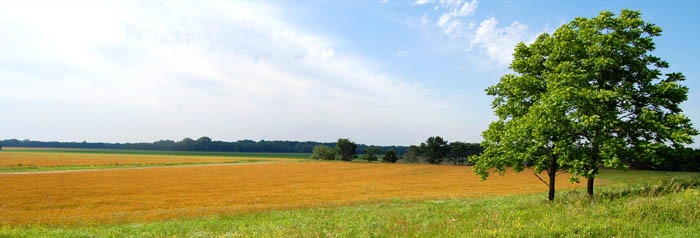
Greenwood County, Kansas Landscape.
Towns & Places
Climax – Semi-ghost town
Eureka – County Seat
Lamont – Unincorporated Ghost Town
Neal – Unincorporated Ghost Town
Quincy – Unincorporated Ghost Town
Reece – Unincorporated Ghost Town
Virgil – Semi-ghost town
Extinct Towns of Greenwood County
One-Room, Country, & Historic Schools of Greenwood County
Toronto Lake
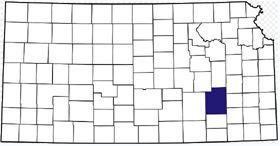
Greenwood County, Kansas.
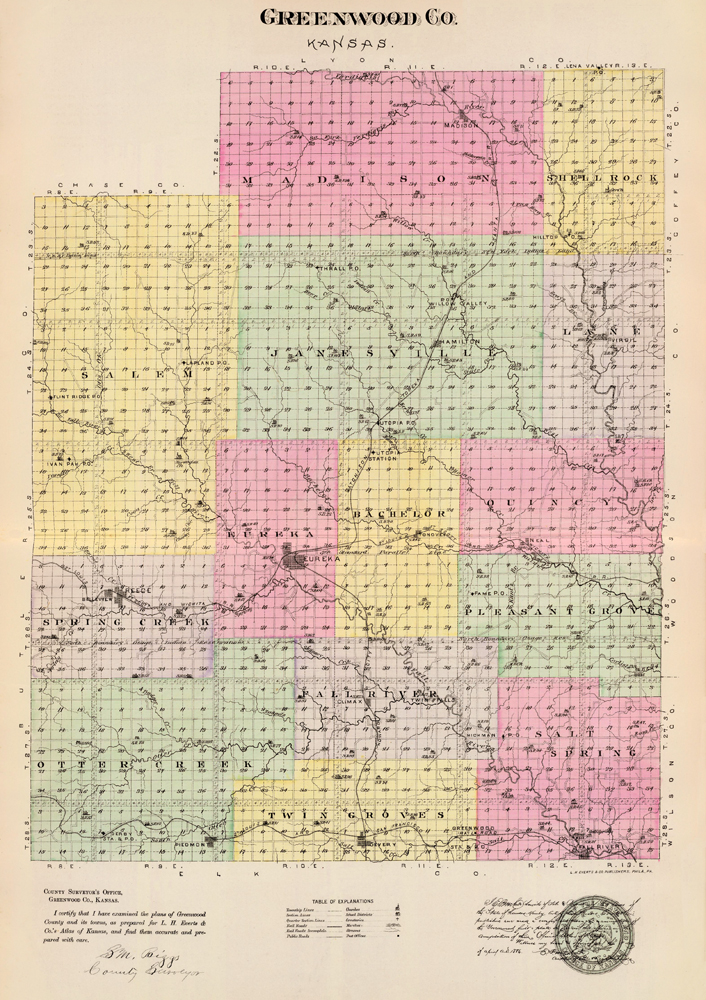
Greenwood County Map by L.H. Everts & Co., 1887.
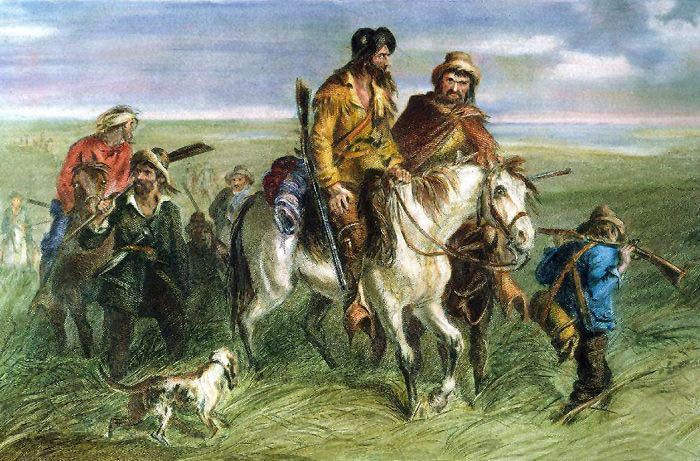
Southerners are coming to Kansas.
Greenwood County, Kansas, located in the southeast portion of the state, is one of the original 36 counties created by the territorial legislature in 1855. As of the 2020 census, the county population was 6,016. Its county seat and the most populous city is Eureka.
Nestled in the rolling Flint Hills of the Tallgrass Prairie, the county was named for Alfred B. Greenwood, the Commissioner of Indian Affairs and a United States Land Commissioner under Presidents Pierce and Buchanan. When the county was initially created, it was a nearly square tract of uniform size, similar to the surrounding counties. However, in 1861, Madison County, which the Territorial Legislature had also created, was divided between Breckenridge (now Lyon) and Greenwood Counties, and Madison County was eliminated. It was an unorganized territory until 1862, when the county was officially organized.
As soon as the territory was opened, settlers arrived, taking advantage of the fertile land and abundant wildlife. The county’s economy was initially built around agriculture, particularly ranching and farming. The first settlement was created in 1856 by people from Mississippi who intended to help make Kansas an ally of the Southern slave-holding States. Some early pioneers included D. Vinning, Austin, Fred Norton, Anderson Hill, Wesley Pearson, Mark Patty, Myrock Huntley, E.R. Holderman, William Martindale, E.G. Duke, James, W.F. Osborn, Isaac Sharp, and David Smith. Others soon followed, including Archibald Johnson, Peter Ricker, Adam Glaze, John Baker, Wayne Summer, and William Kinnaman.
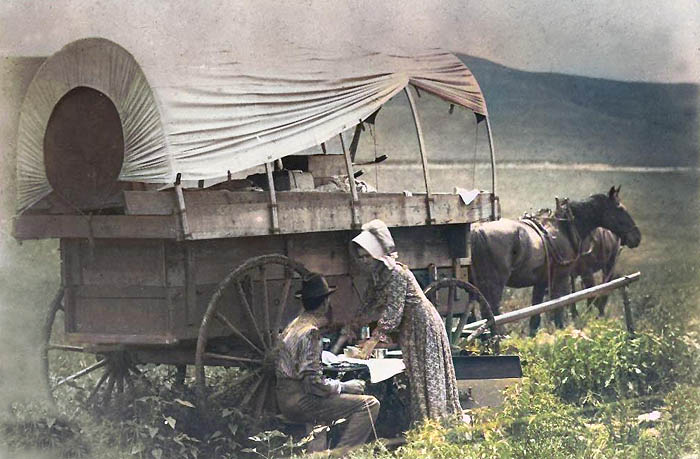
Greenwood County, Kansas Covered Wagon.
The county’s population grew rapidly over the next two or three years, but most settlers were poor people who had come to the new country to improve their conditions. Money was an unknown quantity, and just as they began to earn a little income from their holdings, the 1860 drought reduced them to near starvation. Supplies could only be obtained in Atchison and had to be brought 160 miles by teams. Storms, exceedingly cold weather, and the feeble condition of the wagon teams, due to scanty rations, made getting food to the settlers and their animals almost impossible. Most of the stock died, and the following spring, the settlers found they had no animals to put in their crops. However, those who overcame this difficulty raised a good crop in 1861.
When the Civil War broke out, most pro-slavery people, who had not already left due to the prior year’s drought, soon drifted away, as Kansas had declared itself to be a “Free State.”
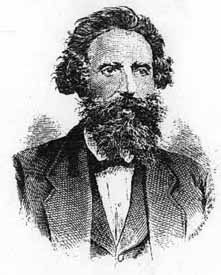
Colonel James Montgomery.
However, Greenwood County would become the scene of violence during the Civil War as its residents divided against themselves and sacked and burned villages. At the same time, the residents were exposed to the attacks of hostile Indians and those who sought, in the troubled times, an excuse for indiscriminate pillage. As a result, a rough fort was built at Eureka in 1861 and named in honor of Colonel James Montgomery of the Tenth Infantry. It was built by the home guard under Captain L. Bemis and was occupied by them during their entire term of service.
Although the county was experiencing violence, its residents still officially organized in March 1862. The first meeting was held at Janesville, the temporary county seat. The county was divided into townships, and county officers were appointed. After the appointment of county officers, the first regular election was held in November 1862.
The end of the Civil War did not end outlawry in the county, as was evidenced by the assassination of William and Jacob Bledsoe, who had been arrested on the pretext of horse stealing in April 1865. One night, they were removed from one impromptu guardhouse to another, but en route, they were assassinated.
The story of their guards, John Taylor, William Brown, and Thomas Craig, was that an attack was made by Indians who had suffered the loss of ponies, and the prisoners were let go. However, the authorities did not share this view of the case, and after a long time, Brown was convicted, while Craig was acquitted. Taylor was never apprehended and was later reported to be dead.
Verdigris River in Kansas.
The following year, a man named Robert Clark was also brutally murdered by a man named G.W. Petty in his cabin on the Verdigris River. During the Civil War, G.W. Petty was a bushwhacker, although he was connected with neither side and worked for personal profit only. After the war, he was reputed to have continued a lawless life. Sometime before 1866, he had lost his wife, whom he was very fond of, and upon whose grave he placed an expensive monument. This monument was discovered in May 1866, so brutally defaced as to be ruined.
Petty suspected Clark and decided to kill him. In the same month, as Clark sat with his wife and children in his cabin on the Verdigris River, a man rode up to the door and asked for directions. Still sitting in his chair but bending out of the door, Clark provided the requested information when another man riding past the window shot Clark, who fell to the floor but staggered up again and tried to reach his gun. As he fell a second time, three men rode up to the window, where they remained motionless until Clark died. When they appeared, Mrs. Clark recognized Petty and cried out: “For God’s sake, Wash Petty, don’t kill me and my children; you have killed my husband!”
No answer was given, and, seeing Clark dead, the men rode off. An indictment was returned against Petty in 1870, and he was arrested. After many delays, he was found guilty and sent to the State Penitentiary in May 1879.
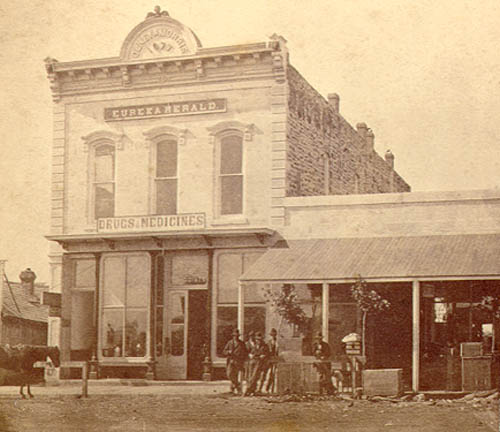
Eureka, Kansas, 1877.
In the meantime, another settlement was growing — Eureka — and in 1866, the voters moved the county seat to the quickly thriving community.
Since the county’s beginning, there was a strip of territory about ten miles in width along the southern part of the county that had belonged to the Osage Indians. The reservation was a strip measuring 20 by 70 miles situated in Greenwood County and Elk, Wilson, and Butler Counties. In 1870, settlers demanded more land, and the property was placed in trust with the United States for distribution to the Indians relocated to Indian Territory (now Oklahoma). The land was then made available for homesteading for $1.25 per acre. Before long, many of the best farms in the county were located in this tract near the towns of Gould and Severy.
In 1871, the county submitted a bond vote to build a new courthouse. After the vote passed, the three-story building began with limestone bricks quarried about 1 ½ miles west of town. The building served the county for several years, but, unfortunately, in the second half of the 20th century, it had to be replaced by a more modern building.
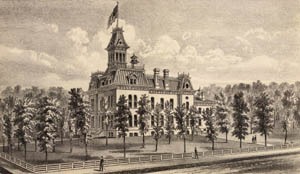
Original Greenwood County Courthouse in Eureka, Kansas.
In 1874, a third murder occurred in the county when O.C. Crookham was shot by Alexander Harman while gathering corn in his field. The circumstances that led to the shooting were, briefly, certain mortgages held by Crookham and the settlement of a claim of Harman for some prairie-breaking. Harman, who appears to have been hardly sane, walked coolly up to Crookham, placed a pistol to his neck, and shot him. Crookham died two days later, and after due process, Harman was found guilty and taken to the penitentiary. However, his conduct was so violent that he was later removed to the Asylum.
Railroad negotiations began as early as 1870, and several bond elections were held over the next decade for various railroads. However, it would be several years before a railroad reached the county. The first was the Atchison, Topeka, and Santa Fe Railroad (then known as the Kansas City, Emporia, & Southern) in 1879. The next was the St. Louis and San Francisco Railroad, built in 1880, and the Missouri Pacific Railroad established its line in June 1882.
In 1910, of the 739,000 acres of land in Greenwood County, 525,000 were under cultivation. The total yearly income from farm crops exceeded $5 million. Livestock was nearly three million. Kafir corn, wheat, oats, Irish potatoes, and poultry were other essential products. The assessed valuation of the property that year was nearly $34 million. At that time, the population was 16,060, with an average wealth of over $2,000 per capita.
The county’s population peaked at 19,235 in 1930. It fell every decade afterward, primarily due to improved transportation and agricultural technologies.
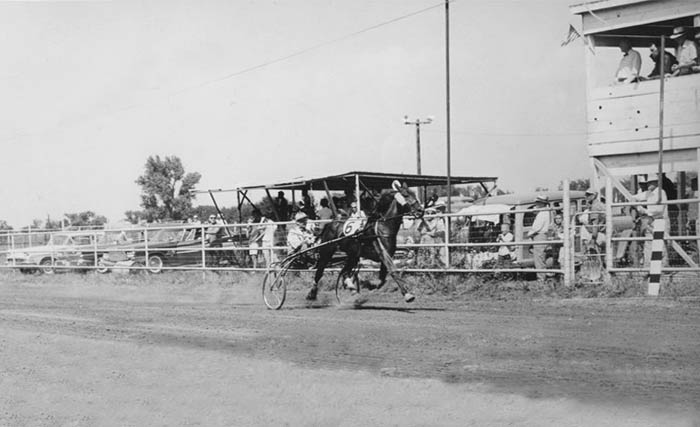
Eureka, Kansas Horse Racing.
Several ghost towns can be seen throughout the area, which died when railroads were removed or after oil production declined. Several historic buildings can also be seen, especially in Eureka and Madison. Other historical places in Greenwood County include a three-arch stone bridge, four miles north and one mile west of the Piedmont turnoff on Highway 96, the Eureka Carnegie Library at 520 N. Main, and the historic Number Eight Schoolhouse just east of Madison.
In Eureka, the old Greenwood Hotel has been restored to its former glory and is available for special events today. Several festivals and events are held throughout the year. Both residents and visitors enjoy fishing at the Fall River Reservoir and Toronto Lake. Visitors can learn more about Greenwood County’s history at the Greenwood County Historical Museum in Eureka.
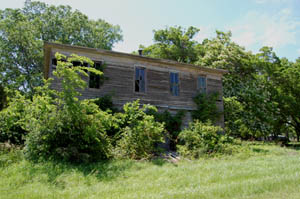
Overgrown building in Neal, Kansas, by Kathy Alexander.
Contact Information:
Greenwood County
311 N. Main, Courthouse
Eureka, Kansas 67045
620-583-8177
©Kathy Alexander/Legends of Kansas, updated January 2026.
Also See:
Greenwood County Photo Gallery
Territorial Kansas & the Struggle For Statehood
Sources:
Blackmar, Frank W.; Kansas: A Cyclopedia of State History, Vol I; Standard Publishing Company, Chicago, IL 1912.
Cutler, William G.; History of Kansas; A. T. Andreas, Chicago, IL, 1883.
Wikipedia