
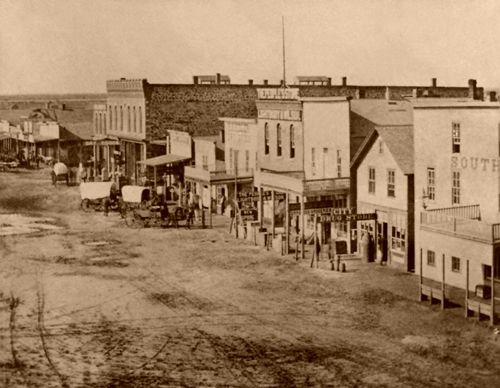
Great Bend, Kansas 1870s
Situated in central Kansas, Great Bend is the county seat of Barton County. The area had long been called home to the Plains Indians before explorers came to the region, beginning with Francisco Vasquez de Coronado in 1541. It began to see people in numbers when the Santa Fe Trail was developed, which passed right through what would later become Great Bend, leaving a long trail of history in its wake, including Indian skirmishes, tales of frontier characters, rowdy cowboy days, and more.
Though Barton County got its start in 1867, it would be several years before its population reached the level to be officially organized. Before that, the county was attached to Ellsworth County for judicial and revenue purposes.
The first settlers came to the area in about 1870, living in rough dugouts and sod houses fitted with holes in the wall to defend themselves against the Indians. Early settlers killed buffalo and other game to provide food, tanned hides sold to easterners, and a few tried farming but were unsuccessful because the buffalo tramped down the crops.
By 1871, the area had grown to enough people to present a petition to the governor asking to organize the county. In the same year, Great Bend was laid out by the Great Bend Town Company in anticipation of county organization and the coming of the Atchison, Topeka & Santa Fe Railroad. The town was named after the “great bend” of the Arkansas River, a prominent feature noted by early Santa Fe Trail pioneers.
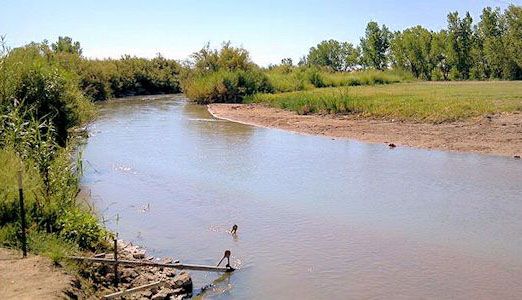
Arkansas River in Kansas
The first recorded settlers in Great Bend Township were Edward J. Dodge, who made a homestead entry on January 23, 1871, and D. N. Heizer in May of the same year. Some of the other settlers of that year were John Cook, W. H. Odell, Thomas Morris, George Moses, and Wallace Dodge.
The Great Bend Town Company erected the first building, called the Southern Hotel, in the fall of 1871 on what would become the northwest corner of the public square. The next building was built by Edwin Tyler, a little south of the Southern Hotel on the west side of the square, part of which was used as a dwelling and the other part as the first store in the fledgling city. For months, they would be the only buildings in the new “town.” However, that began to change in the spring of 1872 when a man named James Holland built another store on the north side of the square. Holland, however, soon went east to purchase goods and was never heard from again. He was thought to have been murdered for his money.
In May, a man named A.S. Allen constructed a drug store on the west side of the square, quickly followed by a grocery and provision store by Ed Markworth, a hardware store by E.L. Morphy, and another grocery store by John Cook. Another hotel was also built, called the Typer House, on the east side of the square, and Great Bend was officially incorporated on June 17, 1872. The town attracted even more settlers when the Atchison, Topeka & Santa Fe Railroad made its first appearance on July 15, 1872. The first publication in the county was also established that year – the Arkansas Valley, primarily a publication of the railroad, but its life was short.
Early in 1873, Great Bend held its first election, and A.A. Hurd was elected mayor. Officers and Commissioners were also elected, and by popular vote, Great Bend was named the county seat, winning out over Ellinwood and Zarah.
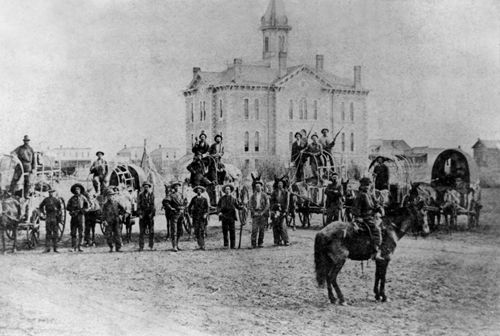
Buffalo hunters in Great Bend, Kansas, circa 1870s
That same year, the Barton County Progress newspaper made its appearance in the county, but it also lasted only a few months. Until then, there were no public schools in the county, so the people voted bonds for that purpose, and a very fine two-story frame schoolhouse was erected one block west of the public square. That same year, a two-story stone and brick courthouse was built in the center of the public square. The first stone and brick business was also built the same year on the square’s north side. This was the only substantial improvement made until 1876, although several frame businesses and dwellings were erected.
The years 1873 through 1875 were exciting, as it was during this time the city became a cattle shipping center and yet another of the many rowdy Kansas cowtowns. The cattle trade would usually begin about June 1 and continue until the middle of October.
A natural consequence of this trade was lively times for the merchants while it lasted, and for the more orderly and peaceable community members, a constant dread. The trade advantages were more than counterbalanced by the disadvantages to society. Like many other rowdy cowtowns, Great Bend had several shoot-outs during this time, the first of which occurred on July 2, 1873, when Marshall Gainsford killed a drunken buffalo hunter in self-defense.
By 1875, primarily due to the cattle trade, Great Bend had nine saloons. The class of people that the cattle trade attracted to Great Bend was that class of thugs and harlots that many believed were a curse and a dread to every community. When the Kansas Legislature in 1876 passed a law fixing the “deadline” 30 miles west of Barton County, the people of Great Bend felt relieved. This “deadline” was a line beyond which Texas cattle could not be brought unless they lived for one winter in the State. The passage of the law had the effect of moving the cattle trade west from Great Bend, and with it went the many cowboys and other rowdy folks that the “peaceable” people had little tolerance for.
In the meantime, another newspaper was launched in 1874 called the Great Bend Register, which would last for decades, and in 1876, another called the Inland Tribune. Also, in 1876, A.S. Allen put up an elegant and well-finished two-story stone and brick building on the corner of Curtis Avenue and Nagie Street, the first floor of which he used as a drug store, and the upper floor was divided into offices. At about the same time, Gray & Baily erected a building of a similar character on the north side of the square, which was occupied as a hardware store by W. H. Dodge & Son. W. W. P. Clement also built a flouring mill.
In 1877, the first church was built by the Catholics. Up until that time, the various congregations had met in private homes. The following winter, a Methodist Church was built, followed by several others in subsequent years.
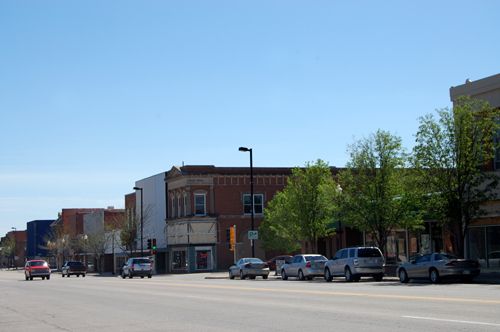
Great Bend, Kansas Today by Kathy Alexander.
In 1878, Great Bend saw some very substantial improvements, including the building of the Union Block on the west side of the square by J. H. Hubbard and Burton and the Moses Brothers. The two-story stone and brick building contained two good storerooms beneath and several offices and a Union Hall above. On the square’s north side, G.L. Brinkman erected a two-story stone and brick building. On Nagie Street, G. P. Townseley put up a building of similar material; the lower story was used as the post office, while the upper story was used as the printing office of the Inland Tribune. Directly opposite this building, on the same street, C. F. Wilner built a good two-story stone and brick, in which he housed a furniture store. Adjoining the Tribune building on the west, Troilett Bros. and D. Merton put up a one-story building with stone walls and a brick front. Other buildings included the frame Occidental Hotel built by C. E. Birdsale and the Central House built by John Barth. Three-grain elevators were also built, and the Walnut Creek Mill was greatly enlarged and refitted with new and improved machinery.
More homes and buildings were erected in the next several years, but construction began to slow down. In 1882, however, a much larger brick schoolhouse was built. It was also in this year that Great Bend saw one of the saddest times in its history. Beginning on December 1, 1882, and lasting until February of the following year, a smallpox epidemic broke out. It began at the end of November 1882 when a man named Gilmore, on his way East from New Mexico, left the train sick at its stop in Great Bend. He soon found his way to a one-room “shanty” in the northeast part of the town, where he was taken in by a man named John Howell. Gilmore was diagnosed with having the most malignant type of smallpox, and when word got out, many fled to escape the dreaded plague. Though Howell’s home was closely quarantined, it was too late, and so many people contracted the disease that the entire town was placed under strict quarantine for two months. Nobody was allowed to come or go, and the streets were deserted. The mail was stopped, churches and schools were closed, all society meetings were discontinued, and people were prohibited from assembling in groups. Some 30 people contracted the disease, 15 of whom died, including Gilmore and John Howell.
Though its lawless cowtown days were over, violence still periodically erupted in the town, and on April 30, 1885, the first lynching occurred in Great Bend when the murderer of a pool hall owner was lynched. A few years later, the “frontier” was almost gone when the last buffalo was killed in the county in 1889.
A second lynching occurred on June 16, 1898, when some 300 vigilantes lynched the murderer of a 15-year-old girl named Myrtle Hofmaster.

Great Bend, Kansas, 1910
By the early 1900s, Great Bend was called home to more than 1,000 people and supported 34 businesses, including eight merchandise stores, seven grocery stores, three hardware stores, two banks, three grain elevators, two flour mills, and a brickyard.
Over the years, the city grew as a regional trade and service center and increased dramatically when oil was discovered in the 1930s. From 1930 to 1940, the town’s population nearly doubled as some 3,000 oil wells began to produce in the surrounding area.
A U.S. Army Air Corps training base was situated in the city during World War II. The town’s population peaked in the 1960s at close to 17,000. In 1973, the Fuller Brush Company relocated its factories in Great Bend, moving from Connecticut after the founder’s death.
Though its population has dropped to about 15,300 today, Great Bend continues to flourish as a medical, legal, and technical service center, as well as a regional shopping and entertainment provider.
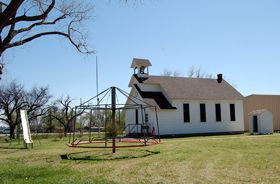
Barton County Museum School by Kathy Alexander.
Great Bend’s and Barton County’s rich history can be seen at the Barton County Historical Society Museum and Village. The museum preserves the area’s history in several restored historic buildings, including an 1871 pioneer home, 1898 church, 1910 train depot, 1915 one-room schoolhouse, and a small post office. It is located at 85 S. Hwy 281. The Kansas Oil & Gas Hall of Fame Museum, located at 5944 W. 10th Street, features local oil and gas production history in the area.
More Information:
Great Bend Convention and Visitors Bureau
3007 10th Street
PO Box 274
Great Bend, Kansas 67530
877-427-9299 or 620-792-2750
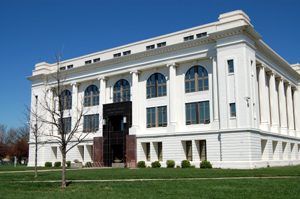
Barton County Courthouse in Great Bend, Kansas by Kathy Alexander.
Compiled by Kathy Alexander/Legends of Kansas, updated June 2023.
Also See:
Santa Fe Trail – Highway to the Southwest
About the Article: Much of the historic text in this article comes from Kansas: A Cyclopedia of State History, edited by Frank W. Blackmar, published in 1912, as well as Kansas: History of the State of Kansas, by William G. Cutler; published in 1883. However, other sources have also been used, the content combined and heavily edited.