LEGENDS OF KANSAS

History, Tales, and Destinations in the Land of Ahs

                                                    Home    Counties    History    Legends & Tales    People    Places   Towns                  

Search


  Legends of Kansas

What's New!!


Also see:


Legends of America


Recommend this site


Rocky Mountain General Store Logo

Rocky Mountain General Store


  The Book Shelf

  Exclusive Products

  Postcard Rack

  Route 66 Emporium

  Vintage Photographs


Legends of America's Exclusive Custom Products


12343 W. 79th Terrace

Lenexa, KS 66215

913-708-5119


Please report broken links, missing pictures, or other problems online by clicking HERE or send us an email.  Thanks!


Extinct Towns of Grant County, Kansas


<< Previous 1 2  Next >>


Appomattox

Golden

Lawson

Old Ulysses

Shockey/Laport

Zionville

More Extinct Towns


In Grant County's early years, the county sported more than a dozen towns. Today, there are but three left -- Ulysses, Hickok and Ryus, though the latter two are incorporated and very small.


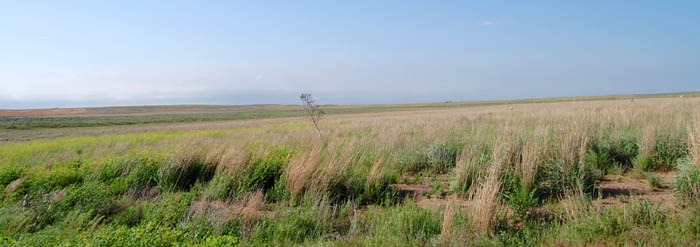
Western Kansas.

A wagon in western Kansas.


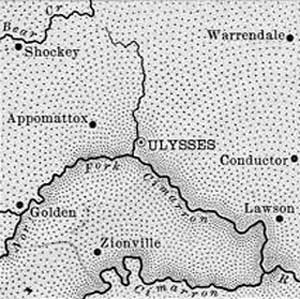
Appomattox (1885-1894) - A town with four names during its relatively short life, this small town was first established with the name of Surprise in 1885. A post office opened on March 17, 1886 in what was then, Hamilton County, as Grant County would not be created until 1887. Some of its first settlers were John Arthur, E. R. Watkins, Frederick Ausmus. Henry H. Cochran, and George W. Cook.

When the work on creating Grant County began, a number of settlers wanted Surprise to vie with Ulysses for the county seat. However, they were unable to come to an agreement with the Surprise Town Company so decided they would create a new town about two miles south of Surprise, which was first called Cincinnati and the two towns merged. However, the county seat supporters felt the town should have a more patriotic name like Ulysses, which was named Ulysses S. Grant. On May 26, 1887, the post office name was officially changed from "Surprise" to "Tilden," named so in honor of Samuel J. Tilden who was a presidential candidate on the Democratic ticket in 1876 against Rutherford B. Hayes.


The town grew quickly and soon included a number of businesses, The Peoples Bank, three physicians, and the Grand Hotel. Though Tilden had laid the groundwork to become the county seat in 1887, the governor's proclamation was not made until June, 1888, which named Ulysses as the temporary county seat.


A few months later, an election was held to determine the permanent location of the county seat in October. The voters had to decide between Ulysses and Tilden, which resulted in the decision that the county seat would stay in Ulysses. But like many other Kansas Counties, the fight wouldn’t end there. With charges of corruption, the fight went all the way to the Kansas Supreme Court, where evidence was submitted by a Tilden partisan named Alvin Campbell. He introduced facts to show that the city council of Ulysses had bonded the people to the extent of $36,000 to buy votes, claiming that the total votes paid for was 388. It was an “open secret” regarding the voting fraud and “professional voters” had been brought in and boarded for the requisite 30 days before the election, and each given $10 each when they had voted. But, it was not known at the time that this had been done at public expense. It was also alleged that “professional toughs” were also hired to intimidate the Tilden voters.


The exposure of the fact that public funds had been used created excitement among the citizens of the county, who found themselves subject to the payment of bonds, and those to blame for the outrage retaliated upon Alvin Campbell by tarring him in August, 1889.


It was also shown in court that Tilden had bought votes and engaged in irregular practices, and Ulysses finally won, though it was a dearly bought victory.


Ulysses High School

The town of Appomattox, which was in a desperate fight for the

county  seat against Ulysses was partially located on the

present-day  site  of the Ulysses High School.


Sure they were going to win the lawsuit in the Kansas Supreme Court, the citizens of Tilden wanted to change the name to something even more patriotic. Colonel T.T. Taylor, who was president of the Surprise Town Company, and had served in the Civil War under General Philip Sheridan, wrote to him and asked him for an appropriate name for a town to be made county seat of Grant County. In response, General Sheridan wrote Taylor back, suggesting the name of Appomattox, as that was where General Lee had surrendered to General Grant in the Civil War. On February 6, 1890 the town's name was changed for the last time as the post office took on the official moniker of Appomattox.


The name of the consolidated towns became Appomattox. The County seat election was between Appomattox and Old Ulysses. In the end, it wouldn't matter, as later that year the Kansas Supreme Court ruled in favor of Ulysses, where it has remained since.


Many of the town residents and businesses then moved to Ulysses and the post office in Appomattox closed its doors forever on November 15, 1894.


Today the old townsite sits on part of grounds of the Ulysses High School.


Golden (1886-1899) - Located southwest of Ulysses on the North Fork of the Cimarron River, Golden's post office was first established in 1886 in Hamilton County before Grant County was created. The population of the small town grew to about 50, but had a number of businesses including a lumber yard, a general store, a blacksmith, and a western supply store. Some early settlers included B.E. Morris, T.S. Hurd, Clarence Vorhees, Frank Byers, and J.A. Harmon. Today, all that is left is the Golden Cemetery. The town was situated on S34-T29-R38.


Lawson (1886-1925) - Located about 15 miles southeast of Ulysses, at S27-T29s-R35w, Lawson was first established in 1886. It gained a post office the following year and other businesses soon followed including a general store, a lumber yard and a real estate and loan company. It had a population of about 45 in 1910. It's post office closed in 1925. Some of its earliest settlers included Dr. E. H. Burks, J. E. Hickok, W. D. Pierson, C. H. Stain and E. O. Smart.


Golden Cemetery in Grant County, Kansas

All that's left of Golden today is its cemetery, Kathy Weiser, April, 2009.

Continued Next Page

<< Previous 1 2  Next >>

From the Rocky Mountain General Store

Postcard-O-Mania - Literally, thousands of postcards from across the U.S. See Route 66, the Old West, Native Americans, and all the states.


    Route 66 Postcard    


                                            Copyright © 2009, www.Legends of Kansas.com