
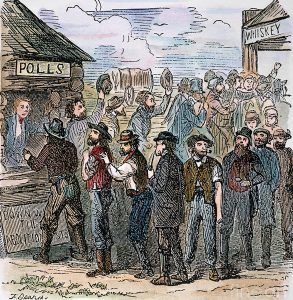
Thousands of pro-slavery men from Missouri crossed the border into Kansas to stuff the ballot boxes.
“If the outrageous fraud by which the Missourians pretended to elect representatives for Kansas astonished the world, the proceedings of the conclave of vagabonds assembled under this mob authority, were still more astonishing. Never did a less responsible body of men assemble under the pretense of making laws.”
— William Addison Phillips, The Conquest of Kansas, by Missouri and her Allies, 1856
The Kansas-Nebraska Act of 1854 created the territories of Kansas and Nebraska and repealed the Missouri Compromise of 1820. It allowed the territory settlers to determine if they would allow slavery within their boundaries. Though the initial purpose of the Kansas-Nebraska Act was to create opportunities for a transcontinental railroad, that changed with the struggles between the north and south for dominance on the issue of slavery.
Numerous debates were held before the act was passed in Congress. During that time, the northern states determined that the only way to rescue the new territory of Kansas from pro-slavery advocates was to send numerous northern emigrants into the territory to establish it as a free state. Before the Kansas-Nebraska Bill was passed, several Emigrant Aid Societies were formed, primarily in New England, to populate the state with anti-slavery proponents.

Ho for the Kansas Plains.
Leading the charge was a Massachusetts House of Representatives politician named Eli Thayer, who formed the Massachusetts Emigrant Aid Company, which provided a plan to raise capital to offer inducements to anti-slavery emigrants sufficient to offset the hardships of frontier life. Thayer’s plan worked. Before long, many other Emigrant Aid societies were formed, sending thousands of emigrants from free states, including New England, Iowa, Ohio, and other Midwestern states, into Kansas Territory.
These emigrants were known as Free-Staters, who quickly established new settlements such as Lawrence, Topeka, and Manhattan. By the time they arrived, several settlements had already been formed by pro-slavery “squatters,” including Atchison, Lecompton, and others.
To protect themselves against the pro-slavery advocates, the Free-Staters formed several organizations, including the “Actual Settlers’ Association of Kansas Territory,” which held its first meeting on August 12, 1854, to adopt regulations that would protect them from the pro-slavery squatters.
In January 1855, a small group of men in the politically charged town of Lawrence organized the “Free State Society” to ” use all its influence for the prohibition of slavery in Kansas.”

The First Territorial Capitol at Pawnee, Kansas, was only used for one session before moving to Lecompton, Kansas, when the pro-slavery advocates controlled the state, by Kathy Alexander.
On May 30, 1855, an election was held to establish the Kansas Legislature, which was won and organized by pro-slavery advocates, primarily due to hundreds of non-residents flooding over the Missouri state line and “stuffing” the ballot boxes. The “Free-Staters” were incensed, but the U.S. Federal Government recognized the new territorial government, which the Free-Staters referred to as the “Bogus Legislature.”
Soon afterward, the Kansas Free-State Party was formed to reject the Bogus Legislature. The Free State Party formed a “second” legislature that began at a meeting at Big Springs, Kansas, in September 1855. The new party encouraged Republicans in Congress to block pro-slavery efforts to control Kansas and formed several new constitutions over the next several years, which would repeatedly be rejected.
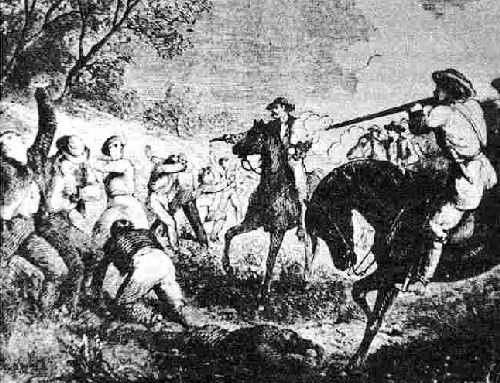
Bleeding Kansas Fight.
During these early days of the Free-Staters, the turmoil between the two factions dramatically increased, leading to the Kansas-Missouri Border War and brutal attacks by Jayhawkers upon the slavery men and raids upon anti-slavery settlers by Missouri Bushwhackers.
The battles between the opposing parties continued until a referendum was finally authorized by the English Bill of 1858, which dashed all pro-slavery hopes of Kansas Territory becoming part of the “South.” However, continued struggles would delay the admission of Kansas as a free state until January 1861. In the meantime, the bitterness between the factions continued into the Civil War.
The Free-State Party formally merged with the Republican Party in 1859 at a meeting in Osawatomie, Kansas.
©Kathy Alexander/Legends of Kansas, updated March 2025.
Also See:
Kansas-Missouri Border War Timeline
Pro-Slavery Movement in Kansas
See Sources.