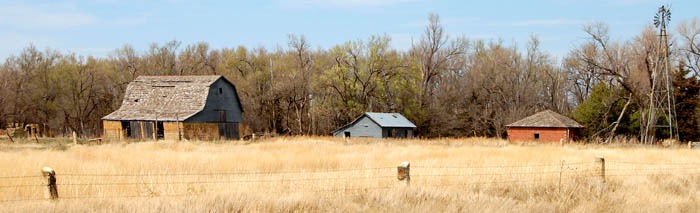
An old homestead in Ellis County, Kansas, by Kathy Alexander.
| Town | Post Office Dates | Additional Information |
| Bantam | 1906-1910 | Located about 12 miles northwest of Hays, the post office moved to Hyacinth in 1910. |
| Big Creek Station | 1867 | The post office moved from Fort Fletcher, which had only been open for four months. The post office moved to Hays. |
| Chetolah | 1888-1897 | Chetolah got its start in 1886 as a potential railroad town. However, the railroad didn’t come through. The Palatine post office was moved to Chetolah in 1888. |
| Coyote | 1868 | The post office was only open for about five months. |
| Czech Colony | None | A colony of settlers from Bohemia came to Ellis County in 1885 and settled on land south of Ellis along the Trego County line. The town never grew big enough for a post office. |
| Easdale | 1878-1887 | The post office moved to Pfeifer in 1887. Located in the southeast part of Ellis County. |
| Emmeram/Norddorf | 1903-1904 | Named after the famous church builder, Father Emmeram Kausler, the community consisted of the Sacred Heart Church and two schools. Though a town plot was filed in 1902, the town never materialized. The post office name was Emmeram. |
| Finch | 1907-1908 | Located on the Saline River, about 20 miles northeast of Hays. |
| Fort Fletcher/Fort Hays | 1866-1867 | Post office at Fort Fletcher. The post office moved to Big Creek Station in 1867. |
| Hog Back Station | None | Named for a ridge of land with a sharp summit and sloping sides located halfway between Hays and Ellis. There was a railroad station located in Hog Back at one time. Now Yocemento. |
| Hyacinth/Bantam | 1906-1914 | A Volga German community, it was located about ten miles northwest of Hays. The name was changed from Bantam to Hyacinth in 1910. The St. John Baptist Church was built in 1906 and served the community until 1967. Only the cemetery remains today. |
| Martin | 1875-1894 | Located in North Central Ellis County on the Saline River. |
| Mendota/Halton | 1878-1909 | Mendota was a small town about 20 miles northwest of Hays on the Saline River. A post office was established in Halton on March 27, 1878. On February 6, 1882, the name was changed to Mendota, and Harvey M. Hallock was the first postmaster. The post office closed on November 30, 1909. |
| Norfolk | 1889-1909 | |
| Over Muncha | 1880 | The post office was only open for five months. |
| Palatine | 1880-1897 | |
| Rome | None | Rome, Kansas, the first settlement formed after Ellis County was officially organized, just west of Hays. Buffalo Bill Cody organized it. |
| Severin | None | Located five miles northwest of Catherine, the town was founded by former members of the Catharine parish. Reverend Father Severin, in whose honor the town was named, was its first pastor. The church was built in May 1916 and was dedicated on June 22, 1916. |
| Smoky Hill Crossing/Station | 1900-1915 | Established in 1867 on the Fort Hays-Fort Dodge Military Road. Billy Dixon owned a “whisky ranch.” |
| Stock Range | 1883-1895 | A small settlement with a post office located in southwest Ellis County on the Smoky Hill River. |
| Sweetwater | 1883-1885 | |
| Toulon | 1889-1891 1898-1901 |
A small village located on the Union Pacific Railroad, five miles east and one mile south of Hays. It was first settled In 1876 by people from Pennsylvania. |
| Turkville | 1875-1918 | Settled by a colony from Tennessee in 1876, which founded the first Baptist church in Ellis County. It was located in the northeast corner of Ellis County on the Saline River. |
| Tyner | 1880-1881 | |
| Vincent | None | This small village got its start in 1907, when several families from the St. Fidelis Church in Victoria wanted a church closer to their farms. |
| Viola | 1881 | The post office was open for less than four months. |
| Yocemento | 1907-1917 | Yocemento was the site of a cement plant that eventually went bankrupt. |
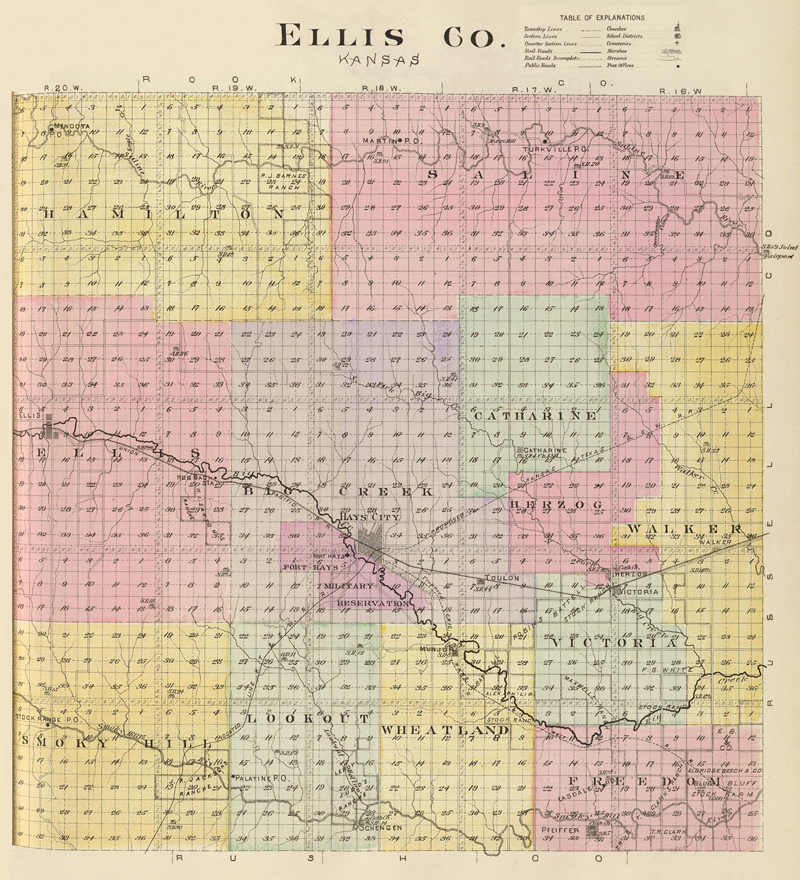
Ellis County, Kansas Map by L.H. Everts & Co., 1887.
©Kathy Alexander/Legends of Kansas, updated June 2026.
Also See:
See Sources.