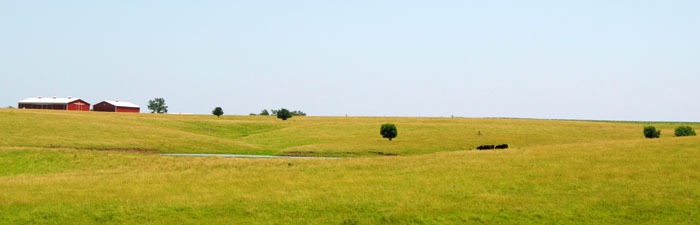
Douglas County, Kansas, landscape near the old town of Lone Star, Kansas, by Kathy Alexander.

Douglas County, Kansas Location.
Towns:
Big Springs – Unincorporated
Clinton – Unincorporated
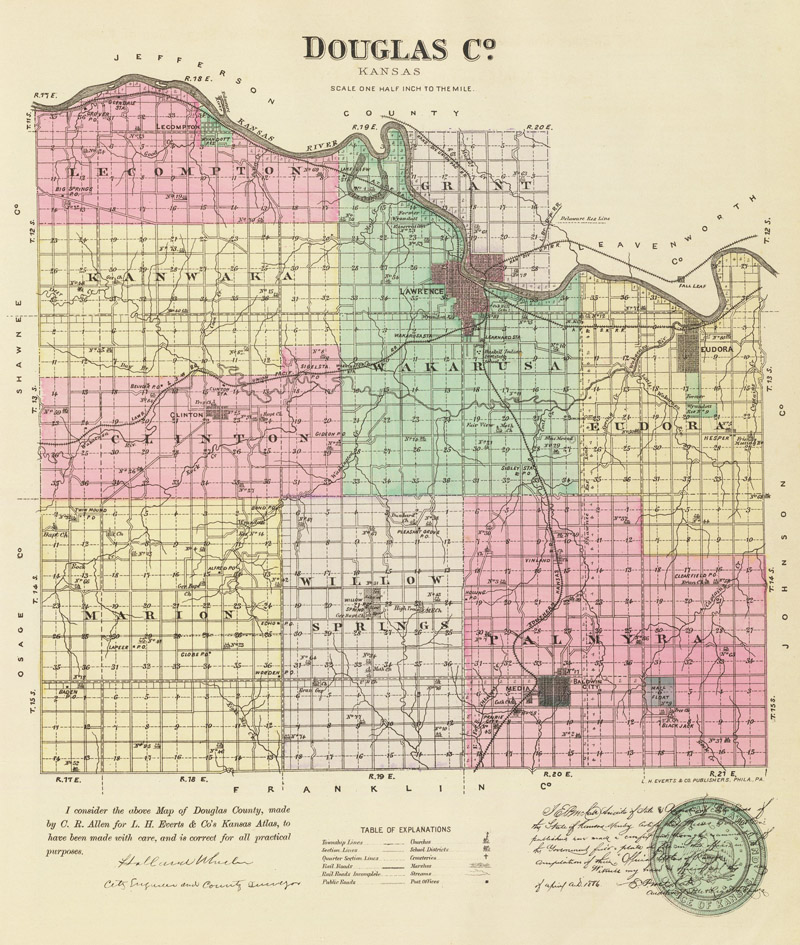
Douglas County, Kansas Map, by L.H. Everts & Co.1887.
Lawrence – County Seat
Vinland – Unincorporated
Haskell Indian Nations University
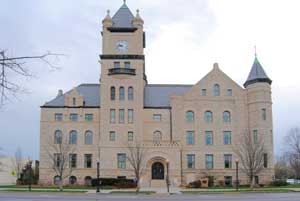
Douglas County Courthouse in Lawrence, Kansas by Kathy Alexander.
One-Room, Country, & Historic Schools of Douglas County
Santa Fe Trail in Douglas County
Located in northeast Kansas, Douglas County was one of the original 33 counties created by the First Territorial Legislature in July 1855. The county was named in honor of Stephen A. Douglas, a United States Senator from Illinois who had supported the Kansas-Nebraska Act in 1854.
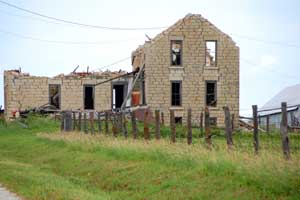
Simmons Point Stage Station on the Santa Fe Trail in western Douglas County, Kansas, by Dave Alexander.
Before the area was opened to white settlement on May 15, 1854, the region was held by the Shawnee Indians as part of their reservation under a treaty made in 1825. This treaty allotted the Shawnee some 200,000 acres, most of it in adjacent Johnson County, and encompassed much of the land in Eudora Township in the northeastern part of Douglas County. As soon as the territory was thrown open to settlement, “squatters” ignored the treaty with the Shawnee, arriving from Missouri and other states to secure claims, as the region had long been known as a desirable location.
These, however, were not the first white men in what would become Douglas County. After Captain William Becknell opened the Santa Fe Trail in 1821, the trail would be crossed by hundreds of traders and emigrants making their way to Santa Fe, New Mexico. The trail entered Douglas County, Kansas, near its southeast corner, a few miles east of the old town of Black Jack, before taking a northwesterly course through Palmyra and on to Willow Springs. Here, it turned to the southwest, passing close to the now-extinct towns of Globe and Baden and into Osage County, about three miles north of the southwest corner of Douglas County. Several sites and trail segments can still be seen when traveling the old route today. U.S. Highway 56 closely follows the trail east to west through the area.
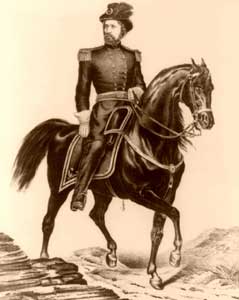
John C. Freemont by Ehrgott Forbriger Co.
The first permanent white settlement in what is now Douglas County was made by Frederick Chouteau in 1827, when he established a trading post on the south bank of the Kansas River, a little above what would become the settlement of Lake View. However, he remained only briefly, moving to Shawnee County in 1830. In 1848, the Methodist Episcopal Church established a mission among the Shawnee on the south bank of the Kansas River, near the mouth of the Wakarusa River, but it was abandoned in 1857.
In June 1842, General John Charles Fremont, on his first exploratory tour to the Rocky Mountains, traveled from Cyprian Chouteau’s trading post on the Kansas River, six miles west of the Missouri line, and encamped near the present location of Lawrence. He described it as follows:
“We encamped in a remarkable, beautiful situation on the Kansas bluffs, which commanded a fine view of the river valley, here from four to five miles wide. A broad belt of heavy timber occupied the central portion, and nearer the hills prairies were of the richest verdure [vegetation].”
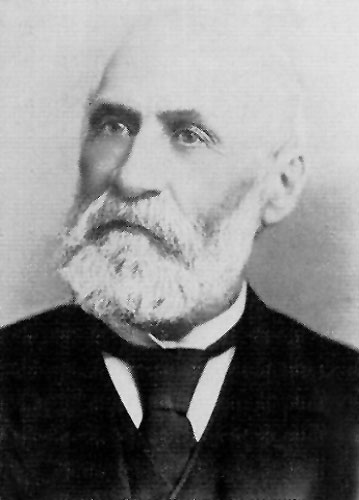
Charles Lawrence Robinson.
Many other California emigrants passing over this route were particularly struck with the beauty of the scenery and the magnificence of the view in the vicinity of present-day Lawrence—among them was Dr. Charles Lawrence Robinson. He later became one of Douglas County’s pioneer settlers and most honored citizens.
When the area officially opened for settlement in May 1854, hundreds of emigrants flocked to the region to make Kansas either a Free or a slave state. The abolitionists primarily settled in Douglas County, and soon Lawrence would become the center of the conflict known as Bleeding Kansas.
Most of the claims taken by the Missourians were merely staked out or a few logs cut and piled up crosswise to show occupation; sometimes, only a notice was posted. Of these non-resident squatters, nearly all returned to Missouri. Still, they had organized and agreed to have no interference with their “paper” claims, threatening to shoot any man who attempted to take possession.
But the New England Emigrant Aid Company made the most systematic movement toward colonization. It directed a party of men from Massachusetts and Vermont to start for Kansas to establish permanent settlements and work to make Kansas a Free State. Other companies followed, and together, they founded the city of Lawrence.

Early day, Lawrence, Kansas Territory.
When squatters took claims, it was assumed that they had secured the land for a permanent home and intended to improve it. As many did not do this, the early settlers formed associations to protect themselves against encroachment upon the land. Before the New England emigrants came to the territory, two such organizations had been formed in what would become Douglas County. A call was issued for a meeting on July 8, 1854, at Blue Jacket’s store on the Wakarusa River. The Free State men who had already located in the vicinity believed that the meeting was to be of men friendly to making Kansas a Free State and attended in considerable numbers. Upon their arrival, they discovered a meeting of squatters to make rules and regulations concerning their claims. A number of those present were pro-slavery in sentiment and wished to introduce resolutions barring emigrants opposed to the institution of slavery; however, there were too many Free State men present to carry out their plan, and a compromise was effected by which any person had a right to bring property into the state. The question of slavery was to be settled when the territory had a sufficient population to be admitted to statehood. Some of the more bitter pro-slavery men were not satisfied with the turn of affairs. They openly declared that they intended to fight the territory’s settlement by Free-State men, especially the New England Company. This first organization was known as the Wakarusa Association.
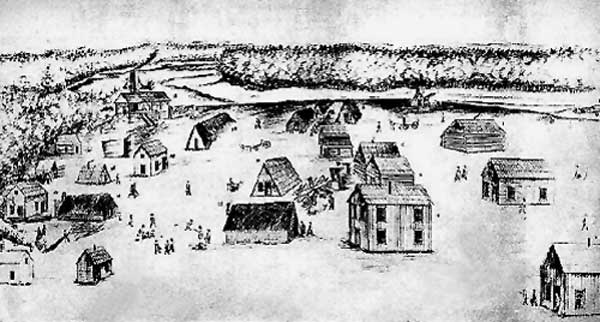
Lawrence, Kansas, in 1854.
Another meeting of the “Free-State” settlers was called on August 12, 1854, to adopt regulations to protect the actual settlers, not unlike those adopted by the pro-slavery men farther east. It was generally understood that only actual settlers were expected to attend. Still, the members of the Wakarusa Association and many other pro-slavery men were present, traveling from a radius of some 40 miles. When the meeting was called to order, and it was stated that the objective was to be a conference of actual settlers in the territory, one of the Missouri men present caused a disturbance, which led to a quarrel and almost caused the meeting to break up.
However, a compromise was reached, and after considerable argument and deliberation, a committee was chosen from each association to agree on a plan to work together to benefit both.
A joint committee was formed to settle many of the claim difficulties and disputes afterward. As new settlers entered the territory, they joined either association as they preferred.
In the meantime, A.D. Searle laid out the townsite of Lawrence in September 1854, and lots began to be sold and buildings erected. The same year, the first church in the county was established—the Lawrence Plymouth Congregational Church. Today, the church still provides services in its 1870 building at 925 Vermont Street, which is listed on the National Register of Historic Places.
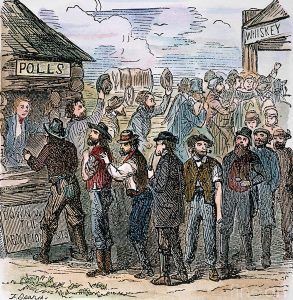
Voting in Kansas.
The first election for a delegate to Congress was held on November 26, 1854, but the Free-Staters took little interest in it for whatever reason. Still, the significant number of Missourians who voted at the time should have given the residents some hint of what would follow at the local elections. Douglas County, with only 50 legal voters, cast 283 votes.
The election for the first territorial legislature members was set for March 30, 1855. By this time, the district in which Lawrence was located had 369 voters. For weeks before the election, the residents in the border counties of Missouri were active, and the Blue Lodges perfected a plan of campaign by which their members were to march into Kansas on Election Day, take possession of the polls, and by a heavy vote gain control of the legislature. Companies were sent into every council district in the territory and into every representative district but one in such numbers to control the election. With the avowed purpose of voting, they came openly, heavily armed and provisioned. About 1,000 of these men entered Douglas County the evening preceding the election and the morning of Election Day.
The polls were crowded all day, and Missourians forced the Free-Staters to pass through two lines before reaching the polls. During the day, some Free State voters were driven away and prevented from voting. Although the district had 369 voters, according to the census, 1,034 votes were cast, and a careful examination showed that only 232 were legal.
The first school was opened in Lawrence on January 16, 1855, and an official school district was established in July that year.
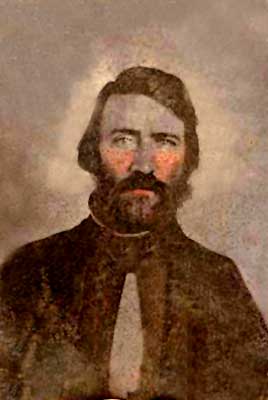
Samuel J. Jones, pro-slavery sheriff of Douglas County, Kansas.
Samuel J. Jones was appointed sheriff of Douglas County by the first territorial legislature, and the county was officially organized on September 24, 1855. The first commissioners divided the county into municipal townships: Lecompton, Lawrence, Franklin, Washington, and Louisiana. By the first act of organizing the county, the county seat was designated as Lecompton, which was made the capital of the territory by the same legislature. It remained the county seat and territorial capital as long as the pro-slavery party was in power.
For the next several years, many of those who lived in Douglas County and other areas of eastern Kansas were involved in what is known as the Kansas-Missouri Border War – the bloody conflict between the advocates and opponents of slavery to settle the question as to whether Kansas should be admitted into the Union as a free or slave state.
The “War” lasted from 1854 until 1859 and included several skirmishes, including the Wakarusa War, the Sacking of Lawrence, the Pottawatomie Massacre, the Battle of Hickory Point, and several others.
In 1858, the legislature passed an act relocating the county seat to Lawrence, where it has remained since.
The same year, Kansas Territorial Governor James W. Denver signed the charter establishing Baker University in Baldwin on February 12, 1858. The United Methodist Church helped fund Baker University’s creation, and it was named after Bishop Osman C. Baker. The school opened its doors to students in November 1858 and was the first four-year university in Kansas. It continues to educate students at its main campus at Baldwin and satellite campuses in Overland Park and Topeka, with an enrollment of about 3,000. Today, several of the college’s original buildings are listed on the National Register of Historic Places.
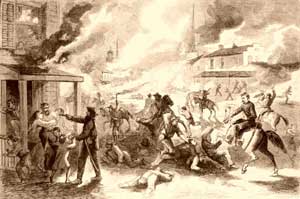
Lawrence Massacre, September 5, 1863, by Harper’s Weekly.
During the Civil War, Lawrence saw the southern sympathizers’ wrath when William Quantrill led some 300-400 men into the Free State stronghold and incited one of the bloodiest events in Kansas history, known as the Lawrence Massacre. In four hours, Quantrill and his men killed some 150 men, burned about a quarter of the town to the ground, including all but two businesses, and looted the banks and retail establishments. However, Lawrence rebuilt and continued to maintain its status as the county seat.
The University of Kansas formally opened its doors to students in September 1866, but its history dates back to 1855. Today, the University of Kansas continues to influence some 28,000 students each year at its Lawrence campus and satellite campuses, as well as research and educational centers, medical centers, and classes across the state of Kansas. The original campus is now the University of Kansas Historic District, covering 85 acres and including 52 resources—buildings, landmarks, and landscapes. Between 1863 and 1951, six of the buildings were individually listed in the National Register of Historic Places.
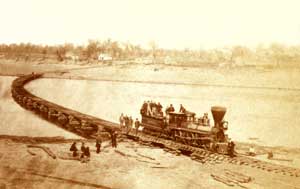
Leavenworth, Lawrence & Galveston Railroad Bridge across the Kansas River, Lawrence, Kansas, by Alexander Gardner, 1867.
The county offices were located in different business blocks until the city hall was built in 1869. In 1903, a fine new courthouse was erected on the corner of Massachusetts and Quincy Streets for $85,000. The county jail and sheriff’s house were located just behind the courthouse on Hancock Street.
The first railroad in Douglas County was the Kansas Pacific Railroad, which was constructed in 1864. In 1869, the Leavenworth, Lawrence & Galveston Railroad was built south from Lawrence into Franklin County. As the railroads continued to push westward, the many wagon trails became obsolete. The railroads also created jobs and led to the establishment of several manufacturing businesses. Railroad construction also created a new town north of the Kansas River that became known as North Lawrence. Here, various businesses clustered around the railroad repair shops and the Delaware Street grist and sawmill. By 1871, Lawrence would be the western terminus of that line, establishing an unbroken connection with St. Louis, Missouri, and points farther east. This spawned more railroads to come through the county, and the completion in 1879 of the Lawrence Dam on the Kansas River ushered in a new era in Lawrence’s economic history.
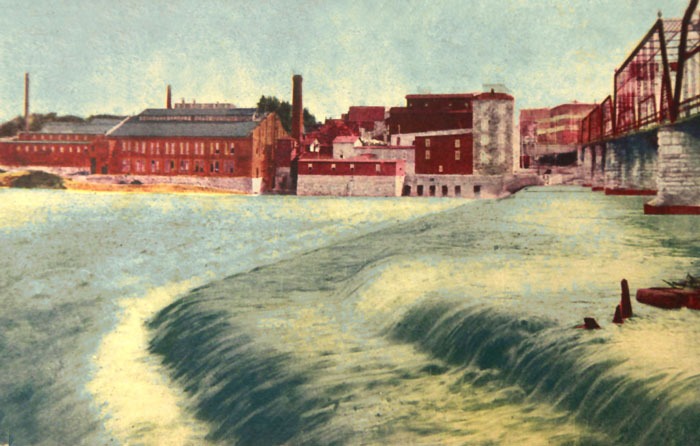
Factories along the Kansas River Front in Lawrence, Kansas.
By the early 1880s, Lawrence had become a prosperous market town for agricultural businesses in Douglas County, part of a regional economy dominated by the larger cities of Kansas City, Missouri, and Topeka, Kansas. At this time, two- and three-story brick-and-stone factory buildings, warehouses, wholesale houses, and retail businesses became more prominent in the townscape.
At this time, the demand for manufactured goods was high, and Lawrence controlled a local trade of about 40,000 people, including manufacturers, prosperous farmers, and stock raisers.
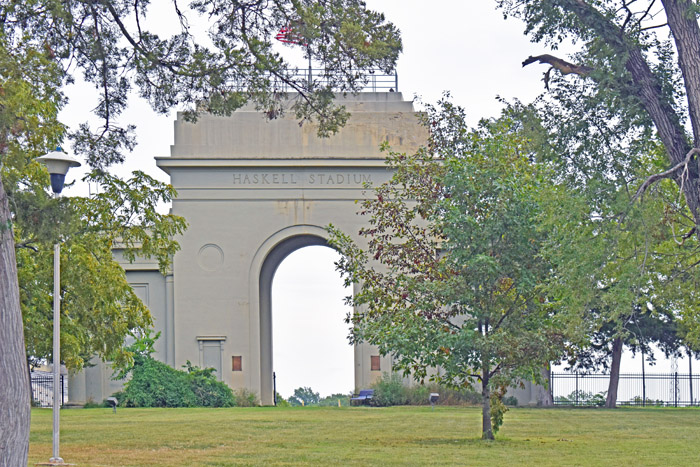
Haskell University Arch by Kathy Alexander.
In 1884, Haskell Indian Nations University was established in Lawrence as a residential boarding school operated by the United States government to educate Native American girls and boys. Today, the tribal university offers associate and baccalaureate degrees to 1,000 students per semester in various subjects. Representing approximately 140 Tribal nations and Alaska Native communities, Haskell is home to the Haskell Cultural Center and Museum, the American Indian Athletic Hall of Fame, and the Indian Leader, the oldest American Indian student newspaper in the country. Twelve campus buildings have been designated as U.S. National Historic Landmarks.
Douglas County was home to 25,096 people by the turn of the century. However, the population would drop as manufacturing slowed and the nation neared the Great Depression over the next two decades.
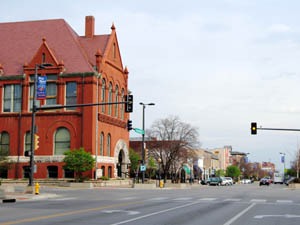
Downtown Lawrence, Kansas, by Kathy Alexander.
By the late 1930s, the number of manufacturing industries had dropped significantly, but the Kaw Valley agriculture continued to be successful. Industrial development shifted from the area’s traditional river and rail lines in the post-World War II period. However, by the early 1950s, the county promoted itself as a site for plant relocation in response to federal recommendations that industry move inland from heavily industrialized coastal areas. Soon, new plants were established, and the county moved into other commercial sectors, including technology, healthcare, education, finance, and scientific research.
By 1950, the county’s population had grown to 34,086 and continued to grow over the years. Today, the county is one of the fastest-growing in Kansas and supports a population of about 122,000 people within its 457 square miles.
Many museums, dozens of historic properties, and numerous recreational opportunities are available throughout the county. West of Lawrence, Clinton Lake offers boating, fishing, and other water sports, and the surrounding parks provide camping and trails for mountain biking, hiking, and horseback riding. To the southwest of Lawrence is Lone Star Lake, a small country lake that offers fishing, boating, and camping. Just northwest of Baldwin City is Douglas State Fishing Lake, which provides hunting, fishing, and limited camping. Other parks around the county include Black Jack Park, which includes the Ivan Boyd Prairie Preserve and Robert Hall Pearson Memorial Park, Broken Arrow Park in Lawrence, and Wells Overlook Park just south of Lawrence.
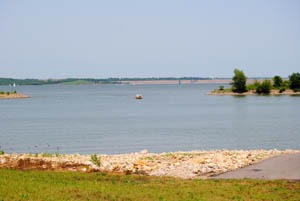
Clinton Lake, Clinton, Kansas, by Kathy Alexander.
Significant events in the county include the Maple Leaf Festival in Baldwin City every third full weekend in October, Lecompton’s Territorial Days every June, and Lawrence’s many parades throughout the year, including Christmas and St. Patrick’s Day.
Contact Information:
Douglas County, Kansas
1100 Massachusetts
Lawrence, Kansas 66044
©Kathy Alexander/Legends of Kansas, updated September 2025.
Also See:
Lawrence, Kansas – From Ashes to Immortality
Territorial Kansas & the Struggle For Statehood
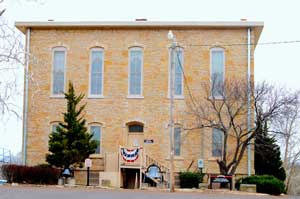
Old Territorial Capitol in Lecompton, Kansas by Kathy Alexander.
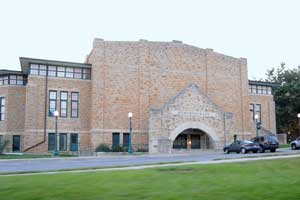
Baker University Memorial Hall in Baldwin, Kansas, by Kathy Alexander.
Sources:
Blackmar, Frank W.; Kansas: A Cyclopedia of State History, Vol I; Standard Publishing Company, Chicago, IL 1912.
Cutler, William G.; History of Kansas; A. T. Andreas, Chicago, IL, 1883.
East Lawrence Industrial Historic District Nomination
Kansapedia
Santa Fe Trail
Wikipedia