|
Legends of Kansas
What's New!!
Also see:
Legends of America


Rocky Mountain General
Store
The
Book Shelf
Exclusive
Products
Postcard
Rack
Route 66 Emporium
Vintage Photographs

12343 W. 79th Terrace
Lenexa,
KS 66215
913-708-5119
Please report
broken links, missing pictures, or other problems online by clicking
HERE
or send us an
email.
Thanks!
| |
|
|
|
Constitutional Conventions of Kansas |
|

|
|
<< Previous 1
2
3
4
Next >> |
|
Kansas was organized as a territory of the United States by the
Kansas-Nebraska Act, which was approved by President Franklin Pierce on May 30,
1854. Scarcely had the echoes of the Congressional debates on that measure died
away, when an agitation was started for the admission of Kansas as a state. The
primary issue at hand was whether Kansas should become a free or a slave state,
and in the first efforts for statehood the
Free-State men were the aggressors.
The
"Bogus Legislature," elected on March 30, 1855 might have called a
Constitutional Convention at its first session in July, 1855, but it did not
do so. One house passed a resolution to that effect, but the other, fearing
the result of the election, declined to concur. From the pro-slavery
standpoint, this was a fatal mistake.
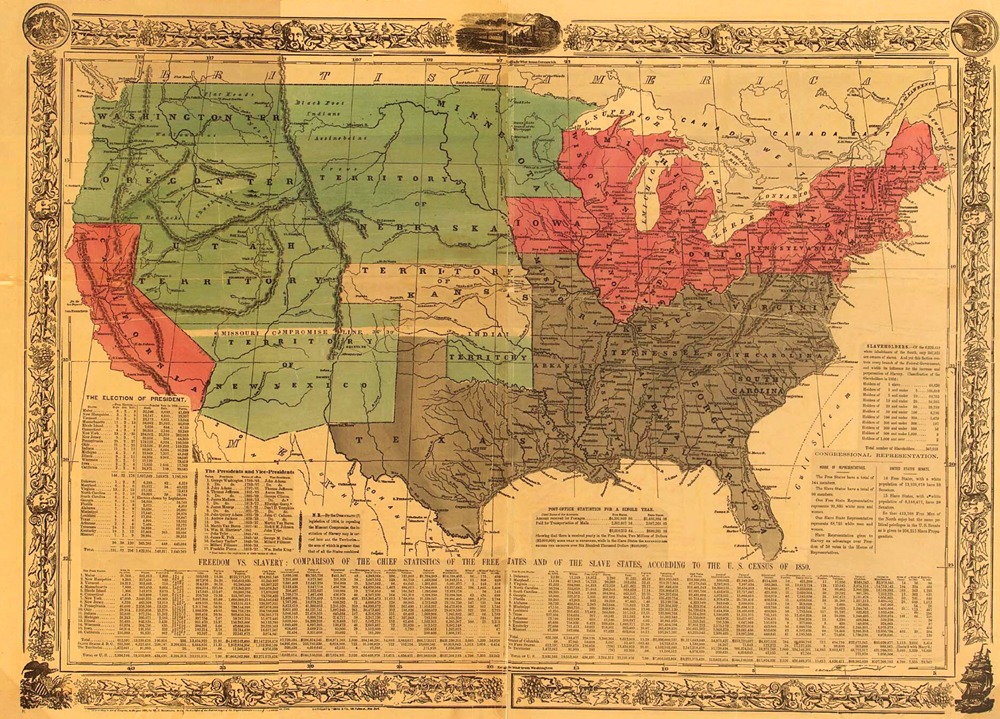
|

1856 map shows slave states in gray, free states in red, US
territories in
green, and undecided Kansas
in center with
no color.
|
|
| Never again was the
pro-slavery interest so strongly entrenched in the territory. The
governor, the courts, the army and the President and his cabinet and
Congress all were with them, and the Legislature might have called a
convention with the assurance that the election could be carried by the same
methods by which it was elected and that those methods would be approved at
Washington. In all probability if this had been done, Kansas
would have been admitted in 1855 with a pro-slavery constitution.
Instead, the pro-slavery men chose to make the fight
against admission at this time because so long as the Federal Government was
behind them they could control the Territorial Government and they believed
that by implementing pro-slavery laws, they could drive the
Free-State men
out of the territory. This was especially true if they could make the charge
of treason stick against the promoters of the Topeka Movement.
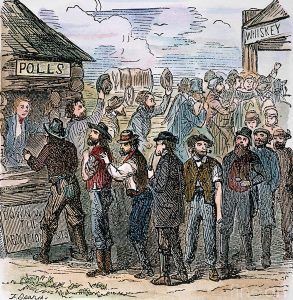
The
Free-State men; however, were determined
and though the
so-called
"Bogus Legislature"was "officially" in charge, a
meeting of
Free-State men was held at Topeka on September 19, 1855 that
called for an election of delegates to a Constitutional Convention to be
held at Topeka on October 23, 1855.
An election was held on October 19,
1855, in which a full list of forty-seven delegates was determined. The
pro-slavery people did not participate in the election, the breach already
being too wide between the parties. They also contended that a
Constitutional Convention could only be called by the the Legislature (Bogus Legislature) and ridiculed the whole movement. The
Free-State men, on the
other hand, contended that a constitution might be drafted by any
convention, however informally called; that the vital question was its
ultimate adoption or rejection by the legal voters at an election held for
that purpose. To support their contention they had the precedent of
California , whose constitution was drafted by a convention held under a
popular call.
Topeka Convention
The Constitutional Convention met at Topeka on October 23, 1855. It
consisted of forty-seven delegates, including eighteen Democrats, six Whigs,
Four republicans, two Free-Soilers, one
Free-State man and one Independent.
The group elected
James H. Lane
as president and Samuel C. Smith as
secretary.
|
|
|
|
Several of the
delegates elected failed to attend the sessions of the convention. The following
list of the men who framed the constitution was compiled from the manuscript
records of the convention.
James M. Arthur,
Thomas Bell, Frederick Brown, Orville C. Brown, Harrison Burson,
Martin F. Conway,
Rufus H. Crosby, A. Curtiss, George A. Cutler,
Mark W.
Delahay, David Dodge, J.
S. Emery, D. M. Field, Matt France, J. K. Goodin, William Graham, William R.
Griffith, W. H. Hicks, G. S. Hillyer,
Cyrus K.
Holliday , Morris Hunt, Amory
Hunting, Robert Klotz, Richard Knight, John Landis,
James H. Lane , S. N. Latta,
Sanford McDaniel, Caleb May, Samuel Mewhinney, J. H. Nesbitt, M. J. Parrott,
James Phenis, Josiah H. Pillsbury, Robert Riddle, W. Y. Roberts, Charles L. Robinson, James L. Sayle, Phillip C. Schuyler, George W. Smith, H. Smith, C. W.
Stewart, J. C. Thompson, J. M. Turner, J. M. Tuton, N. Vandever, and J. A.
Wakefield.
|
|

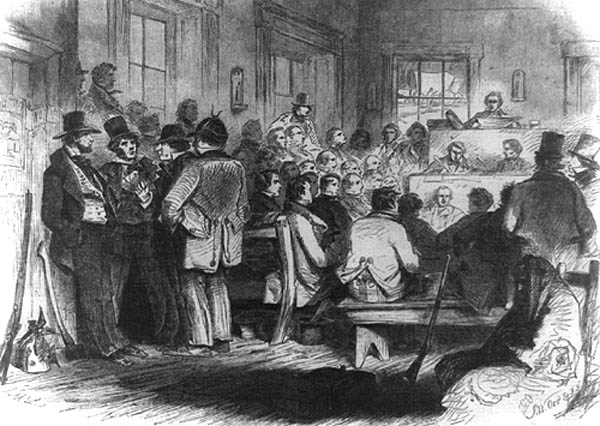
The
Topeka Constitutional Convention, Frank Leslie's
Illustrated
Newspaper, 1855.
|
The convention
completed its labors on November 11, 1855 and provisions were made for the
submission of the constitution to the people on December 15th. In the event the
constitution was ratified by popular vote at that time, the chairman of the
Free-State Executive Committee of the territory was directed to issue a
proclamation ordering an election for state officers and members of the
legislature on the third Monday of January, 1856, and the legislature then
chosen should meet on March 4, 1856.
In the December
15th election,
Charles L. Robinson was elected governor and the first
Free-State Legislature met at Topeka March 4,
1856. It elected ex-Governor
Andrew Reeder (who had been appointed by
President Franklin Pierce in June, 1854) and
James H. Lane
as United States Senators.
|
|
The adoption of the constitution and the election of
these state officers caused no small commotion in the political circles at
Washington. The Bogus Legislature was still in existence and recognized by the
Government at Washington as the only legislative authority in
Kansas and the
Territorial Governor appointed by the President was in full charge of the
executive branch with the United States Army at his command and the Federal
judiciary submissive to his desires. The whole Topeka movement was regarded as
treasonable. President Franklin Pierce in a special message to Congress on January 24,
1856, said:
"No
principle of public law, no practice or precedent under the Constitution of the
United States, no rule of reason, right, or common sense, confers any such power
as that now claimed by a mere party in the territory. In fact, what has been
done is of a revolutionary character. It will become treasonable insurrection if
it reaches the length of organized resistance by force to the fundamental or any
other federal law. "
Continued Next Page
|
|
|
|
|
<< Previous 1
2
3
4
Next >> |
|
From the Rocky Mountain General Store
Kansas Postcards -
If you're like we are and can't get enough of
Kansas,
take a virtual tour through our many
Kansas Postcards. Each one of these is unique and, in many cases, we have only one
available, so don't wait. To see them all, click
HERE!
 |
| |
|