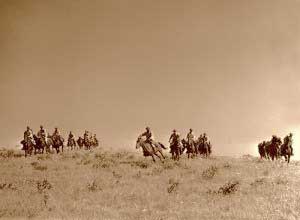
Kansas Cavalry Unit.
In proportion to population, Kansas furnished more troops to the Union army during the Civil War than any other loyal state. This is not surprising when the character of the men who made the state is considered. Most of the pioneers were nurtured in an atmosphere opposed to slavery. When they established their homes in the Territory of Kansas, they were compelled to undergo a long struggle with the slave power, and when the slave states attempted to secede from the Union, the men of Kansas felt they had an old score to settle — an old wrong to avenge. Under all calls for volunteers from April 15, 1861, to December 19, 1864, the quota of Kansas was 16,654 men, while she furnished 20,097. These volunteers were divided into seven regiments of infantry, nine of cavalry, and three batteries of light artillery. In addition to these organizations, there were two regiments of colored infantry and an independent colored battery accredited to the state.
The first infantry was organized under the call of President Abraham Lincoln on May 8, 1861, and was mustered into the U.S. service at Leavenworth on June 3. Soon after the muster, it was ordered to Missouri, marched through Boonville, Springfield, and Clinton, and joined General Nathaniel Lyon’s forces at Grand River. It took part in the Battle of Wilson’s Creek, Missouri, on August 10, 1861, where it was killed and wounded. Over half the number of men were actually engaged, winning the commendation of the Union commanders. The regiment was then employed until the following October to guard the lines of the Hannibal & St. Joseph and the Missouri Pacific Railroads. In February 1862, it was ordered to Fort Leavenworth, where the men received a ten-day furlough, and early in May, before being ordered to join the army at Pittsburg Landing, Tennessee. During the summer, it was engaged in opening and guarding the Mobile & Ohio Railroad. In October, it moved to Corinth, Mississippi, where it was assigned to the advance in pursuit of the retreating Confederates. On February 1, 1863, it was mounted by order of General Ulysses S. Grant and then employed in the vicinity of Vicksburg, guarding roads, etc. The regiment was mustered out at Fort Leavenworth on June 17, 1864, except for the reenlisted men, who had been organized into a veteran battalion at Bovina, Mississippi, on May 28, 1864. This battalion was mustered out at Little Rock, Arkansas, on August 30, 1865. While in the service, the First Kansas traveled over 6,000 miles and participated in 30 engagements. The casualties of the regiment amounted to 97 killed, 34 died of wounds, 94 died of disease, and 210 were discharged for disability.
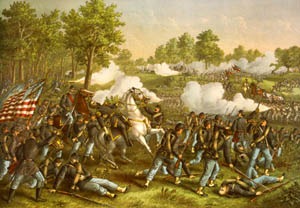
Battle of Wilsons Creek, Missouri by Kurz and Allison, 1893.
The Second Infantry was a three-month regiment organized under the call of April 15, 1861, for 75,000 men. It was mustered in at Kansas City, Missouri, on June 20, 1861, and was mustered out at Leavenworth on the last day of the following October. Immediately after the muster, the regiment was ordered to Missouri and joined Sturgis’ brigade at Clinton. Early in July, it joined the First Kansas, and the two regiments were formed into a brigade under the command of Colonel Deitzler. Subsequently, it joined General Lyon’s forces and took part in the Battle of Wilson’s Creek. It also participated in engagements at Forsythe, Dug Springs, Paris, Shelbina, and Iatan in Missouri. The casualties were five killed, eight died of wounds, one went missing, two died of disease, and seven were discharged for disability.
The Second Cavalry was the outgrowth of several companies that were organized in Wyandotte and adjoining counties late in 1861. These companies were consolidated with Nugent’s Missouri Home Guards, and on March 27, 1862, the regiment was organized as the Second Kansas Cavalry, with Robert B. Mitchell as colonel.
The main portion of the regiment was mustered out at Little Rock, Arkansas, on April 21, 1865, and the veteran battalion at Fort Gibson, Indian Territory, on June 22, 1865. Its first service was in the Indian Territory. In August, it was ordered back to Fort Scott, Kansas, where it received orders to assist in pursuing Colonel Coffey’s command. At Coon Creek, Missouri, on August 23, the regiment encountered some of Shelby’s men, and a sharp skirmish ensued.
Later, it was engaged at Newtonia, Marysville, and some minor actions. At old Fort Wayne, a portion of the regiment made a brilliant charge, capturing four artillery pieces. After that, most of the service was along the border until the winter of 1863-64, when it moved into Missouri and Arkansas. It formed part of General Steele’s expedition to Little Rock, participated in the battles of Cane Hill, Prairie Grove, and Cabin Creek, and won a reputation for valor, skill in scouting, etc. While in the service, the Second Cavalry lost 51 killed, 13 died of wounds, eight were reported missing, 94 died of disease, and 91 were discharged on account of disability.
Two regiments designated as the Third and Fourth were projected in the fall of 1861, but they were consolidated as the Tenth Infantry in the spring of 1862.
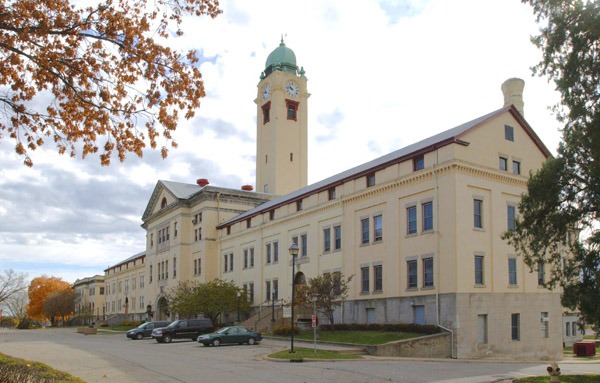
Grant Hall, Fort Leavenworth, Kansas.
The organization of the Fifth Cavalry was commenced in the summer of 1861. Its active service began in July when Companies A and F left Fort Leavenworth for Kansas City, Missouri, and a few days later joined Colonel Weer’s expedition to Harrisonville, where Company F lost one man killed. Hampton P. Johnson, who had been selected for the colonel of the Fifth, was killed at Morristown, Missouri, on September 16, 1861. However, the adjutant-general’s report gives his name as colonel when the regiment was mustered in at Barnesville, Bourbon County, December 31, 1861.
Early in 1862, the regiment was reorganized, and on March 7, Lieutenant-Colonel Clayton was promoted to the colonelcy. Some time was spent in drilling while in camp at Fort Scott, and in May, Colonel Clayton led an expedition to destroy forage and other supplies south and West of Helena, Arkansas. The Fifth participated in the Battle of Helena, several other engagements, and the military operations around Pine Bluff. Lieutenant Young of Company L and Lieutenant Greathouse of the First Indiana were sent with 100 picked men to destroy the bridge at Long View, 40 miles below Camden, and they performed the duty in such a way as to win the praise of their superior officers. After the Battle of Camden, the more significant portion of the regiment’s duty consisted of scouting, picketing roads, guarding railroad lines, etc. A portion of the Fifth was mustered out at Leavenworth on December 2, 1864, and the veterans were mustered at Devall’s Bluff, Arkansas, on June 22, 1865. The casualties of the regiment were 41 killed, 12 died of wounds, 221 died of disease, and 114 were discharged for disability.
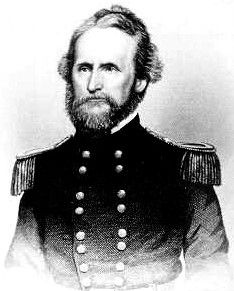
General Nathaniel Lyon.
Under General Nathaniel Lyon’s authority, three cavalry companies were organized to guard the Kansas border. It was soon discovered that three companies would not be sufficient, and eight were organized and formed into a regiment, which was mustered into the U.S. service as the Sixth Kansas Cavalry on September 10, 1861, at Fort Scott. For several months after its organization, the Sixth was kept busy running down and disbanding guerrilla bands along the border and participating in the actions at Newtonia and old Fort Wayne. In December 1862, it was raised to a full cavalry regiment, after which it was employed in Arkansas and the Indian Territory for most of the time it was in service. Part of the Sixth was with Colonel Doubleday’s expedition into the Indian country, and the entire regiment was with Colonel Weer’s expedition into the Cherokee Nation. The last service of the regiment was in Arkansas. A portion was mustered out on March 22, 1865, at Devall’s Bluff, Arkansas, and the remainder at the same place on the 18th of the following July. The regiment lost 76 killed, 19 died of wounds, five were reported missing, 123 died of disease, and 118 were discharged for disability. In the adjutant-general’s report, the historical sketch of this regiment says, “Kansas lost a greater number of men killed in action and died of wounds, in proportion to the number of troops furnished, than any other loyal state — the percent being over 61 per 1,000 — whilst the Sixth lost a greater number than any other cavalry regiment of Kansas troops, its loss being nearly 80 per 1,000 of the whole number enlisted.”
The Seventh Cavalry was mustered in at Fort Leavenworth on October 28, 1861, with Charles R. Jennison as colonel. While all the Kansas troops were sometimes called “Jayhawkers,” the name was especially applied to this regiment, which was usually called “Jennison’s Jayhawkers.” Jennison resigned on May 1, 1862, and was succeeded by Albert L. Lee, who was promoted to brigadier-general. When the regiment was mustered out at Fort Leavenworth on September 29, 1865, Thomas P. Herrick was in command, having been promoted to the colonelcy. Immediately after being mustered in, the regiment was ordered to Missouri. On November 11, 1861, a detachment under Lieutenant-Colonel Anthony met and defeated a force of guerrillas under Upton Hays on the Little Blue River. In this action, Hays’ force outnumbered Anthony’s 4 to 1. The winter was spent in western Missouri, and from January to March, the regiment was in camp at Humboldt, Kansas.
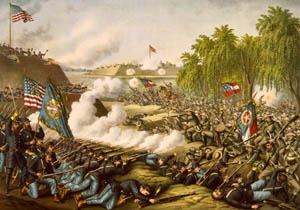
Battle of Corinth, Mississippi by Kurtz & Allison.
It was then ordered to join General Halleck’s army at Corinth, Mississippi, where it was employed for some time in guarding working parties on the Mobile & Ohio railroad. It engaged the enemy at Jacinto, Rienzi, and Luka; took part in the skirmishes at Bear Creek and Buzzard Roost; joined General Grant at Grand Junction; was in the fights at Tuscumbia, Town Creek, Pontotoc, and several minor actions; and was constantly employed in scouting and skirmishing from May 9, 1863, until January 8, 1864. After the men received their veteran furlough, the regiment was ordered to Memphis, Tennessee, and soon afterward was sent back to Mississippi. It took part in the battle of Tupelo, July 14-15, 1864, then returned to Memphis, and in September was ordered to St. Louis. It was an active participant in the Price Raid, after which it was stationed in Nebraska until ordered to Fort Leavenworth for the muster out. The Seventh lost 55 men killed, nine died of wounds, 161 were discharged for disability, 98 died of disease, and two were reported missing.
The Eighth Kansas, an infantry regiment, was mustered in at Lawrence on September 2, 1861, with Henry W. Wessels of the U.S. Army as a colonel, John A. Martin as lieutenant colonel, and Edward F. Schneider as major. On February 7, 1862, Colonel Wessels was ordered to Washington to assume command of his regiment — the Sixth U.S. Infantry — and Lieutenant-Colonel Martin was promoted to the command of the regiment. On November 1, 1862, he received his commission as colonel. The Eighth was mustered out on November 28, 1865, at San Antonio, Texas, under the command of Lieutenant-Colonel John Conover.
On February 28, 1862, General Hunter issued an order reorganizing several Kansas regiments. The Eighth received a battalion organized for service in New Mexico under the command of Colonel Robert H. Graham, who commanded the regiment until Colonel Martin received his commission.
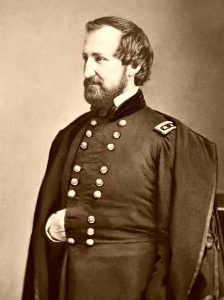
Major General William Rosecrans.
In May 1862, an order came to send all available troops to General Halleck at Corinth, Mississippi, and the Eighth was one of the regiments included in the order. Soon after reaching Mississippi, the regiment began to liberate and harbor slaves, and General Quinby threatened to muster it out because it was “mutinous, undisciplined, and demoralized.” General William Rosencrans instructed his inspector-general to investigate the matter, and that officer reported the Eighth one of the best regiments in the army. After taking part in the action at Jacinto and the military operations about Eastport, General Buell in Tennessee was ordered to be reinforced with Buell’s army. It marched to Louisville, Kentucky, fought the battles of Perryville and Lancaster, and then returned to Nashville. It participated in the engagements of the Tullahoma Campaign, the Battle of Chickamauga, and the actions about Chattanooga, especially the capture of Brown’s Ferry, which opened the Tennessee River to navigation and saved the besieged army in Chattanooga. The Eighth was with Sherman on the Atlantic Campaign, and in the fall of 1864, returned to Nashville with General Thomas. When Hood’s army was so signally defeated, the regiment was ordered to New Orleans and from there to Texas, where it remained until mustered out, as stated above. The losses of the Eighth were 62 killed, 25 who died of wounds, 135 who died of disease, three who were reported missing, and 181 who were discharged on account of disability.
The Ninth Cavalry was mustered in at Leavenworth on March 24, 1862, with Edward Lynde as a colonel, Charles S. Clarke as lieutenant colonel, and James M. Pomeroy as major. The consolidation of several independent battalions formed this regiment. Soon after being mustered in, Companies A, B, C, G, and I were detached and, in a little while, were scattered over the plains from the Missouri River to the Rocky Mountains. Under Major Bancroft, companies D, E, F, and H were stationed at Locust Grove in the Cherokee country. In August 1862, Colonel Lynde, with a part of the regiment, participated in the pursuit of Colonel Coffey. In the fall, the regiment was ordered to Sarcoxie, Missouri, and was used in the fight at Newtonia. Two companies took part in the battles of Cane Hill and Prairie Grove, after which the regiment was ordered back to the border. In time, most of the companies came back from the West, and in March 1864, General Schofield ordered all Kansas troops back to their own state. Shortly afterward, the regiment was consolidated and ordered to join General Banks for the Red River expedition. However, the order was changed and sent to Arkansas, where it remained until the end of the war. It was mustered out at Devall’s Bluff, Arkansas, on January 16 and the remaining on July 17, 1865. The casualties of the Ninth amounted to 43 killed, 13 wounded, and 201 who died of disease. During the time the regiment was in service, 158 men were discharged on account of disability.
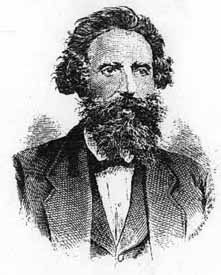
Colonel James Montgomery.
As previously stated, the Tenth Infantry was formed by the consolidation of the Third and Fourth regiments, the formation of which commenced in the fall of 1861. James Montgomery, of border war fame, was colonel of the Third and William Weer of the Fourth. When the two were united to form the Tenth on April 3, 1862, William F. Cloud was made colonel. In the following August, it took part in the pursuit of Coffey and Cockrell; was at Newtonia; in the military movements about Pea Ridge and Bentonville, Arkansas; took part in the battles of old Fort Wayne, Cane Hill, and Prairie Grove, where Colonel Weer commanded the brigade, after which it moved to Van Buren, Arkansas.
In the summer of 1863, it was sent to Indiana to intercept the Confederate General Morgan, Company I, remaining on provost duty at St. Louis. It returned to Kansas City from Indianapolis, where Company I rejoined the command. The regiment remained in Kansas until September, when it was ordered to the Sni Hills in Missouri to break up the guerrilla gangs that infested that region.
On August 14, 1864, the reenlisted men were formed into a veteran battalion at St. Louis, and the remainder of the regiment was ordered to Leavenworth, which was mustered out on the 24th. The veteran battalion was then ordered to Nashville, Tennessee, where it joined the Army of the Cumberland under General Thomas. It was engaged at Columbia and Franklin and, after the battle of Nashville in December, participated in the pursuit of Hood’s shattered army. The Tenth was on duty in Mississippi and Alabama until the end of the war, taking part in the siege of Mobile and the storming of Fort Blakely. The battalion was mustered out at Montgomery, Alabama, on August 30, 1865; the men returned to Kansas, where they were paid and discharged on September 20. Considering the arduous service in which it was engaged, the losses of the Tenth were comparatively light, having 15 men killed and ten who died of wounds, though 122 died of disease and 84 were discharged for disability.
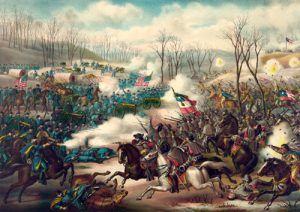
Battle of Pea Ridge, Arkansas, by Kurz and Allison.
The Eleventh Kansas was a cavalry regiment that was organized under the call of July 2, 1862, when the War Department authorized James H. Lane to recruit a regiment. Lane transferred the authority to Thomas Ewing, Jr., Chief Justice of the Kansas Supreme Court, and the regiment was mustered in at Fort Leavenworth on September 15, 1862, with Thomas Ewing, Jr., as colonel; Thomas Moonlight as lieutenant-colonel, and Preston B. Plumb as major. It remained in camp until after the second battle of Newtonia, when it was ordered to join the Army of the Frontier, then commanded by General Blunt, in pursuit of the enemy. Arms had not yet been received, but at Fort Leavenworth were several old-fashioned Prussian muskets of large caliber and heavier than the Enfield rifles, which were issued to the men. Leaving Leavenworth on October 4, the Eleventh moved to Pea Ridge, Arkansas, where it was assigned to Cloud’s brigade of Blunt’s division.
After a double-quick march of 6 miles, it arrived at old Fort Wayne just at the close of the fight, but it was subsequently engaged at the Boston Mountains, Cane Hill, Prairie Grove, and several minor skirmishes in Arkansas.
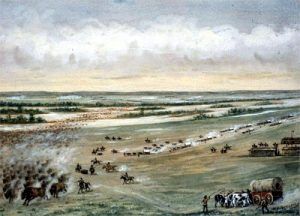
Fort Kearny, Nebraska.
In April 1863, it was ordered back to Kansas City, and the following year, under the command of Colonel Moonlight, it took part in the Price Raid. It was then ordered to Fort Kearny, Nebraska, and later to Fort Laramie, Wyoming, to join the expedition against the Sioux Indians in the Powder River country. It was then employed in guarding the overland stage line until mustered out on August 19 and September 26, 1865, at Fort Leavenworth. The casualties of the regiment were 56 killed, nine died of wounds, 103 died of disease, 107 were discharged for disability, and two were reported missing. In some of the reports, this regiment is mentioned as an infantry organization, probably because initially it was intended as such but was converted into a cavalry regiment.
The Twelfth Infantry was organized under authority issued to C. W. Adams of Lawrence in August 1862. Within six weeks, the regiment was complete. It was mustered in at Paola on September 30, 1862, with Colonel Charles W. Adams, Lieutenant-Colonel in command. The regiment was immediately divided into detachments and stationed at various points along the state line, engaged in scouting after bushwhackers. It was at Baxter Springs on October 8, 1863. After that engagement, Company H was assigned to duty on the plains until the following February when the regiment was ordered to Fort Smith, Arkansas, where it was assigned to Thayer’s division to participate in General Steele’s movement on Little Rock. The Twelfth remained in Arkansas until mustered out at Little Rock on June 30, 1865. The losses of this regiment were 13 killed, one died of wounds, 113 of disease, 82 were discharged on account of disability, and one was reported missing.
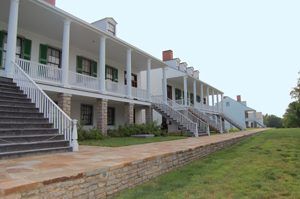
Fort Scott, Kansas, by Kathy Alexander.
The Thirteenth Infantry was mustered in at Atchison on September 30, 1862, with Thomas M. Bowen as colonel. Early in October, it joined the forces under General Blunt. It fought at old Fort Wayne, Cane Hill, Prairie Grove, Van Buren, and in several skirmishes in Arkansas, and in January 1863, moved to Springfield, Missouri. In May, it was ordered to Fort Scott, Kansas, where it remained until August, when it again took the field against Cabell, Cooper, and Stand Waite in the Indian Territory. On March 3, 1865, it was ordered to Little Rock, Arkansas, where it remained on provost and garrison duty until mustered out on June 26, 1865, when the men returned to Kansas, where they were paid and discharged. This regiment lost 15 killed, eight died of wounds, 105 of disease, and 156 were discharged for disability.
The Fourteenth Cavalry was mustered in at Fort Scott on November 20, 1863, with Colonel Charles W. Blair in command. The order that led to the formation of this regiment came from the War Department to General Blunt in the spring of 1863. The order was for a battalion recruited to a full regiment.
The same day it was mustered, orders were received to move at once to Fort Smith, Arkansas, where it was assigned to Thayer’s division of General Steele’s expedition to Little Rock and Camden, Arkansas. After that movement, it was assigned to duty at Clarksville, Pine Bluff, and other Arkansas points until May 1865, when it moved to Fort Gibson and was mustered out on June 25, 1865. The Fourteenth lost 49 killed, two died of wounds, 108 died of diseases, 49 were discharged for disability, and eight were reported missing.
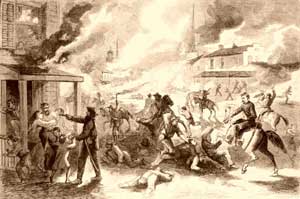
Lawrence Massacre, September 5, 1863, by Harpers Weekly.
Almost immediately after the Quantrill raid on Lawrence in August 1863, Governor Carney began organizing a cavalry force to protect the border. The result was the Fifteenth Cavalry, which was mustered into the U.S. service on October 17, 1863, with Charles R. Jennison as colonel. The regiment operated along the line between Kansas and Missouri, imperfectly armed until February 1864, when it received new arms and took part in the Price Raid the succeeding autumn. It was in the action at Westport and the Big and Little Blue battles. The losses of the regiment were 12 killed, nine died of wounds, 79 of disease, and 144 were discharged for disability.
On October 8, 1864, the Sixteenth Cavalry was mustered in at Fort Leavenworth, just in time to aid in repelling the invasion of General Price. Werter R. Davis was commissioned colonel. After the Price Raid, a part of the regiment was sent against the Indians on the plains, the remainder being used to patrol the border. The Sixteenth was mustered out at Fort Leavenworth on December 6, 1865, having lost ten killed, four died of wounds, 94 died of disease, 50 were discharged on account of disability, and two were among the missing.
The Seventeenth Infantry was organized for 100 days’ service and mustered in at Fort Leavenworth on July 8, 1864, under the command of Lieutenant-Colonel Samuel A. Drake. The records in the Adjutant-General’s office do not show the nature of the service it performed, its casualties, or the date of its muster out.

Colored Infantry.
The First Colored Infantry was mustered in on May 2, 1863, at Fort Scott, with Colonel James W. Williams in command. It served most of the time in Arkansas, forming part of General Steele’s expedition, and was mustered out at Pine Bluff, Arkansas, on October 1, 1865. Of all the Kansas regiments, this one suffered the heaviest losses, with 160 men killed, 10 died of wounds, 166 of disease, and 67 discharged on account of disability.
On November 1, 1863, the Second Colored Infantry was mustered in at Fort Scott and was officerred by Samuel J. Crawford as colonel. Like the First, most of its services were in Arkansas. It was mustered out at Camden, Arkansas, on October 9, 1865. The casualties of this regiment amounted to 23 killed, 16 died of wounds, one was reported missing, 29 were discharged for disability, and 187 died of disease.
The First Battery was mustered in at Mound City on July 24, 1861, with Thomas Bickerton as captain. It took part in the battle of Prairie Grove, operated around St. Louis, was engaged in the pursuit of General Morgan on his raid through Indiana in the summer of 1863, and then served in the Army of the Tennessee and the Army of Mississippi until the close of the war. It lost three men killed, two who died of wounds, 21 of disease, and 20 were discharged for disability. The battery was mustered out at Fort Leavenworth on July 17, 1865.
The Second Battery was mustered in at Fort Scott on September 10, 1862, and was mustered out at Leavenworth on August 11, 1865. It was officered with Captain Edward A. Smith in command when it entered the U.S. service. It participated in the campaigns in Arkansas and Missouri, sometimes as an entire battery and sometimes divided into sections. In May 1863, it was reorganized at Fort Scott by order of General Blunt, after which one section was stationed at Baxter Springs, Kansas, and another section was left at Fort Scott. The third section then took part in the military operations in the Cherokee Nation, being particularly effective in the engagement at Honey Springs. In April 1865, the Third battery was added to the Second, and the consolidated battery was mustered out as stated above. The losses of the Second were killed, 15 died of disease, and six were discharged for disability.
The Third Battery was initially recruited as a cavalry company by Henry Hopkins and John F. Aduddell and was mustered into the U.S. service as Company B, Second Kansas Cavalry. After the capture of the Confederate guns at old Fort Wayne in October 1862, the company was detached from the regiment and mustered in as a battery to man the captured guns. Henry Hopkins was the captain, John F. Aduddell was the first lieutenant, and Oscar F. Dunlap was the second lieutenant. It was engaged in the battles of the Boston Mountains, Cane Hill, and Prairie Grove. The original members were mustered out on January 19, 1865, and the veterans were assigned to the Second Kansas battery. The Third lost five killed, one missing, 17 died of disease, and seven discharged for disability.
The Independent Colored Battery was mustered in at Fort Leavenworth on January 1, 1865, and mustered out at the same place on July 22, 1867. It saw no active service in the field. Three Indian regiments were also accredited to Kansas.
Guerrilla raids into Kansas were frequent during the early years of the war, but the event that caused the greatest excitement in the state was the Price Raid of 1864.
Compiled and edited by Kathy Alexander/Legends of Kansas, updated April 2025.
About the Article: Much of the historical text in this article comes from Kansas: A Cyclopedia of State History, edited by Frank W. Blackmar and published in 1912, and Kansas: History of the State of Kansas, by William G. Cutler and published in 1883. However, other sources have also been used, and the content has been combined and heavily edited.
Also See: