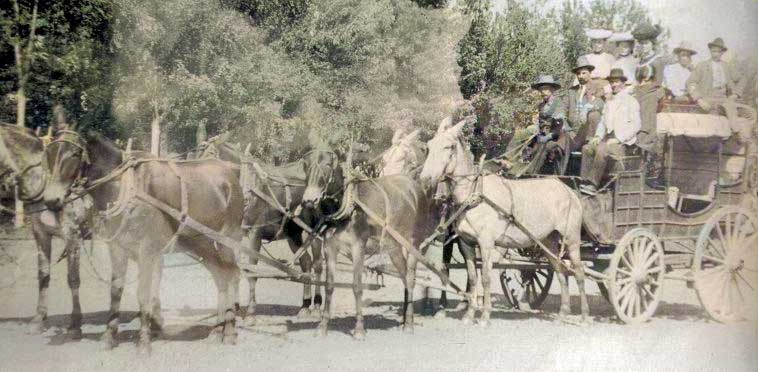
A stage in Medicine Lodge around 1903.
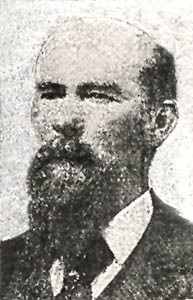
Donald R. “Cannonball” Green.
Operated by the flamboyant and colorful Donald R. “Cannonball” Green, the Cannonball Stage Line connected the railroad to towns across southwestern Kansas and into the untamed red lands of Oklahoma. Green began his first stage service in Kingman, Kansas, in 1876; it initially ran from Kingman to Pratt, then to Coldwater, and later to Greensburg, a town he helped found in 1886 and that was named for him.
Born in Kentucky in 1839, Green lived in Wichita, Kansas, before the construction of the Wichita & Western Railroad.
In 1876, Green opened a small livery stable in Kingman, Kansas. He had been a champion stagecoach driver and soon founded a stage line to transport people through the region. He insisted on speed, and his stage line expanded rapidly. The stage line was named the Cannon Ball, inspired by the song “Wabash Cannonball” and by the powerful locomotive.
Green’s stage line served areas the railroad didn’t reach, and for a few years, he also carried the mail from Wichita to Kingman. One of the contracts for this stage line was to carry the Wichita Eagle newspaper from Wichita to various towns in the West. Marshall M. Murdock, the founder of the Wichita Eagle, secured the agreement and was a close personal friend of Cannonball Green.
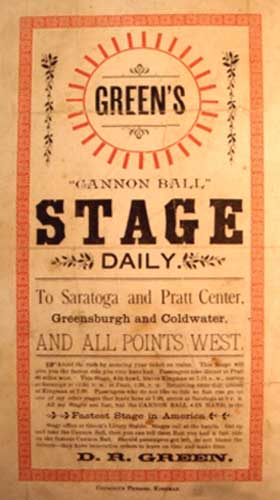
Green’s Stage Advertisement.
The stage route, known as the Cannonball Highway, started on Wichita’s West Street, ran West along Maple Street for 11 miles, turned South for one mile, and then hooked up with what is now U.S. 54 West to Kingman.
Known for their speed, Green’s coaches were pulled by teams of six or eight horses that were changed every eight to ten miles. His teams and coaches could make the run in about 10 hours, with relay stops every 20 miles. The coaches were painted yellow and green.
Green was more than just a driver; he was an advisor and teacher, sharing his knowledge of southwestern Kansas and the prairie landscape with passengers. Green’s stage line grew into 70 vehicles and 1,000 horses, covering 1,500 miles of Kansas plains.
Standing six feet tall, Green was described as a flamboyant, boastful character who liked dominating a crowd while twirling his diamond-studded watch chains. He was also characterized as a whole-souled, genial Westerner who became universally popular with the traveling public. He took great pride in his coaches’ speed and advertised that even “Father Time” couldn’t keep up with the “Cannonball.”
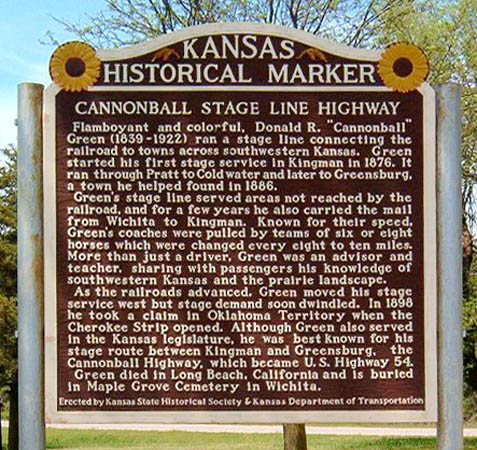
Cannonball Stage Marker on U.S. 54 just East of Greensburg, Kansas.
In those days, Green said a Concord Coach cost $1,200.00, and mules as much as $400.00 apiece. His coaches covered 100 miles a day. In addition to the Concord, the lines were provided with many more smaller stages or coaches; “but when a newspaper editor showed up,” he said, “I would always give him a seat in one of the big coaches … I received thousands of dollars worth of advertising from these editors.” At one point, Green’s business operated 70 coaches and over 1,000 head of horses.
But the flamboyant Green would also take no flak from customers. He once ejected Carrie Nation from his coach after she snatched a cigar from his mouth and tossed it away.
Cannonball Green’s business was exceedingly prosperous from about 1870 to 1880. As small settlements sprang up across the plains, “Cannonball Green” helped organize Greensburg, which was named for him.
The Cannonball route’s prosperous days wouldn’t last; as railroads moved west, demand for stage service soon dwindled, and Green began looking for other business ventures. In 1889, he was elected Kiowa County’s second representative in the Kansas Legislature.
Later, in 1898, he filed a claim in the Oklahoma Territory when the Cherokee Strip opened, and he became one of Pond Creek’s founders and a county officer.
Green died in Long Beach, California, in 1922 at the age of 83 and is buried in Maple Grove Cemetery in Wichita, Kansas.
In 1997, the state renamed a 60-mile stretch of U.S. 54 from Kingman to Greensburg the Cannonball Stage Line Highway, in honor of Cannonball Green.
“All my stages are fast, but the Cannonball 4-In Hand is the FASTEST STAGE IN AMERICA…. Get up and take the Cannon Ball, then you can tell them East that you had a fast ride. Should passengers get left, do not blame the drivers; they have imperative orders to leave on time and make time.”
— D.R. Green, 1880.
©Kathy Alexander/Legends of Kansas, updated September 2026.
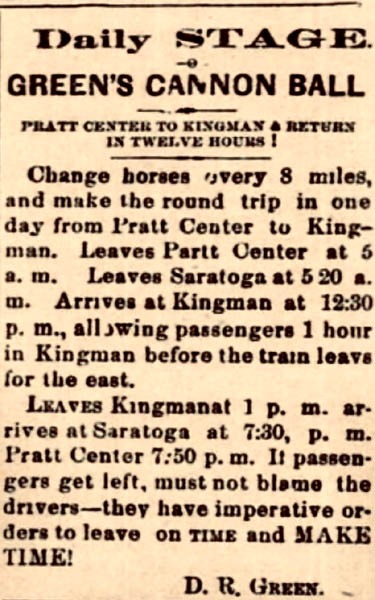
Cannonball Stage Advertisement
Also See:
Stagecoaches of the American West
Stagecoach Kings (Lines) & Drivers
Tales & Trails of the American West
Wagons and Stagecoaches Photo Gallery
Sources:
Barber County Index, August 24, 1922
Find A Grave
Kansas State Historical Society
Michael Vinson Americana – Dead Link
Wichita Beacon, August 2, 1922
Wichita Eagle, May 12, 2008