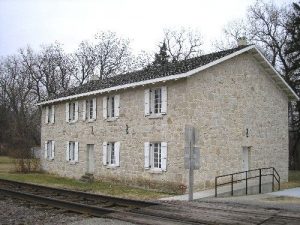
Kansas’ first capitol at Pawnee, Kansas, by Kathy Alexander.
“If the outrageous fraud by which the Missourians pretended to elect representatives for Kansas astonished the world, the proceedings of the conclave of vagabonds assembled under this mob authority were still more astonishing. Never did a less responsible body of men assemble under the pretense of making laws.”
— William Addison Phillips, The Conquest of Kansas, by Missouri and her Allies, 1856.
The First Kansas Territorial Legislature, which met in 1855, was called the “Bogus Legislature” by the Free-State Kansas men. The fraudulent legislative election would lead free-state supporters to establish a separate state government and be the precursor for the Kansas-Missouri border war.
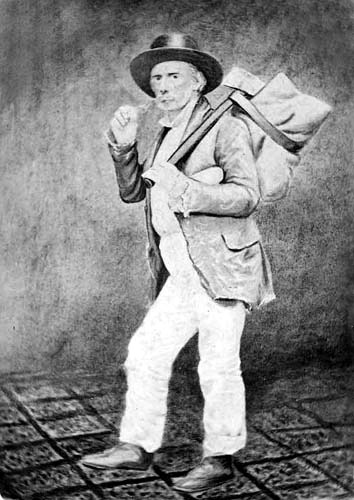
Governor Andrew Reeder
Andrew H. Reeder was appointed as the first Territorial Governor of Kansas in June of 1854 by President Franklin Pierce. However, he would not arrive in Kansas until October 1854. After making a tour of the state, Governor Reeder issued a proclamation that called for the first election to be held on November 29, 1854, to choose a delegate to Congress from Kansas.
Many Kansans of the time took little interest in the election, but that was not the case in Missouri. The night before the election, numerous pro-slavery advocates from Missouri crossed the border into Kansas and outnumbered the legal voters at many voting precincts the next day.
The pro-slavery candidate, John W. Whitfield, received 2,258 out of 2,905 votes. In precincts giving him the largest majority, his vote was more significant than the number of voters in the respective precincts, as shown by the census taken shortly afterward. Although the Free-State settlers and others having anti-slavery sentiments protested, Whitfield was still allowed to serve as the delegate representing Kansas Territory.
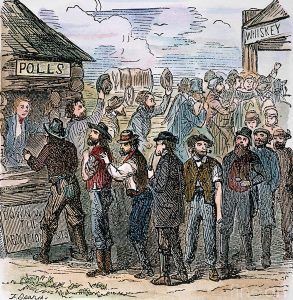
Voting in Kansas
The next election, on March 30, 1855, was to choose members of the first Territorial Legislature. This election was of prime importance because it was supposed that the Legislature would provide for the holding of a constitutional convention and prescribe rules for the election of delegates. On election day, nearly 5,000 Missouri men, led by Federal Senator David Atchison and his followers, crossed the territorial border and stuffed the ballot boxes with votes for pro-slavery candidates. In Lawrence alone were some 1,000 Missourians, fully armed and leading two cannons loaded with musket balls. The result was that the pro-slavery candidates received 5,427 votes against 791 anti-slavery votes, although the census taken in January and February showed a voting population of only 2,905.
In the end, 37 out of 38 candidates for the Territorial Legislature were pro-slavery supporters. Free-Staters immediately protested, but it was to no avail. Even Governor Reeder, who was sent to the territory as friendly to the pro-slavery interests, was so outraged at the fraud that he declared the votes void and called for a new election. However, before that could happen, the new Territorial Legislature quickly convened in Pawnee, on the present-day site of Fort Riley, on July 2, 1855.
The pro-slavery men then ousted all of the Free-State men and petitioned the President to remove Reeder as governor, which was granted. Their final decision was to move the Legislature to Shawnee Mission, as the Pawnee location was too far from Missouri to influence.
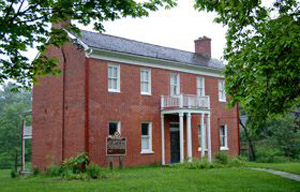
The Shawnee Methodist Mission still stands in Fairway, Kansas, by Kathy Alexander.
The legislature’s pro-slavery members then began to adopt the statutes of Missouri as the law of Kansas, including the infamous “Black Law,” which provided criminal sanctions for anyone helping fugitive slaves. They also appointed all the first county officials, taking away individual county residents’ rights, creating a joint-stock company, and chartered prospective railroads, giving them unheard-of privileges. After a brief period at Shawnee Mission, they relocated the capital to Lecompton.
Upon Reeder’s removal as governor, the appointed Secretary of Kansas, Daniel Woodson, became the Acting Governor and approved the demands of the pro-slavery legislature, including the authorization of a slave code that made speaking out against slavery in the territory a punishable offense. President Pierce then permanently appointed Wilson Shannon, a pro-slavery sympathizer, to office.
The Free-State men, in the meantime, were determined not to recognize any act of the Bogus Legislature nor participate in their elections. Before long, Free-Staters were meeting to define their own “policies,” and in a meeting held at Lawrence on June 8, 1855, the men adopted the following resolution.
“In reply to the threats of war so frequently made in our neighboring state, our answer is ‘we are ready.”
And so it was.
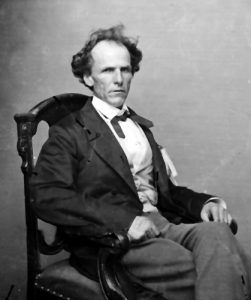
James Lane
The angry Free-State settlers, led by Dr. Charles Robinson and James H. Lane, decided to establish their own government and create a state constitution. This was referred to as the Topeka Movement and adopting the Topeka Convention. Kansas then had two competing legislatures, but the federal government only recognized the pro-slavery legislature. What followed was the bloody skirmishes of the Kansas-Missouri Border War, which raged for several years before the opening of the Civil War.
Kathy Alexander/Legends of Kansas, updated March 2024.
Also See:
Bleeding Kansas – Kansas-Missouri Border War