
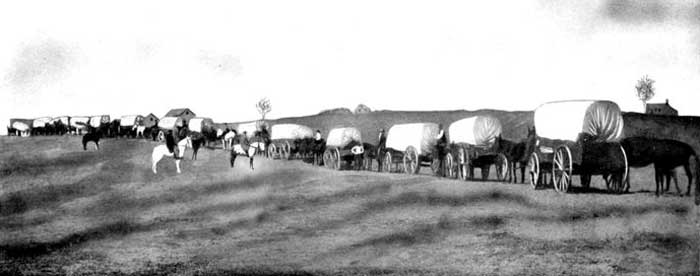
Overland Emigrant and Freight Train, Operated by Sprague & Digan, leaving West Main Street, Atchison, Kansas, April 1, 1866, en route to the Far West.
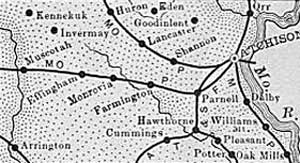
Atchison County Map, 1899
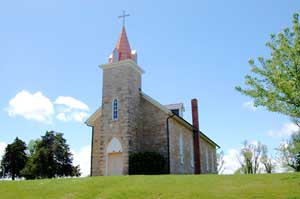
St. Patrick Catholic Church in Atchison County, Kansas, by Kathy Alexander.
More Extinct Towns (See Below)
With its proximity to Missouri, Atchison County, Kansas, was one of the first to be populated in the Kansas Territory. Immediately, the fight between pro-slavery advocates and abolitionists began as settlers from both sides rushed into Kansas in an attempt to establish the state with their politics. Some of the first in Atchison County were a party from Iatan, Missouri, who took claims near Oak Mills in June 1854. The following month, a larger group of settlers and those who would become the county’s founders flooded into what would become Atchison. Settlements soon sprang up all over the county, but, like other new territories, only the strongest would survive to the present time. Some of these old extinct towns would be very difficult to find, but for the many signs posted by the Future Farmers of America years ago. Though the signs placed by students long ago are very helpful in determining the sites of these “lost” settlements, they haven’t been maintained over the years and are sometimes unreadable.
More Extinct Towns:
| Town | Post Office Dates | Additional Information |
| Arrington | 1862-1973 | Also known as Arrington Springs, it was a settlement on the Delaware River in southwestern Atchison County. |
| Brownlee | 1885-1887 | |
| Burnside | 1857-1858 | |
| Cantonment Martin | N/A | Cantonment Martin was the first military post in Kansas under the authority of the United States Government. |
| Cow Island | N/A | Also called Isle au Vache, this island in the Missouri River was where Cantonment Martin once stood. |
| Dalbey | N/A | |
| Eden | 1858-1900 | It was located in the county’s northern portion on Independence Creek, about five miles east of Huron. The post office was located on various farms in the area. In 1880, the town boasted a banker, a wine manufacturer, a mason, a blacksmith, a physician, a general store, and a saloon. The post office was discontinued when a rural delivery service was established in 1900. In 1910, its population was 20. |
| Farmington | 1868-1940 | Located on the Central Branch of the Missouri Pacific Railroad in Atchison County, Kansas, Farmington began as a station on the railroad. |
| Good Intent | 1872-1900 |
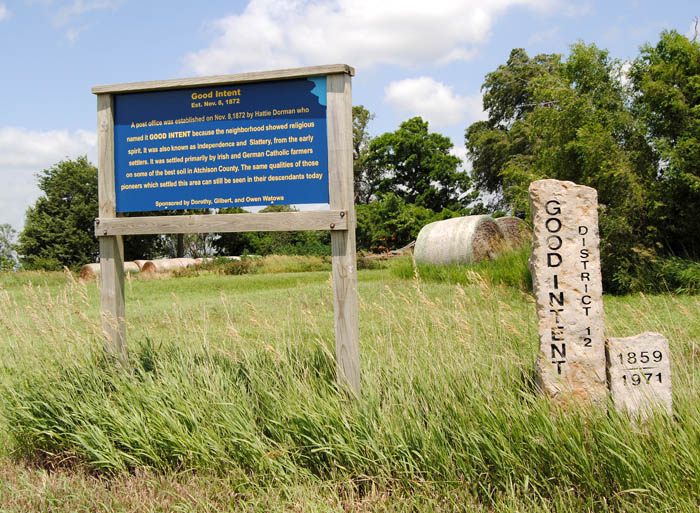 Site of Good Intent, Kansas. A country post office, this place had a Congregational church and a district school, and shipped grain and produce in 1980. It was on the daily mail stage route from Atchison to Highland, from which mail was delivered to C.M. Streeper, the postmaster. It was six miles northwest of Atchison, the county seat and nearest railroad and banking point, and 56 miles from Topeka. |
| Hawthorne | 1891-1900 | |
| High Bridge | 1888-1900 | In the southeastern part of Atchison County, this hamlet was located about 10 miles south of Atchison. |
| Huron | 1857-1992 | Located in northcentral Atchison County, started as a railroad town in 1882. Though it still has a small population today, it is a virtual ghost town with no open businesses. |
| Invermay | 1882-1897 | A country post office, it shipped grain and livestock, and mail was delivered daily to John Andrews, the postmaster. It was 21 miles west of Atchison, the county seat, and six miles southwest of Everest, its nearest railroad and banking point. |
| Kennekuk | 1857-1900 | Kennekuk was one of the first places in the county where whites located permanently when a Methodist Episcopal Church Mission was established in 1833 among the Kickapoo tribe. |
| Locust Grove | 1862-1887 | The post office moved from Mount Pleasant. |
| Monrovia | 1857-1955 | Monrovia started as a stage stop on the Overland Stage Route in 1856. |
| Mormon Grove | NA | Mormon Grove, established in about 1855, was one of the many outfitting stations utilized by the Mormons as they traveled westward. |
| Mount Pleasant | 1855-1862 1864-1888 1888-1900 |
The first settler in the area was Thomas L. Fortune, who arrived in 1854 and opened a general store. Its post office opened and closed several times. |
| Noll | 1899-1900 | A small village situated on the Missouri River about five miles below Atchison. |
| Oak Mills | 1868-1945 | Oak Mills, Kansas, was once located along the Missouri River. The site was originally home to a Kanza Indian village. |
| Ocena, Oceana | 1855-1858 | The post office moved to Pardee in August 1858. |
| Pardee | 1858-1903 | Pardee was one of the oldest settlements in Atchison County. It was established by Caleb May in October 1854. |
| Parnell | 1883-1923 | Situated on both the Atchison, Topeka & Santa Fe Railroad and the Missouri Pacific Railroad, the town was platted in December 1883. The station was named for a hero of the Civil War, James L. Parnell, a private soldier in the Thirteenth Kansas volunteer infantry, who was killed during the skirmish at Haare Head, Arkansas, on August 4, 1864. Parnell was the original settler on the townsite and was one of the first citizens of Atchison County to respond to President Abraham Lincoln’s call of July 1862. It was located seven miles southwest of Atchison. In 1910, it had only a population of 12. |
| Plum Grove | 1862-1868 | The post office moved to Oak Mills in January 1868. |
| Port Williams | 1856-1860 | Located in Walnut Township, the settlement was situated on the Missouri Pacific Railroad. |
| Potter | 1888-2009 | Located in Stranger Creek Valley, Potter, started as a station on the Atchison, Topeka & Santa Fe Railroad. |
| Saint Nicholas | 1859-1863 1868-1873 |
The post office moved to Cummingsville in December 1873. |
| Shannon | 1882-1941 | A small village located on the Missouri Pacific Railroad about seven miles northwest of Atchison on the Parallel Road. G.W. Sutliff platted it in February 1883. At that time, it had two blacksmiths, two lumber dealers, a grocer, two general stores, a lawyer, and a boot-and-shoe store. It had a population of 25, and mail was delivered daily to H. St. Clair, the postmaster. In 1910, it had a population of 50, one store building housing the post office, a few residences, a railroad station, and a small elevator. |
| Spencer | 1860-1867 | |
| Sumner | 1857-1870 | Sumner, Kansas, was once one of the most important towns in Atchison County. |
| Todd | 1897-1900 |
©Kathy Alexander/Legends of Kansas, updated June 2026.
Also See:
Sources:
1880 Kansas State Gazetteer and Business Directory
Blackmar, Frank W.; Kansas Cyclopedia, Standard Publishing, 1912
Cutler, William G.; History of the State of Kansas, A. T. Andreas, 1883.
Kansas Post Office History